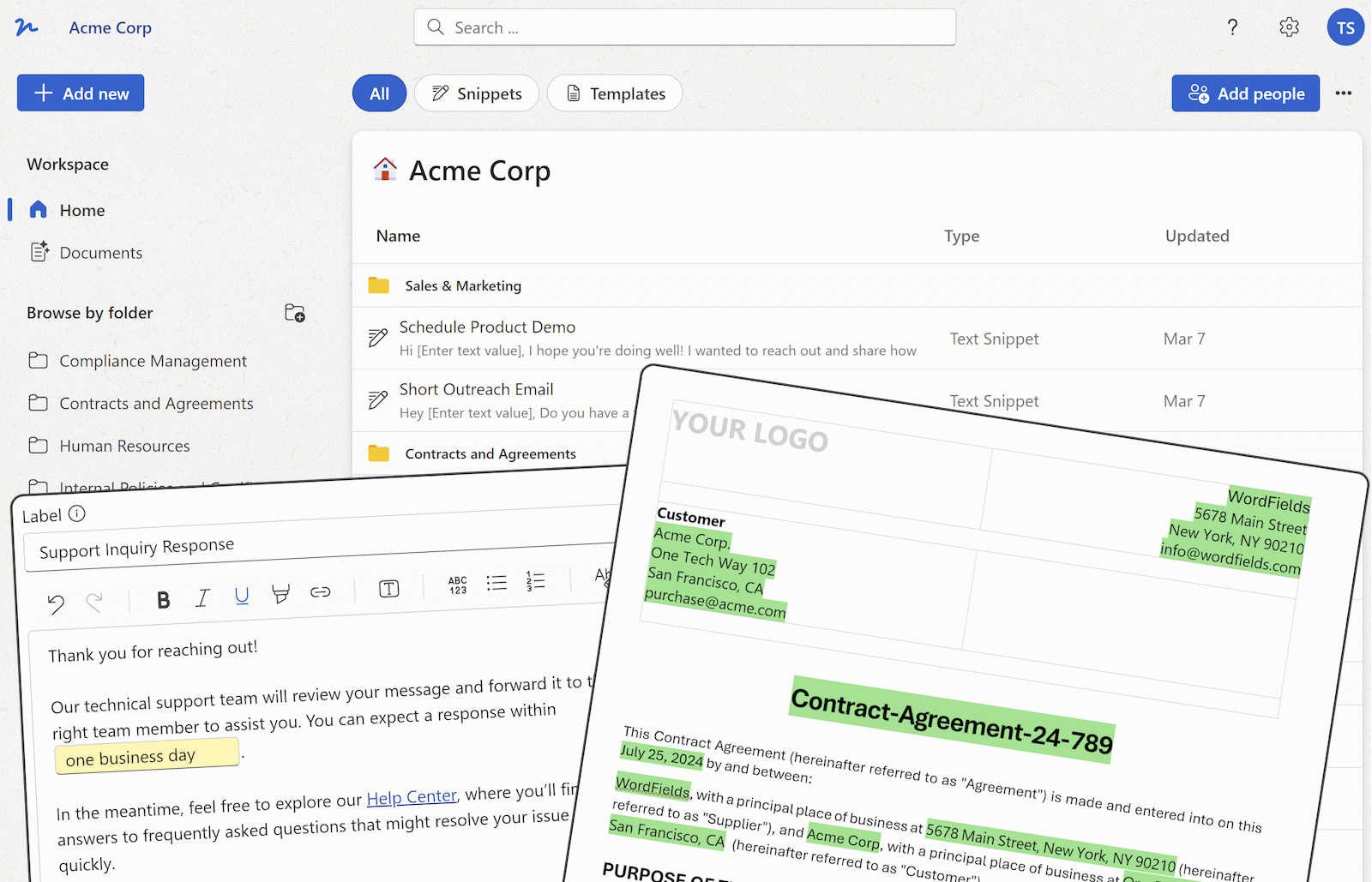
Automate document generation
If someone on your team is still opening a contract template, manually replacing names and dates, saving a copy, and emailing it out — that process is a liability. It's slow, it breaks under pressure, and sooner or later someone sends the wrong version to the wrong person.
Document generation automation fixes this by turning your templates into smart, reusable forms. You fill in the data once; the document builds itself.
This article covers why manual document creation fails at scale, what automation actually involves, and how to get it working in your workflow.
Why manual document creation breaks down
The problem isn't that people are careless — it's that the process itself creates opportunities for mistakes.
A typical manual workflow looks something like this: open the master template, duplicate it, find and replace the variable content (name, date, contract value, address), save the file with a new name, and send it. Repeat for every document.
This works fine when you're doing it twice a week. It stops working when you're handling 30 employment contracts a month, or when three people on your team are all working from slightly different versions of the same template.
Common failure points include:
- Stale templates — someone edited the "master" six months ago and forgot to tell anyone
- Missed fields — a placeholder like [CLIENT NAME] makes it into the final document
- Inconsistent formatting — copy-pasting between documents pulls in wrong fonts or spacing
- No audit trail — no easy way to know who created what, or which version was sent
Scaling a manual process doesn't make it better. It just creates more of the same problems, faster.
What document generation automation actually does
At its core, document automation replaces the find-and-replace workflow with a structured form. Instead of opening a template and editing it directly, users fill out a form — and the system generates the finished document from their input.
The template lives in one place. The form fields map to placeholders in the document. When the form is submitted, a complete, correctly formatted document is produced — without anyone touching the template itself.
This means:
- The template stays intact. No one can accidentally overwrite it.
- Every document is consistent. The same structure, the same formatting, every time.
- Generation is fast. A document that takes 15 minutes to prepare manually takes under a minute with automation.
- Errors are caught earlier. Required fields, input validation, and field types (date, number, dropdown) prevent bad data from reaching the document.
For teams producing high volumes of contracts, proposals, offer letters, or reports, the time savings compound quickly.
What to look for in a document automation tool
Not every tool is built the same way. Before committing to one, consider:
Template format support. If your documents live in Word or Excel, you want a tool that works with .docx and .xlsx natively — not one that converts them to a proprietary format and loses your formatting in the process.
Form generation. The best tools build the fill-in form automatically from the merge fields you define in the template. You shouldn't have to design the form separately.
Access control. In most teams, not everyone should be able to edit templates. Look for role-based permissions that distinguish between who can create templates and who can only use them.
Document numbering. For contracts, invoices, and anything that needs tracking, automatic sequential numbering saves time and keeps records clean.
Notifications. If multiple people need to know when a document is created — a manager, an HR team, a legal contact — look for automatic notification support.
Integration. Some tools connect to cloud storage (OneDrive, SharePoint, Google Drive) so completed documents are automatically saved to the right place.
Tip
If your team works heavily in Microsoft Word, prioritize tools that preserve .docx formatting exactly. Some automation platforms convert documents to HTML or PDF internally, which can break complex layouts, tables, and headers.
Setting up document automation: the basic steps
The process varies by tool, but the general approach is consistent:
Start with an existing document. Take a contract, letter, or report you already use. This becomes your template base.
Identify the variable content. Go through the document and mark everything that changes between uses — names, dates, amounts, addresses, job titles. These become your merge fields.
Add merge fields to the template. In WordFields, this is done directly in the visual template designer — click where you want a field, select the field type from the sidebar, and it's inserted. No syntax to memorize.
Configure field types and requirements. Set each field to the right data type — text, number, date, dropdown. Mark required fields. Add descriptions if the field name alone isn't self-explanatory.
Test before you share. Fill out the form yourself and check the output document carefully. Make sure every field resolves correctly and the formatting holds.
Publish to your team. Once the template is ready, share it with the right people. Members fill out the form; they never touch the template directly.
Note
You don't need to rebuild your documents from scratch. WordFields lets you upload your existing Word or Excel files and add merge fields on top of them. Your formatting, fonts, and layout stay exactly as they are.
How WordFields handles document automation
WordFields is built around this workflow. You upload your existing Word or Excel document, add merge fields using the visual template designer, and WordFields generates the fill-in form automatically.
Key features relevant to automation:
- Visual template designer — click to place merge fields directly in the document; no manual syntax required
- Forms are generated automatically — no separate form builder needed
- Role-based access keeps templates protected; members fill forms but can't edit the source document
- Document numbering can be configured per template, with custom patterns by year, month, or sequence
- Notifications alert designated recipients whenever a new document is created from a template
- Cloud storage integration (OneDrive, SharePoint) saves completed documents automatically
Tip
WordFields also supports text snippets — reusable blocks of formatted text with fill-in fields, useful for emails, support responses, and short-form content that doesn't need a full document template.
The practical result
Teams that automate document generation typically see three concrete improvements: less time spent per document, fewer errors reaching the final output, and better template hygiene because there's only one version to maintain.
The shift isn't just about speed. It's about removing the conditions that cause mistakes in the first place — and making sure your team is always working from the right template, with the right data, every time.