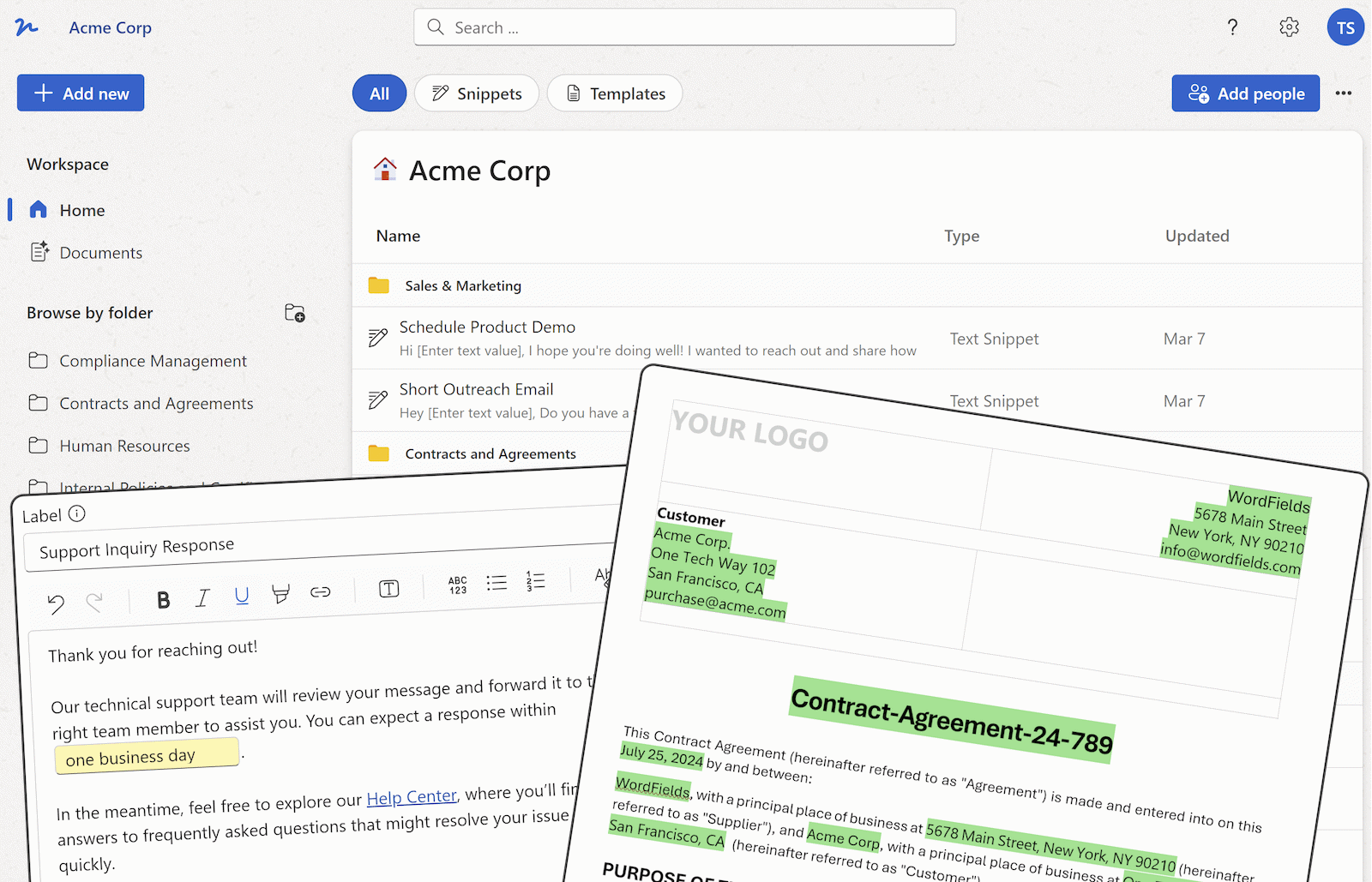

Document automation is creating a document from a template and a few answers, instead of opening last month's copy and changing the names by hand. The wording, layout and formatting live in the template; only the parts that differ, such as the client, the date and the amount, are supplied each time. The result is an ordinary document, a Word file or a PDF, that looks as if someone had prepared it carefully, because someone did, once.
Key takeaways
- A template holds everything that stays the same; fields mark what changes.
- The values for the fields come from a form someone fills in, a list (mail merge), or another system.
- It pays off for documents created often from the same wording, where a mistake is costly.
- You can start with Word's own tools and move to a dedicated tool when several people share the templates.
How does document automation work?
Every approach, from Word's mail merge to a contract system, has the same three parts.
- A template. The document as it should look, with its wording, tables, logo and page layout.
- Fields. Marked places in the template where something changes: a name, an address, a date, a price, a clause that is only sometimes included. In Word these are called merge fields.
- The values. Something supplies a value for each field, and the document is produced with the values in place.
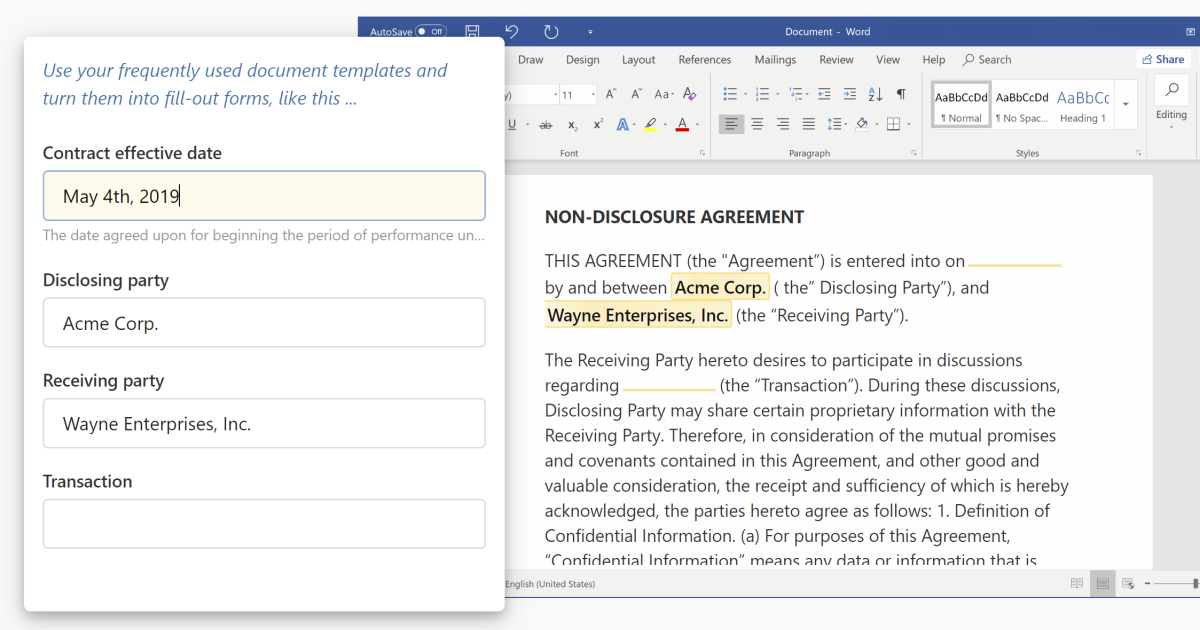
Where the values come from is what tells the approaches apart:
| Values come from | Good for | Example |
|---|---|---|
| A list, one row per document | Many documents at once | Fifty renewal letters by mail merge |
| A form someone fills in | One document at a time | An offer letter for one candidate |
| Another system | Documents nobody should have to request | An invoice created when an order closes |
Most small teams need the middle row far more often than the other two: a person needs one contract, now, for one customer.
Which documents are worth automating?
A document is a good candidate when it is created often, from wording that rarely changes, and when a mistake in it costs something. In practice that means:
- Sales: quotes, proposals, order confirmations, statements of work.
- HR: offer letters, employment contracts, reference letters, onboarding checklists.
- Legal and contracts: NDAs, service agreements, renewal and termination notices.
- Operations and finance: purchase orders, invoices, delivery notes, standard reports.
- Quality: records and forms that have to follow an approved format.
A document written fresh each time, such as a one-off report or a negotiated agreement, gains little. If more than about half of the text changes every time, it is a draft, not a template.
What do you actually gain?
The honest list is shorter than most software pages make it.
- Time per document. Filling in six fields is quicker than finding the right file, saving a copy and hunting for every place the old client's name appears.
- Fewer mistakes. The classic errors of copy and paste, the previous customer's name on page three or a placeholder left in, can't happen when the text is never edited by hand. Required fields and field types (a date is a date, an amount is a number) catch others.
- One current version. When the template lives in one place, a change to the wording reaches everyone at the next document. Nobody works from a copy saved to their desktop last year.
- Consistency. Every document has the same structure, formatting and approved wording, whoever created it.
What it doesn't do: it doesn't write the template for you, and it doesn't fix a process nobody has agreed on. If three people use three different contracts today, the first job is choosing one.
When is it not worth it?
Setting up a template takes an hour or two of careful work: deciding what changes, marking the fields, testing the result. That is repaid quickly for a document made every week and never for one made twice a year. Start with a single document, the one your team creates most, and add the next when the first is in daily use.
It's also worth being realistic about scope. A team of five that sends ten quotes a month doesn't need a contract lifecycle platform. It needs its own Word quote, with fields.
How do you get started?
- Pick one document that is created often and from stable wording.
- Mark what changes. Go through it and list every detail that differs between two real examples.
- Choose where the values come from: a list for bulk, a form for one at a time.
- Build the template and test it with real data, including the awkward cases: a long company name, a missing middle name, a date at the end of a month.
- Decide who may change the template and where the finished documents go.
In Word alone, a list means mail merge and a form means content controls. Both work on one computer and become hard to manage once several people share the same templates.
That is the gap WordFields fills for small teams: you open the Word or Excel file you already use, put fields where the text changes, and everyone creates documents from a short form, with the formatting kept. Each document can be numbered automatically and is kept on record, so you can see who created what, and when.
For the practical steps, from choosing a tool to rolling a template out to your team, read how to automate document generation.
Frequently asked questions
What is the difference between document automation and mail merge?
Mail merge is one kind of document automation: it fills one template from a list and produces a document per row. Document automation is the wider idea, and also covers creating a single document from a form, documents built with conditions and calculations, and documents generated by another system through an API.
Do I need special software for document automation?
Not to start. Word's mail merge and content controls cover simple cases on one computer. A dedicated tool becomes worth it when several people create the same documents, when the template must not be changed by the people using it, or when you need numbering and a record of what was created.
Which documents should a small business automate first?
Start with the document your team creates most often from the same wording: usually a quote, an offer letter, a contract or an invoice. Pick one where a mistake is costly and where only a handful of details change each time. One template that is used every week teaches you more than ten that are used twice a year.
Is document automation the same as a document management system?
No. Document automation creates documents; a document management system stores, organizes and controls them after they exist. Many teams use both: documents are generated from templates and then saved to SharePoint, OneDrive or another system where they are kept.