Word for the web is useful for quick edits and real-time collaboration. But it's missing a significant chunk of Word's feature set — including macros, Track Changes with merge and compare, captions, bibliography tools, watermarks, and advanced page layout controls (Microsoft Support, 2024). When you hit one of those limits, switching to the desktop app takes about three seconds.
Key Takeaways
- Click Editing → Open in Desktop App inside Word for the web to hand off the document instantly.
- The file stays in OneDrive or SharePoint — changes in the desktop app sync back to the cloud automatically.
- You can also go the other direction: open the desktop app first, then navigate to your OneDrive files via File → Open.
- Word for the web doesn't support macros, Track Changes merge/compare, watermarks, captions, or bibliography tools — these require the desktop app (Microsoft Support, 2024).
- The Open in Desktop App button only appears when Word is installed and you're signed in with the matching Microsoft account.
Method 1: Open Directly From Word for the Web
This is the fastest path. No OneDrive navigation needed — you hand off the document you're already looking at.
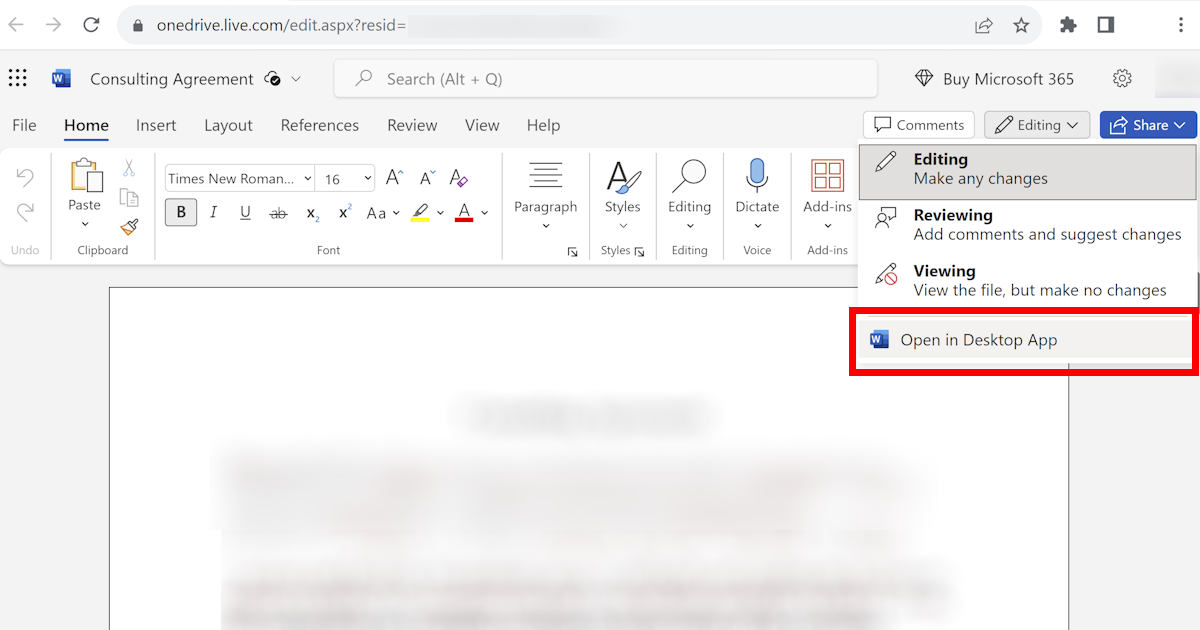
- Open your document in Word for the web and make sure you're in editing mode (not Reading View).
- Click the Editing button in the top toolbar — it's near the top-center of the screen.
- Select Open in Desktop App from the dropdown.
- Your browser may ask for permission to open Microsoft Word. Click Open or Allow.
- The document opens in your desktop Word app, already synced to the same cloud file.
Any edits you make in the desktop app save back to OneDrive automatically when you use Ctrl+S or close the file. The browser version reflects those changes when refreshed.
Tip
In older versions of Word for the web, the button appears in the ribbon as Open in Word under the Home tab, or you can right-click the file in OneDrive and choose Open in Word from the context menu.
Method 2: Open From OneDrive in Your Browser
If you've already closed the browser tab, you don't need to reopen the document online first.
- Go to onedrive.live.com and sign in with your Microsoft account.
- Locate the Word document you want to open.
- Right-click the file and select Open in Word from the context menu. Alternatively, hover over the file and click the three-dot menu, then choose Open in Word.
This bypasses the browser editor entirely and hands the file straight to your desktop app. It's the cleaner option when you know from the outset that you need the desktop version.
Method 3: Open From the Desktop App Directly
You can skip the browser altogether and pull the file from within Word itself. This works well if you already have Word open and want to access a cloud document.
- Open Word on your desktop.
- Go to File → Open.
- Select OneDrive or SharePoint from the location list on the left.
- Sign in if prompted, then browse to your file and double-click it.
Word opens the cloud file just as it would a local one. The key difference: the document saves back to OneDrive rather than your hard drive, so changes stay synced across devices.
What Features Actually Require the Desktop App?
This is the question most guides skip. Knowing the specific gaps helps you decide when switching is worth the friction.
Word for the web doesn't support any of these (Microsoft Support, 2024):
| Feature | Desktop only? |
|---|---|
| Macros and VBA | Yes |
| Track Changes with merge, compare, combine | Yes |
| Captions, citations, bibliography | Yes |
| Watermarks | Yes |
| Creating or modifying custom styles | Yes |
| Headers and footers (editing) | Yes |
| Advanced page layout tools | Yes |
| Mail merge | Yes |
The web version handles most everyday tasks — typing, basic formatting, commenting, real-time collaboration. The moment your work involves any item in that table, the desktop app is the right tool.
One thing worth knowing: Word for the web can display many of these features correctly even though it can't create them. A document with a watermark will show it in the browser, but you can't edit or remove it there.
Frequently asked questions
Why is the 'Open in Desktop App' button missing in Word for the web?
The button only appears when Microsoft Word is installed on your computer and you're signed in with the same Microsoft account. If the button is absent, verify Word is installed, check that you're signed in to the correct account, or try refreshing the browser. On some corporate networks, IT policy may restrict this option.
Will my changes sync between the desktop app and Word for the web?
Yes. Because the file lives in OneDrive or SharePoint, both the desktop app and the browser version point to the same document. Changes made in the desktop app sync to the cloud automatically when you save, and are immediately visible to anyone accessing the file in the browser.
Can I open a Word document stored on my local hard drive in Word for the web?
Not directly. Word for the web only works with files stored in OneDrive or SharePoint. To edit a local file in the browser, upload it to OneDrive first via onedrive.live.com or the OneDrive desktop sync folder, then open it from there.
What features are only available in the Word desktop app, not the browser version?
Word for the web does not support macros, Track Changes with merge and compare, captions, citations and bibliography tools, watermarks, custom styles creation, advanced page layout tools, or headers and footers editing. For any of these, the desktop app is required.