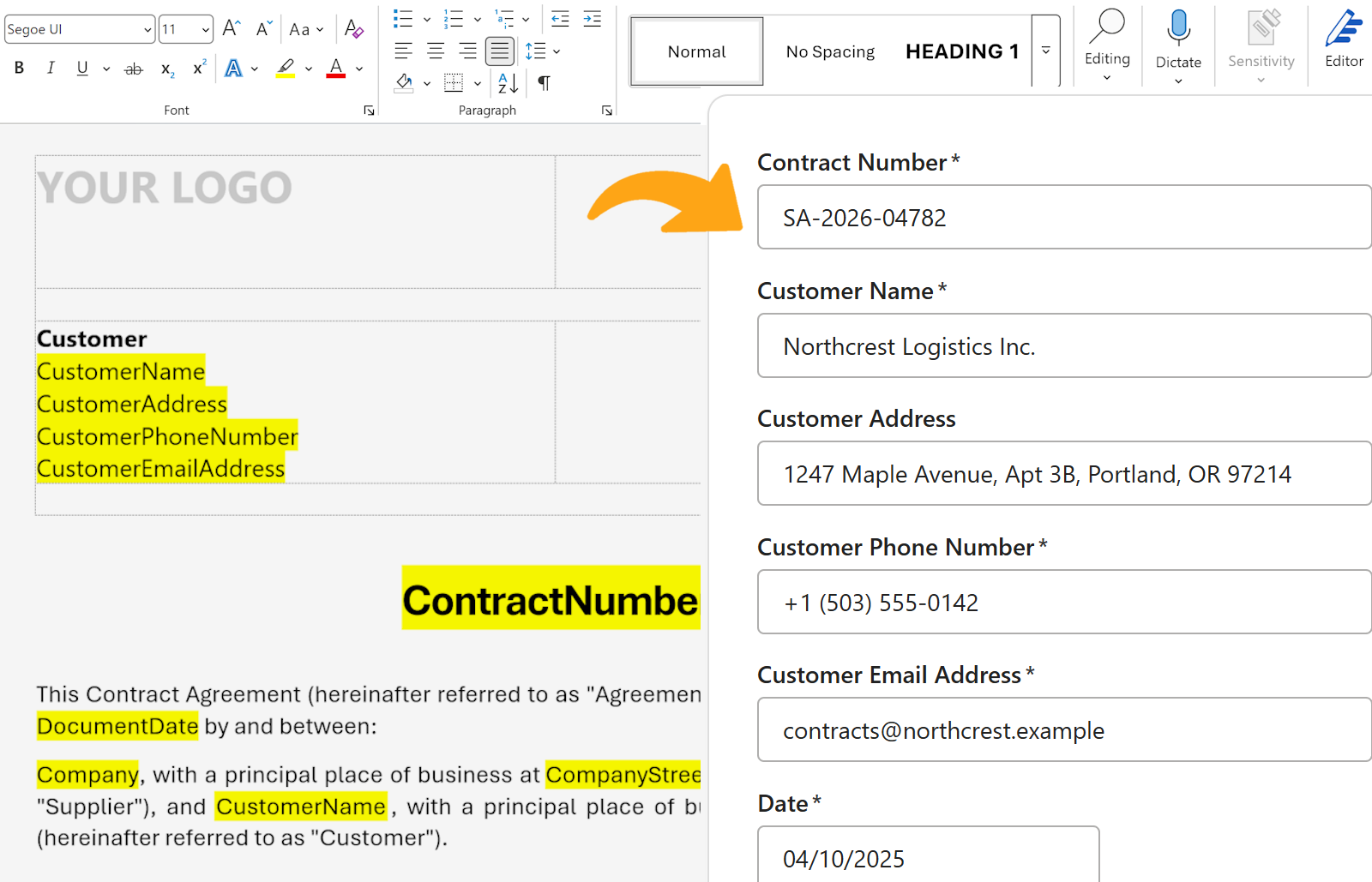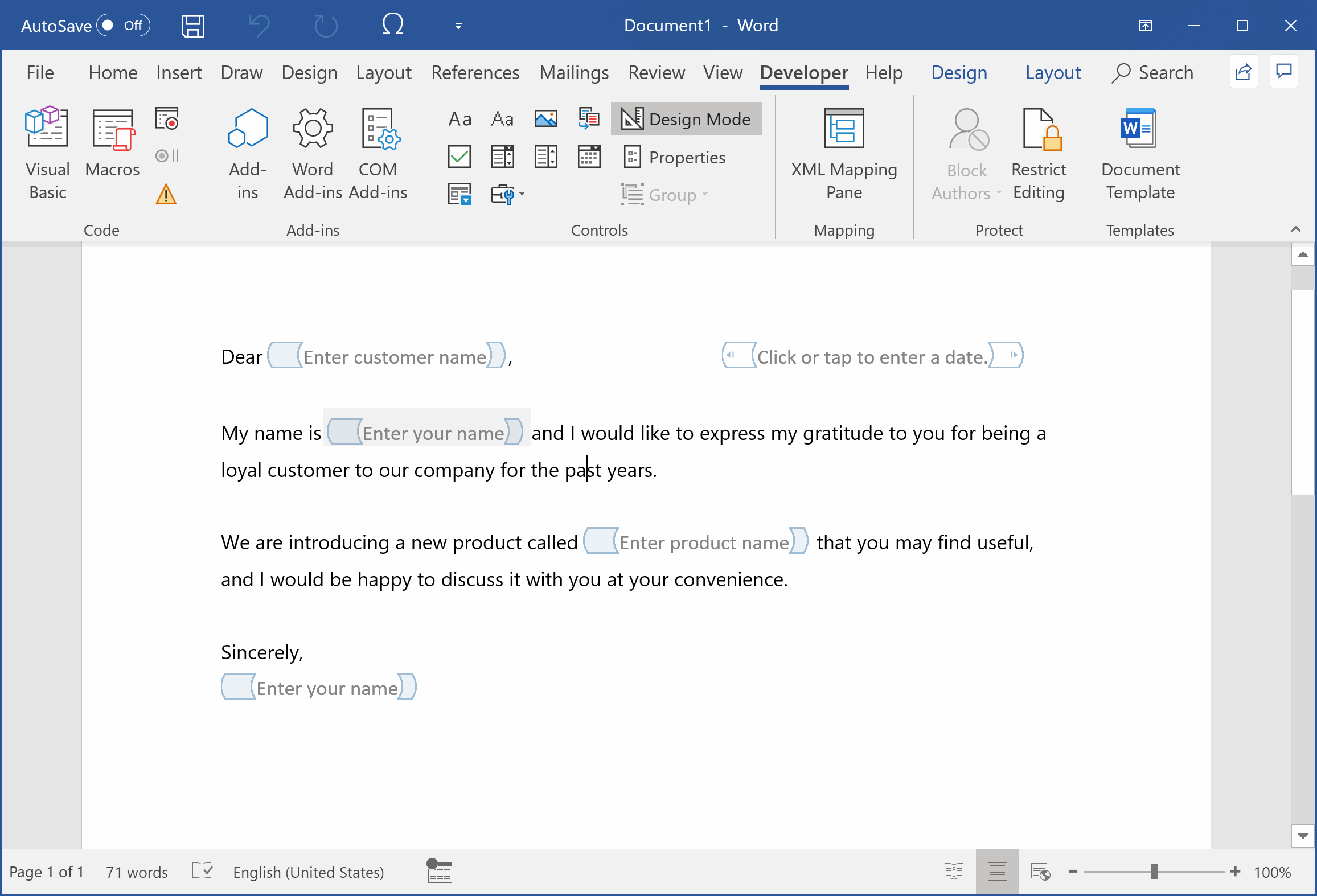
If you've ever copy-pasted the same contract forty times in a week and rewritten the client name each time, you already know the problem a merge field solves. It's the difference between editing one document and editing one template that produces forty documents for you.
A merge field is a placeholder inside a document, written in a specific syntax such as {{name}} or «Name», that gets swapped for real data at the moment the document is generated. Each placeholder pulls its value from a linked data source like a spreadsheet, a form, or a CRM record. The template stays clean. The data stays separate. New documents get built in seconds instead of minutes.
Key Takeaways
- A merge field is a document placeholder (like
{{client_name}}) that auto-fills with data from a separate source at generation time.- McKinsey finds that employees lose roughly 9.3 hours a week searching for information (McKinsey Global Institute, 2012); a single reliable template cuts into that number on the first use.
- Word's Mail Merge works for bulk letters, but daily contract, NDA, and proposal workflows usually outgrow it.
What is a merge field, exactly?
A merge field is a named placeholder inside a template that gets replaced with a value from an external data source the moment the document is generated. With Microsoft Word used by over 1.2 billion people worldwide (Document Formatting Services, 2026), merge fields are one of the most-used automation features almost nobody talks about by name.
Think of the template as a form letter with blanks. The merge field is the blank. The data source is the clipboard you read from to fill each blank. When you run the merge, the tool walks through each row in your data and produces one finished document per row.
In practice, merge fields show up as text surrounded by a specific syntax. Word shows them as chevrons like «Name» in the editor. Most modern automation tools use double curly braces like {{Name}} because the format stays readable even without the editor's formatting layer. The syntax varies. The idea does not.
Why do merge fields matter for real work?
Merge fields matter because repetitive document work absorbs a real share of the week. McKinsey Global Institute reports that 60% of all occupations have at least 30% of their activities technically automatable today (McKinsey Global Institute, 2017, reaffirmed in 2025). Drafting boilerplate contracts, quotes, and letters is on exactly that list.
Three numbers make the case clearly:
- Employees spend 1.8 hours every day, or roughly 9.3 hours a week, searching for and gathering information already stored somewhere in the company (McKinsey Global Institute, 2012). Templates with merge fields cut into that number by keeping every data point exactly once, in a single source of truth.
- Deloitte's global intelligent automation survey finds that organizations moving beyond the pilot stage report average cost reductions of 32%, up from 24% in earlier survey years (Deloitte, 2022).
- Deloitte also documents that intelligent document processing deployments achieve 60 to 80% processing time reduction in financial services (Deloitte, 2022). The mistake you do not retype is the mistake you do not make.
In our experience helping teams move off manual document work, the biggest gains aren't the ones people expect. People brace for time savings. What actually surprises them is the drop in version confusion. When one template holds the official text and merge fields pull the rest, nobody sends last quarter's NDA by accident. If you want the full picture of what that shift looks like, our beginner's guide to document automation walks through the basics end-to-end.
How do you use merge fields in Microsoft Word?
Microsoft Word handles merge fields through its Mail Merge feature, found under the Mailings tab. The core flow is the same whether you're generating fifty letters or a single personalized invoice. For most teams, Word's built-in Mail Merge is the first step on a longer automation journey, and it's worth learning end-to-end before reaching for anything heavier.
Here's the workflow in ten steps:
- Open a new or existing document in Word.
- Click the Mailings tab in the ribbon.
- Select Start Mail Merge and pick the document type you want, such as letters, labels, or email messages.
- Choose your recipients. You can use an existing list like an Excel sheet or Outlook contacts, or build a new list from scratch.
- Place your cursor where the personalized text should appear.
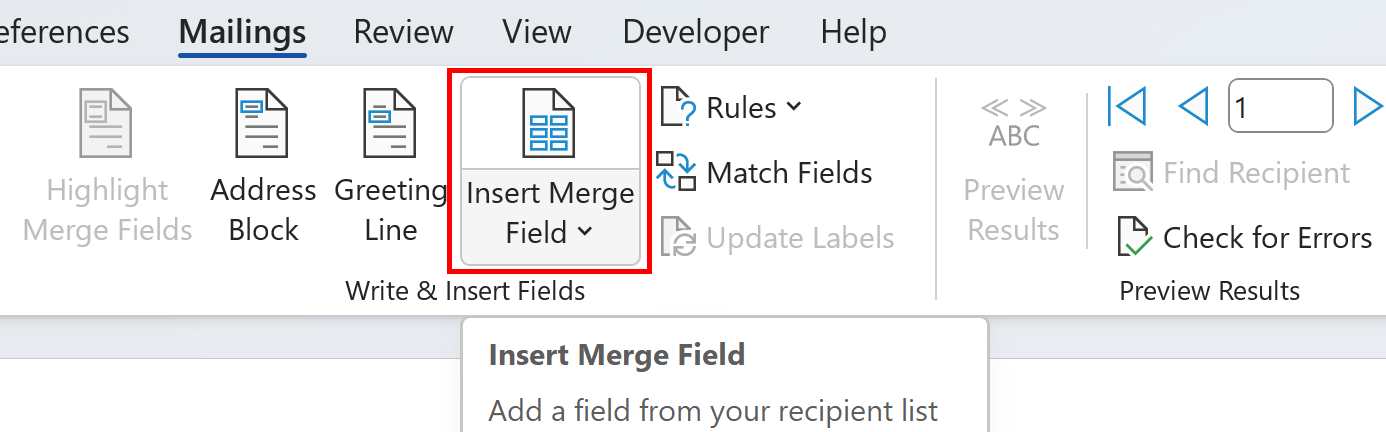
- Click Insert Merge Field in the Mailings tab to see every column available from your data source.
- Pick the field you want to insert. Word drops it in as a field code, shown as chevrons like
«Name». - Repeat steps 5 to 7 for every placeholder you need across the document.
- Preview the merged document with the Preview Results button to confirm each row fills the template correctly.
- Finish the merge by clicking Finish & Merge and picking the output you want: print, email, or save as new documents.
Tip
Use Preview Results before running the full merge. It's the single fastest way to catch mismatched column names or a blank value that would otherwise ship inside a customer-facing PDF.
If you want more detail on the end-to-end Mail Merge workflow, including how to set up the data source, our separate walkthrough on using mail merge in Word covers the details step by step. For setting up the starting template itself, the how to create a template in Word guide focuses on the structural side.
Where does Word's Mail Merge fall short?
Mail Merge handles bulk, identical documents well. It tends to struggle the moment documents need to differ from each other beyond simple name-swapping. Workflow automation is now part of the majority of corporate stacks, according to Deloitte's global intelligent automation survey (Deloitte, 2022), and most teams hit a ceiling with Word's native tools faster than they expect.
The common friction points we see, in rough order of how often teams hit them:
- Conditional sections. Need a warranty clause only when the product category is hardware? Mail Merge has
IFfields, but they're fiddly to build and brittle to maintain. - Repeating rows. Itemized invoices and multi-line quotes need blocks that repeat per line item. Word can do this with Directory merges, but the syntax is unforgiving.
- Images and signatures. Mail Merge doesn't natively handle a dynamic image per recipient or an e-signature block. Workarounds exist. None of them are pleasant.
- Web forms for non-technical teammates. Running a merge requires opening Word, connecting to a data source, and clicking through a wizard. That's a lot of steps for a colleague who just needs to generate one NDA. If staying inside Word is the goal, you can make a Word document fillable with form controls instead, which solves a slightly different problem.
- Version control. When three people keep personal copies of the master template, nobody knows which one is current.
Teams that outgrow these limits tend to look for a mail merge alternative that keeps the familiar merge-field idea but swaps the wizard for a web form anyone can use. Same placeholder concept. Different interface and a lot fewer broken IF statements. For teams whose bottleneck is actually email rather than documents, a shared library of email templates for teams often solves the upstream problem first.
Is there an easier way to use merge fields?
The shortest answer is yes: use a document automation tool where merge fields live inside a shared template, filled by a web form instead of a local Word file. The pattern keeps paying back for the same reason Deloitte's survey respondents report average cost reductions of 32% once intelligent automation moves past pilot stage (Deloitte, 2022). The setup looks similar to Mail Merge, but the day-to-day experience is closer to filling out an online form.
Here's the four-step version to make a Word document fillable:
- Sign up for a free WordFields account
- Upload your Word document template, such as an NDA, employment contract, or proposal. Drag and drop works, too.
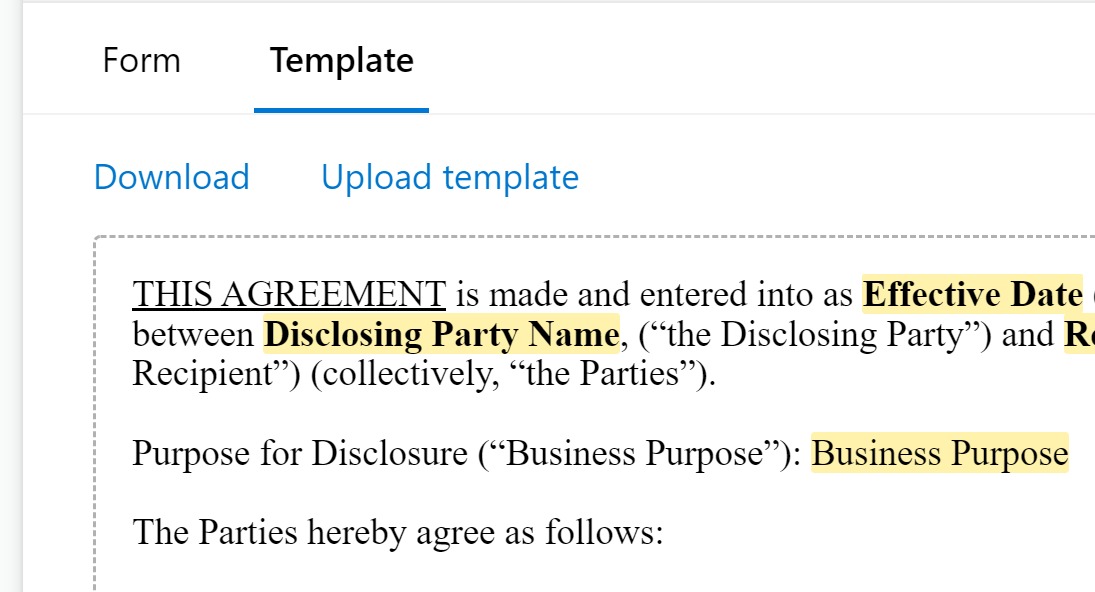
- Highlight any text in the template that should change from document to document. Each highlight becomes a merge field automatically, with a name you can rename later.
- Save the template and open its form. Fill the form out to generate your first automated document.
Note
Uploaded templates keep every existing header, footer, font, and logo. Only the highlighted text gets swapped at generation time.
The tradeoff is simple. Word's Mail Merge stays on your laptop and costs nothing extra if you already own Office. A hosted tool adds a subscription but removes the wizard, adds web forms, handles version control across teammates, and opens the door to conditional logic, repeating rows, and signatures. Which one fits depends on volume. If you're producing the same five document types week after week, the hosted approach usually wins. For more on how this compares end-to-end, see our overview of automating document generation.
Common merge field mistakes to avoid
Most merge field issues are not bugs in Word or in any tool. They're small template hygiene problems that compound at scale. From what we've seen across hundreds of customer templates, these five account for most of the broken-document help tickets. Each one takes under a minute to fix once you know what to look for.
- Inconsistent field names.
{{ClientName}},{{client_name}}, and{{ Client Name }}are three different fields to the merge engine. Pick one convention per template and stick to it. - Trailing spaces in headers. A column named
Emailwith a trailing space will not match a field called{{Email}}. This is the single most common reason a merge "randomly" breaks. - Hardcoded values the template forgot. The classic: a contract says "Valid for 30 days" in three places, and two are hardcoded while one is a merge field. Updates to the field do not fix the hardcoded copies.
- Missing data rows. Empty cells produce blank output. Mail Merge does not warn you. Previewing every row before the final merge catches this.
- Overusing merge fields for conditional logic. If you find yourself building long chains of
IFfields, you've probably outgrown Mail Merge. That's a signal, not a failure.
Warning
Never paste merge field syntax as plain text into the body of a Word document. It will render literally as {{name}} instead of being replaced. Always insert merge fields through the Insert Merge Field menu, or through your automation tool's template editor, so the field code is embedded correctly.
The short version, and what to do next
A merge field is one small idea with a long shadow. It's a named placeholder inside a template that gets swapped for real data the moment a document is generated. That single pattern powers mail merge, contract automation, invoice generation, and roughly every business workflow that produces the same document shape over and over. The concept scales from fifty birthday cards up to thousands of contracts a month.
The practical takeaway: if you already use Word's Mail Merge and it works, keep using it. If you keep running into conditional clauses, repeating rows, images, signatures, or teammates who shouldn't have to open Word at all, that's the signal to look at a mail merge alternative built around the same merge-field idea.
Your next step depends on where you are:
- Never used merge fields before: open Word, grab a small contact list, and try the ten-step walkthrough above. Ten minutes is enough to see it work.
- Comfortable with Mail Merge but outgrowing it: upload one of your most-used templates into WordFields and see what the form-based version feels like. Start free here.
Frequently asked questions
What is a merge field in a Word document?
A merge field is a placeholder inside a Word document that gets replaced with real data when the document is generated. Common examples include {{name}}, {{address}}, and {{date}}. Word's Mail Merge feature pulls values for each field from a linked source such as an Excel sheet, Outlook contacts list, or database table.
What is the difference between a merge field and mail merge?
A merge field is a single placeholder inside a document. Mail merge is the process of replacing many merge fields at once using an external data source. You add merge fields to a template first, then mail merge runs the template against a list of recipients to produce personalized copies of the same document.
Why do merge fields sometimes show up empty or broken?
Empty or broken merge fields usually mean the field name in the template does not match any column in the data source. Common causes include trailing spaces in headers, missing values in the source row, mismatched capitalization, and fields renamed after being inserted. Previewing results before the final merge catches most of these issues early.
Can merge fields include images, signatures, or conditional text?
Word's built-in mail merge supports basic fields and a few rules like IF and NEXT, but it struggles with images, e-signatures, and complex conditional blocks. Dedicated document automation platforms add support for dynamic images, conditional sections, repeating rows, and signature fields without manual field coding.
What is the best merge field syntax, double curly braces or chevrons?
Microsoft Word displays merge fields as chevrons like «Name» in the editor, but stores them as field codes underneath. Many modern tools use double curly braces like {{Name}} because the format reads cleanly for humans and parses reliably across systems. The syntax you see depends on the tool, not the underlying concept of a placeholder.