A fillable field in Word is a content control: a marked box in the document that takes one kind of answer, such as a line of text, a date, a choice from a list or a tick. You insert them from the Developer tab, which is hidden until you turn it on under File → Options → Customize Ribbon. This article goes through each field type, what it's for, and the settings worth knowing. For building a complete form around them, see how to create a fillable form in Word.
How do you turn on the Developer tab?
The controls live on a tab Word doesn't show by default.
- Click File, then Options.
- Select Customize Ribbon.
- In the list on the right, check Developer.
- Click OK.
On a Mac, open Word → Preferences → Ribbon & Toolbar and check Developer there. The tab appears in the ribbon and stays until you turn it off. More on what else it holds in our guide to the Developer tab.
Which field type should you use?
The Controls group on the Developer tab has a button for each type. Hover over a button to see its name.
| Field type | Takes | Use it for |
|---|---|---|
| Plain Text Content Control | Text in one format | Names, addresses, reference numbers, amounts |
| Rich Text Content Control | Formatted text, tables, pictures | A paragraph the person may need to format |
| Date Picker Content Control | A date from a calendar | Start dates, deadlines, the document's date |
| Drop-Down List Content Control | One option from your list | A department, a plan, a payment term |
| Combo Box Content Control | An option from your list, or typed text | A list with an "other" case |
| Check Box Content Control | Ticked or not | Yes-or-no items, checklists |
| Picture Content Control | An image | A photo, a signature image, a logo |
Two rules of thumb. Use plain text unless there is a reason not to: it keeps the document's fonts intact whatever is pasted into it. And use a drop-down list wherever the answer comes from a known set, because it removes spelling variants (Net 30, net30, 30 days) before they start.
How do you insert a field?
- Click in the document where the field should go.
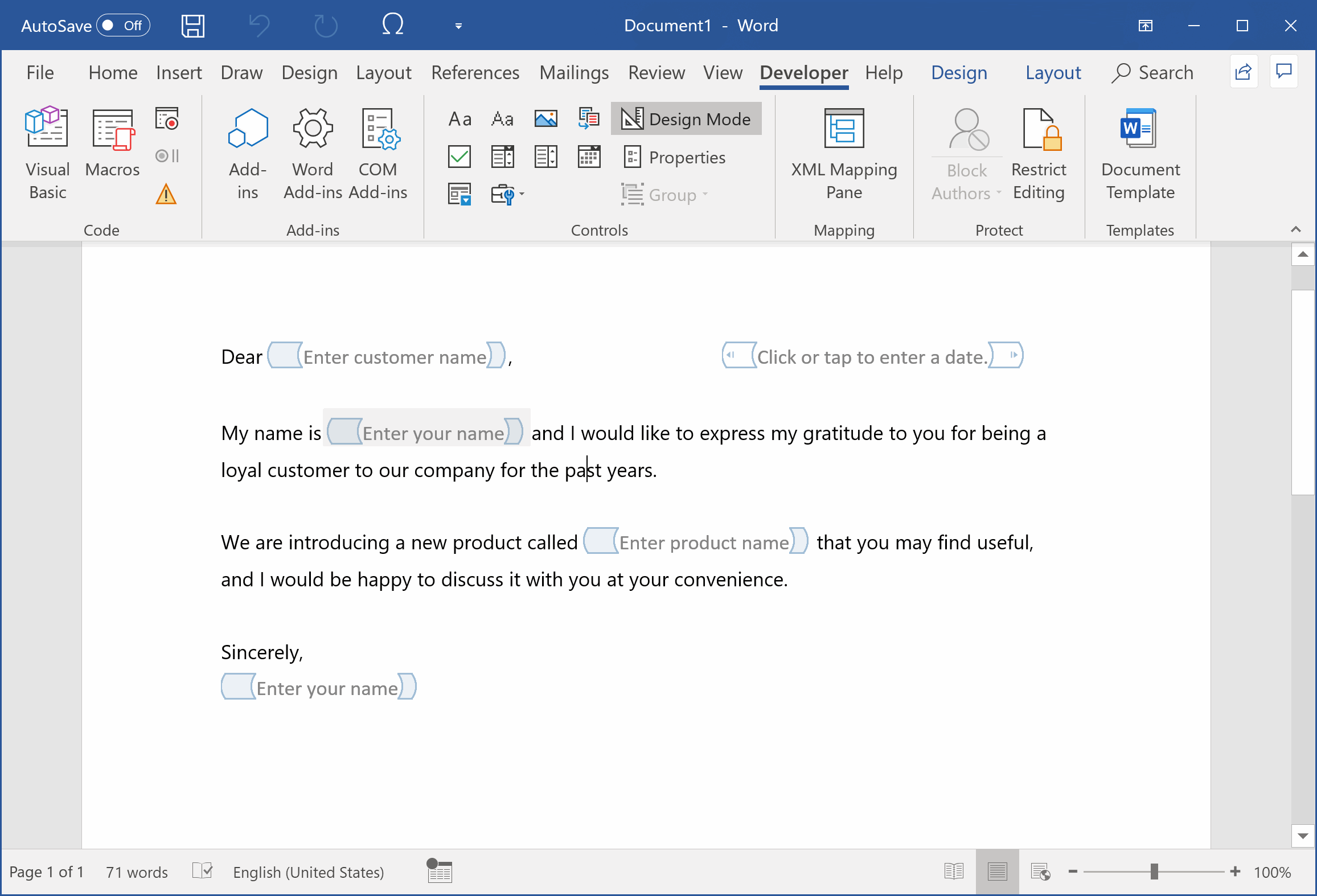
- On the Developer tab, in the Controls group, click the field type.
- The control appears with the placeholder Click or tap here to enter text.
To turn existing text into a field, select the text first and then click the field type: the control wraps the selection, and the text becomes its starting value.
Which properties are worth setting?
Click a control and then Properties in the Controls group. The dialog differs a little by type; these are the settings that matter.
- Title. A label shown on the control's tab when it is selected, such as
Client name. It tells the person filling in the form what goes there. - Tag. A name for the control that other tools and macros use. Give it the same value as the title unless you have a reason not to.
- Content control cannot be deleted. Check this on every field of a form, or one stray press of
Deleteremoves the field itself. - Contents cannot be edited. For a field that should be visible but fixed.
- Allow carriage returns (multiple paragraphs). On a plain text control, lets the answer run over several lines, for an address or a note.
- Remove content control when contents are edited. The box disappears once filled in, leaving plain text. Useful for a document that should end up with no trace of the form.
A drop-down list or combo box has a list of entries at the bottom of the dialog: click Add, type the display name, and repeat. A date picker has a display format, such as MMMM d, yyyy for November 12, 2026. A check box lets you choose the symbols for ticked and unticked.
Tip
To change the grey placeholder text, turn on Design Mode on the Developer tab, click in the control and type your own hint, such as The customer's legal name. Turn Design Mode off afterwards.
What about the legacy form fields?
The Legacy Tools button in the Controls group opens an older set of form fields from Word 97 to 2003. They still work, and they have two things content controls lack: a text field can be limited to a number or a maximum length, and a field can run a calculation. They only work once the document is protected for filling in forms, and they behave unevenly in newer versions and in Word for the web.
Use content controls for anything new. Use the legacy fields only when you maintain a form that was built with them.
What can't fillable fields in Word do?
Content controls are a good fit for a form you send to someone once. They show their limits when a team fills in the same document again and again.
- No required fields. Word doesn't stop anyone from leaving a field empty.
- No repeated values. A client name that appears five times is typed five times, unless you set up XML mapping.
- Everyone works in the file. Whoever fills in the form has the document itself open, so the wording is only as safe as the protection on it.
- The desktop app is needed to build the form; Word for the web can't insert the controls.
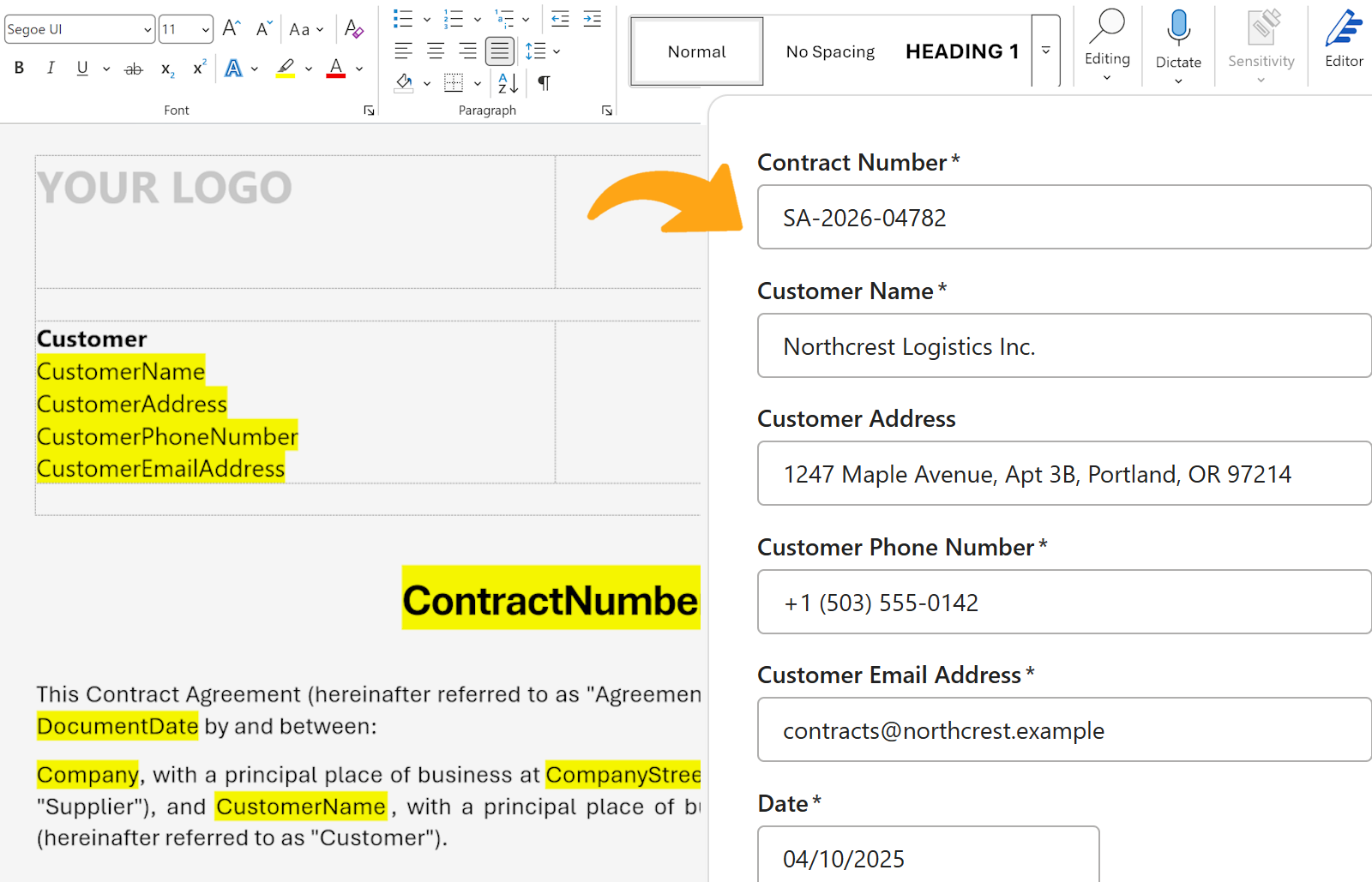
If that's your situation, with an offer letter, a quote or a contract your team creates every week, it's simpler to make the Word document fillable in WordFields. You select the text that changes and insert a field; a field can be required, can be a date, a number or a choice from a list, and can repeat wherever the same value belongs. Your team fills in a form and gets the finished Word file, and nobody opens the original.
Frequently asked questions
What is the difference between a rich text and a plain text content control?
A plain text control holds text in one format: whatever is typed takes the formatting of the control as a whole. A rich text control lets the person filling it in format individual words, and can also hold tables and pictures. For names, numbers and addresses, plain text is the safer choice because it keeps the document's formatting consistent.
Why can't I click the content control buttons on the Developer tab?
The buttons are greyed out when the document is in an old format or is protected. Save a .doc file as a .docx document, and check Restrict Editing on the Developer tab to see whether protection is on. In Word for the web the controls can't be inserted at all: open the document in the desktop app.
How do I change the 'Click or tap here to enter text' placeholder?
Turn on Design Mode on the Developer tab, click inside the control, and type over the placeholder text. Turn Design Mode off again when you are done. The placeholder is only shown while the field is empty, and it is not printed once the field has a value.
Can the same value appear in several places in a Word document?
Not with content controls on their own: each one is filled in separately. To repeat a value you need to map the controls to the same document property or custom XML part, or use a bookmark with REF fields. If you often need a client name repeated through a document, a template tool with named fields is simpler.