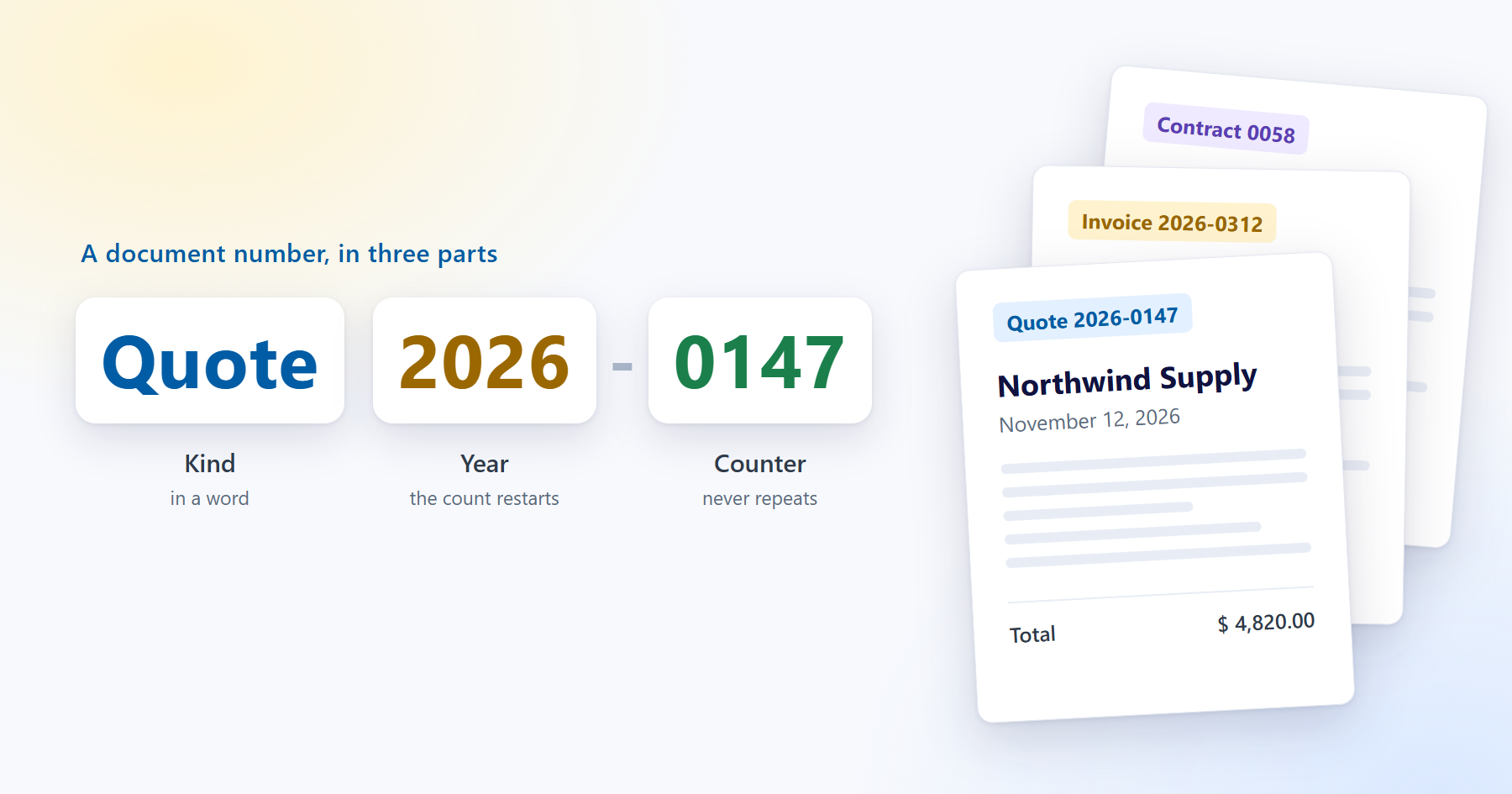
A document numbering system is a rule that gives every document of one kind a unique identifier, such as Quote 2026-0147. A good one has three parts, the kind of document, the year, and a counter that never repeats, and it is applied by one counter instead of by whoever happens to be creating the document. This article shows how to design one, with examples for quotes, contracts and invoices.
Key takeaways
- Keep the number to three parts: the kind of document, in a word, the period and a counter.
- Restart the counter with the year, and put the year in the number.
- One counter per kind of document, kept in one place. Never ask people to work out the next number.
- A number is never reused, even when the document is cancelled.
What goes in a document number?
Start from what someone needs to do with the number: say it on the phone, type it into a search box, sort a folder by it. That argues for short and predictable.
| Part | Example | Why |
|---|---|---|
| Kind of document | Quote, Invoice, Contract |
Says what it is, with no code to learn |
| Period | 2026, or 2026-11 for year and month |
Shows the document's age; lets the count restart |
| Counter | 0147 |
Makes it unique; padded so it sorts correctly |
Put together: Quote 2026-0147. The year and the counter are joined by a hyphen, which survives in a file name.
Many schemes use a code in place of the word, Q-2026-0147 or INV-2026-0312. A code earns its place only where the number has to fit a short field in another system, or a small box on a printed form. Everywhere else the word is clearer: nobody has to learn that MIN means minutes, or ask whether C is a contract or a certificate.
What to leave out is just as important. Don't build the customer's name, the author's initials or the version into the number. Those details belong in the document's title or in a register, where they can change without the number changing. A number that tries to describe the document ends up long, and wrong the first time something is renamed.
When should the count restart?
There are three sensible choices.
- Never. One counter runs for ever:
Contract 0001,Contract 0002. Good for documents that live for years, such as contracts and agreements, where the year of signing matters less than the identity. - Every year.
Invoice 2026-0001starts again in January asInvoice 2027-0001. The usual choice for invoices, quotes and purchase orders, because it matches the financial year and keeps numbers short. - Every month.
Quote 2026-11-001for the first quote of November 2026. Only worth it at high volume, where the month helps people find things.
Decide which date drives the restart: the day the document is created, or the date written on the document. They differ more often than you'd expect. An invoice dated December 31 but prepared on January 2 belongs in December's sequence, so for invoices it's the document's own date that should count.
Examples
| Document | Scheme | Looks like | Restarts |
|---|---|---|---|
| Quote | Quote {year}-{4 digits} |
Quote 2026-0147 |
Every year |
| Invoice | Invoice {year}-{4 digits} |
Invoice 2026-0312 |
Every year, by invoice date |
| Contract | Contract {4 digits} |
Contract 0058 |
Never |
| Purchase order | Purchase order {year}-{4 digits} |
Purchase order 2026-0091 |
Every year |
| Meeting minutes | Minutes {year}-{2 digits} |
Minutes 2026-11 |
Every year |
| Quality record | {department} record {3 digits} |
Laboratory record 204 |
Never, a counter per department |
The number then leads the document's title and file name: Quote 2026-0147 Northwind Supply.docx. Sorted by name, the folder is in order, and a search for the number finds the file. More on the rest of the name in file naming conventions.
Five rules that keep a numbering system working
- One source for the next number. The moment two people can each decide what the next number is, you get duplicates. The counter has to live in one place.
- Never reuse a number. A cancelled quote keeps its number and is marked void. A gap with a note is fine; a repeat is not.
- Pad the counter.
0009sorts before0010. Without the zeros,10sorts before9. - Write the scheme down. One line per kind of document: the pattern, when it restarts, who may change it.
- Don't change it mid-year. If the scheme has to change, change it at a restart, and keep the old numbers as they are.
For invoices, check your country's rules as well: many tax authorities expect invoice numbers to be unique and in sequence.
How do you keep the counter?
For a few documents a month, a shared spreadsheet works: one row per document, and the next number is the last row plus one. It depends on everyone opening the sheet before they create the document, and on nobody taking the same row at the same moment. That's also your document register, which is worth having anyway.
It breaks down as volume grows, in a predictable way: someone in a hurry copies last week's quote, guesses the number, and the sheet is filled in later or not at all.
The dependable fix is to have the number assigned at the moment the document is created, by the tool that creates it. In WordFields, a template has its own automatic numbering: you choose when the count restarts (never, every year or month, by the date created or the document's date, or when a value such as the department changes) and write the title pattern once.
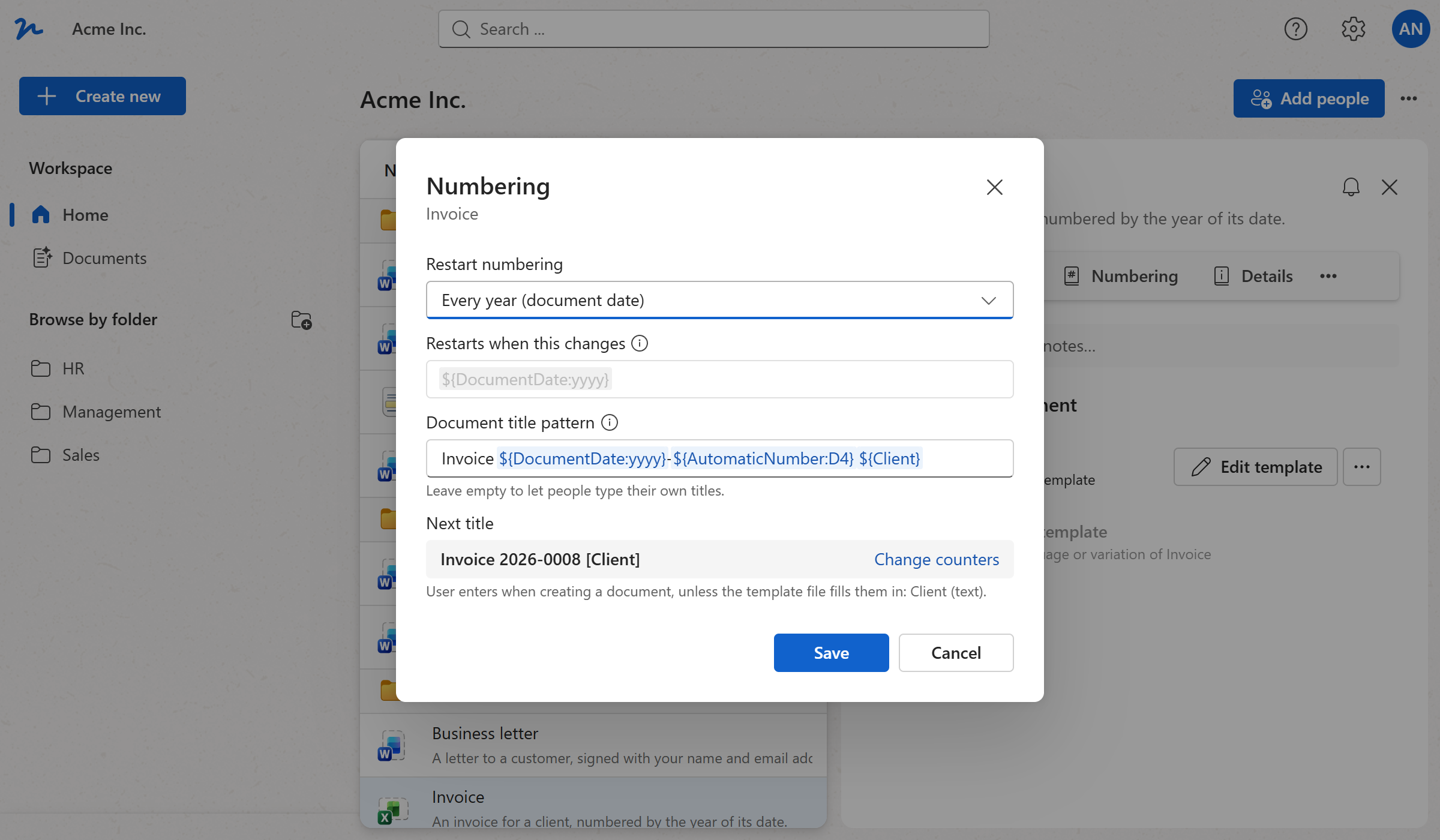
Quote ${DocumentDate:yyyy}-${AutomaticNumber:D4} ${Client}
gives every quote created from that template a title like Quote 2026-0147 Northwind Supply, with the year from the document's date, the next number padded to four digits, and the client from the form. Nobody types the number or looks it up, and each document is kept on record with its number, author and date. The settings are described step by step in the help center under automatic document numbering.
Frequently asked questions
Should document numbers restart every year?
For most small teams, yes. Putting the year in the number and restarting the count each January keeps numbers short, shows at a glance how old a document is, and matches how accounts and archives are organized. Never restart without the year in the number, or two documents end up with the same one.
How many digits should a document number have?
Enough that the count never outgrows them within one period. Four digits (0001 to 9999) covers nearly any small business for a year. Pad with leading zeros so numbers sort correctly in a file list: 0009 comes before 0010, but 9 comes after 10.
Do invoice numbers have to be sequential?
In many countries tax rules require invoice numbers to be unique and to follow a sequence, and a gap can raise questions in an audit. The rules differ by country, so check with your accountant. Whatever the rule, a single counter that hands out the next number is the only reliable way to keep the sequence.
What should I do when a number is used by mistake?
Keep it. Mark the document as void in your register and move on to the next number. Reusing or deleting a number is what breaks trust in the sequence: a gap with a note explains itself, and two documents with one number never do.