Three professional apology email templates for B2B support teams. Apologise for service failures, miscommunication, and proactive incidents with consistent, trust-restoring replies.
Hi [Client name],
I want to apologise directly for [Issue description]. This was our failure, and I won't dress it up as anything else.
I understand the impact this has had on [Affected area or operation], and I'm sorry we put you in that position.
Here is what we have done: [Immediate corrective action taken]. Here is what we are doing to make sure it doesn't happen again: [Process or structural change to prevent recurrence].
If there is anything further we can do to mitigate the impact on your end, please tell me and I will make it a priority. You can reach me directly at [VALUE("Author.EmailAddress")].
[VALUE("Author.FullName")]
[VALUE("Organization")]
Hi Client name,
I want to apologise directly for Issue description. This was our failure, and I won't dress it up as anything else.
I understand the impact this has had on Affected area or operation, and I'm sorry we put you in that position.
Here is what we have done: Immediate corrective action taken. Here is what we are doing to make sure it doesn't happen again: Process or structural change to prevent recurrence.
If there is anything further we can do to mitigate the impact on your end, please tell me and I will make it a priority. You can reach me directly at =VALUE("Author.EmailAddress").
=VALUE("Author.FullName")
=VALUE("Organization")
Hi [Client name],
I need to correct something we communicated to you and apologise for the confusion it caused.
On [Date or reference of the original communication], we told you [What was incorrectly communicated]. That was wrong. The correct position is [The correct position or information].
I understand this may have affected [Decision or action the client took based on the error], and I'm sorry we put you in that position. [Immediate step taken to correct impact, if any].
Going forward, [What is changing to prevent this]. If you have any questions about what this means for your account, please come back to me directly — I want to make sure you have accurate information from this point on.
[VALUE("Author.FullName")]
[VALUE("Organization")] | [VALUE("Author.EmailAddress")]
Hi Client name,
I need to correct something we communicated to you and apologise for the confusion it caused.
On Date or reference of the original communication, we told you What was incorrectly communicated. That was wrong. The correct position is The correct position or information.
I understand this may have affected Decision or action the client took based on the error, and I'm sorry we put you in that position. Immediate step taken to correct impact, if any.
Going forward, What is changing to prevent this. If you have any questions about what this means for your account, please come back to me directly — I want to make sure you have accurate information from this point on.
=VALUE("Author.FullName")
=VALUE("Organization") | =VALUE("Author.EmailAddress")
Hi [Client name],
I'm reaching out before you come to us, because I want you to hear this from us first.
[Incident description] affected your account on [Date or period when it occurred]. Specifically, [What was impacted and how]. I'm sorry this happened and I'm sorry for the impact on your operations.
Here is where things stand now: [Current status]. The issue has been [resolved / is being resolved by [deadline]], and we have [Preventive action taken or planned] to ensure this does not recur.
You do not need to take any action. I will follow up with a full update by [Follow-up date]. If you want to speak sooner, reply to this email and I'll arrange a call.
[VALUE("Author.FullName")]
[VALUE("Organization")] | [VALUE("Author.EmailAddress")]
Hi Client name,
I'm reaching out before you come to us, because I want you to hear this from us first.
Incident description affected your account on Date or period when it occurred. Specifically, What was impacted and how. I'm sorry this happened and I'm sorry for the impact on your operations.
Here is where things stand now: Current status. The issue has been resolved / is being resolved by [deadline], and we have Preventive action taken or planned to ensure this does not recur.
You do not need to take any action. I will follow up with a full update by Follow-up date. If you want to speak sooner, reply to this email and I'll arrange a call.
=VALUE("Author.FullName")
=VALUE("Organization") | =VALUE("Author.EmailAddress")
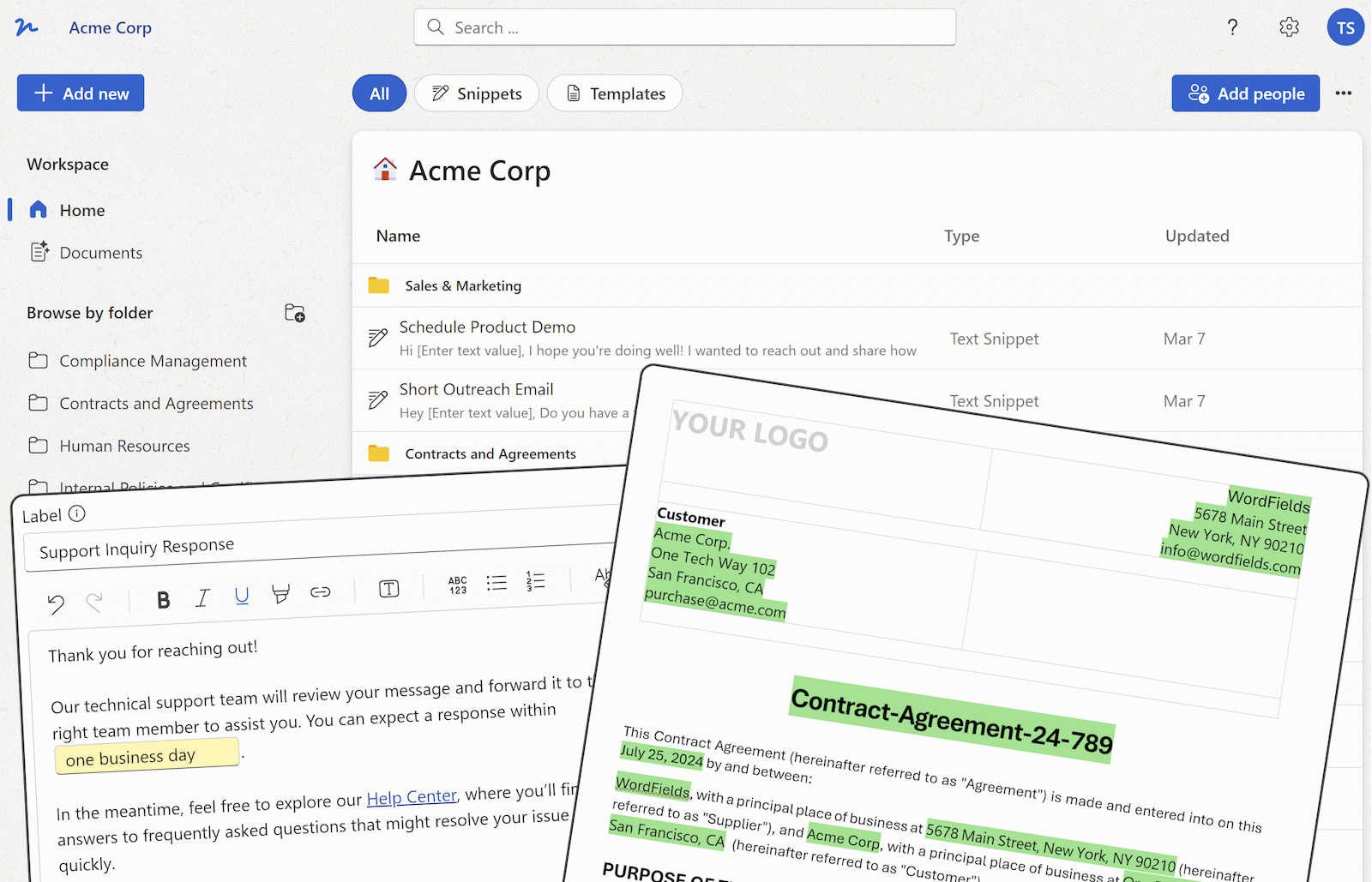
Each snippet auto-populates your name, email address, and organisation name when used in WordFields. Fill in the incident-specific fields at the point of use and insert directly into your email client, CRM, or helpdesk via the Chrome extension — without switching tabs.
What's included
Each snippet auto-populates the following fields when used in WordFields:
- Client name, for direct address in the opening line
- Issue or incident description, so the apology is tied to the specific failure — not a generic expression of regret
- The corrective action already taken and any process change, keeping the apology anchored to substance
- Sender name, email address, and organisation name — pulled automatically from the logged-in user and workspace, with no manual entry required
When to send a customer apology email
The service failure apology is for situations where your team caused a failure with a direct, measurable impact on the client — a missed deliverable, a defective output, a breach of a contracted standard. In B2B contexts, this type of apology carries more weight when sent quickly and by a named person rather than a generic support address. The template is structured to own the failure cleanly in the first sentence, state what has already been done, and what is changing — because a service failure apology that contains only regret and no action reads as performative to a client who has already been operationally affected.
The miscommunication apology applies when your team provided incorrect information that a client relied on — whether in a proposal, a support interaction, a contract summary, or an onboarding call. The risk with miscommunication apologies is that they drift into passive constructions that obscure who gave the wrong information and when. This template corrects that: it names what was said, names what is correct, and acknowledges the downstream impact on any decision or action the client took based on the error. That specificity is what separates an apology that restores confidence from one that makes the client feel they're being managed.
The proactive incident apology is the highest-leverage variant and the most underused. It applies when your team identifies that a client has been affected by an error or disruption before the client raises it themselves — a data error discovered during internal QA, a service degradation detected in monitoring, an invoicing mistake found in reconciliation. Sending this before the client contacts you inverts the dynamic: instead of defending yourself against a complaint, you are demonstrating that you monitor your own performance and hold yourself accountable without being asked. Research from B2B customer experience studies consistently shows that clients who receive proactive outreach after an incident rate their satisfaction higher than clients who had to chase — even when the incident itself was equally serious.
Frequently asked questions
How do you write a professional apology email to a client?
Name the specific failure in your opening sentence — don't open with a vague 'we're sorry for any inconvenience.' Take direct ownership without deflecting to process, staffing, or external factors. State what has changed or what action is already in motion, not just what will be investigated. Close with a named contact, not a generic support address.
What is the difference between a customer apology email and a complaint response email?
A complaint response email is reactive and resolution-focused — the client has raised an issue and you are addressing it. An apology email may be proactive, sent before the client escalates, and is primarily about restoring trust and acknowledging impact. The apology email's primary job is relational; the complaint response's primary job is operational. In practice, an apology often accompanies a resolution, but the two have different centres of gravity.
When should you send a proactive apology email to a client?
Send a proactive apology as soon as you identify that a client has been — or is about to be — affected by an error or disruption, before they contact you. Proactive outreach signals accountability and typically receives a more positive response than a reactive apology sent after the client has had to chase. In B2B contexts, proactive apologies are especially important for service outages, data errors, or delayed deliverables where the client may not yet know the full extent of the impact.
How do you apologise for a miscommunication to a client without sounding defensive?
Own the miscommunication directly — 'We gave you incorrect information' is cleaner than 'there appears to have been a miscommunication.' Avoid language that implies the client share responsibility for the confusion. Explain what the correct position is, what the error was, and how you are ensuring the client has accurate information going forward. Keep the tone factual and direct rather than emotionally heavy, which can read as performative rather than genuine.
Should a client apology email include compensation?
Compensation is appropriate when the failure had a measurable operational or financial impact on the client — not for every apology. In B2B contexts, the most valued forms of recovery are often speed of resolution and transparency, rather than token discounts. If you do offer compensation, make it specific and relevant to the impact. A blanket offer of a generic discount in response to a serious service failure can read as dismissive rather than generous.
What should you not say in an apology email to a client?
Avoid: 'mistakes happen' (dismissive), 'we're sorry you feel that way' (non-apology), 'this is not typical of us' (deflects rather than owns), and 'please accept our sincerest apologies' without a specific action attached (empty formality). Don't explain internal causes at length — clients want accountability and resolution, not an operational post-mortem. And don't close with 'please don't hesitate to reach out' as your only next step; name a specific action or contact instead.
How quickly should an apology email be sent to a client?
Within the same business day for most service failures; immediately for high-impact incidents like outages or data errors. The apology and the resolution do not need to arrive in the same email — an acknowledgement that you are aware of the impact and are acting is more valuable sent quickly than a complete resolution sent slowly. Follow up with a resolution email once the fix is confirmed.
How do you maintain a consistent tone across apology emails sent by different team members?
Store approved apology templates in a shared workspace where all agents access the same current version. Use fillable fields for the variable parts — client name, incident description, action taken — so agents personalise at point of use without rewriting from scratch. When company policy or process changes, update the template once and every agent immediately works from the revised version. This prevents tone drift and ensures no critical element — acknowledgement, action, contact point — is accidentally omitted under pressure.
Related customer service email templates
Explore more professional document and email templates you can copy, customize, and use immediately