Free internal email templates for sales discount approvals — the rep's request, manager approval, and manager decline. Fill in the fields and send consistently every time with WordFields.
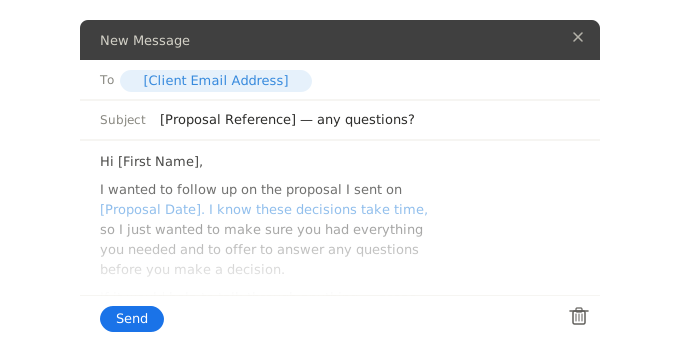
Hi [Manager first name],
Requesting approval to offer [Client company name] a [Discount percentage]% discount on [Product, service, or proposal dated [date]].
Deal context: [Two to three sentences — deal size, contract length, strategic value, or competitive situation. Be specific.]
Justification: [Why this discount is necessary — e.g. competitor pricing, budget constraint, volume commitment, long-term account value]
I need a decision by [Decision deadline] to keep the deal on track.
[VALUE("Author.FullName")]
Hi Manager first name,
Requesting approval to offer Client company name a Discount percentage% discount on Product, service, or proposal dated [date].
Deal context: Two to three sentences — deal size, contract length, strategic value, or competitive situation. Be specific.
Justification: Why this discount is necessary — e.g. competitor pricing, budget constraint, volume commitment, long-term account value
I need a decision by Decision deadline to keep the deal on track.
=VALUE("Author.FullName")
Hi [Rep first name],
Approved — you can offer [Client company name] a [Approved discount percentage]% discount on [Product or service].
[Any conditions — e.g. conditional on a 12-month contract minimum / do not extend to other deals without a separate request. Leave blank if none.]
Make sure this is reflected in the quote before it goes out.
[VALUE("Author.FullName")]
Hi Rep first name,
Approved — you can offer Client company name a Approved discount percentage% discount on Product or service.
Any conditions — e.g. conditional on a 12-month contract minimum / do not extend to other deals without a separate request. Leave blank if none.
Make sure this is reflected in the quote before it goes out.
=VALUE("Author.FullName")
Hi [Rep first name],
I can not approve [Requested discount percentage]% on this one — [Brief reason — e.g. takes us below floor margin / deal size does not justify it].
[Alternative where possible — e.g. can approve up to X% if they commit to a Y-month contract / offer a value-add instead. Leave blank if none.]
[VALUE("Author.FullName")]
Hi Rep first name,
I can not approve Requested discount percentage% on this one — Brief reason — e.g. takes us below floor margin / deal size does not justify it.
Alternative where possible — e.g. can approve up to X% if they commit to a Y-month contract / offer a value-add instead. Leave blank if none.
=VALUE("Author.FullName")
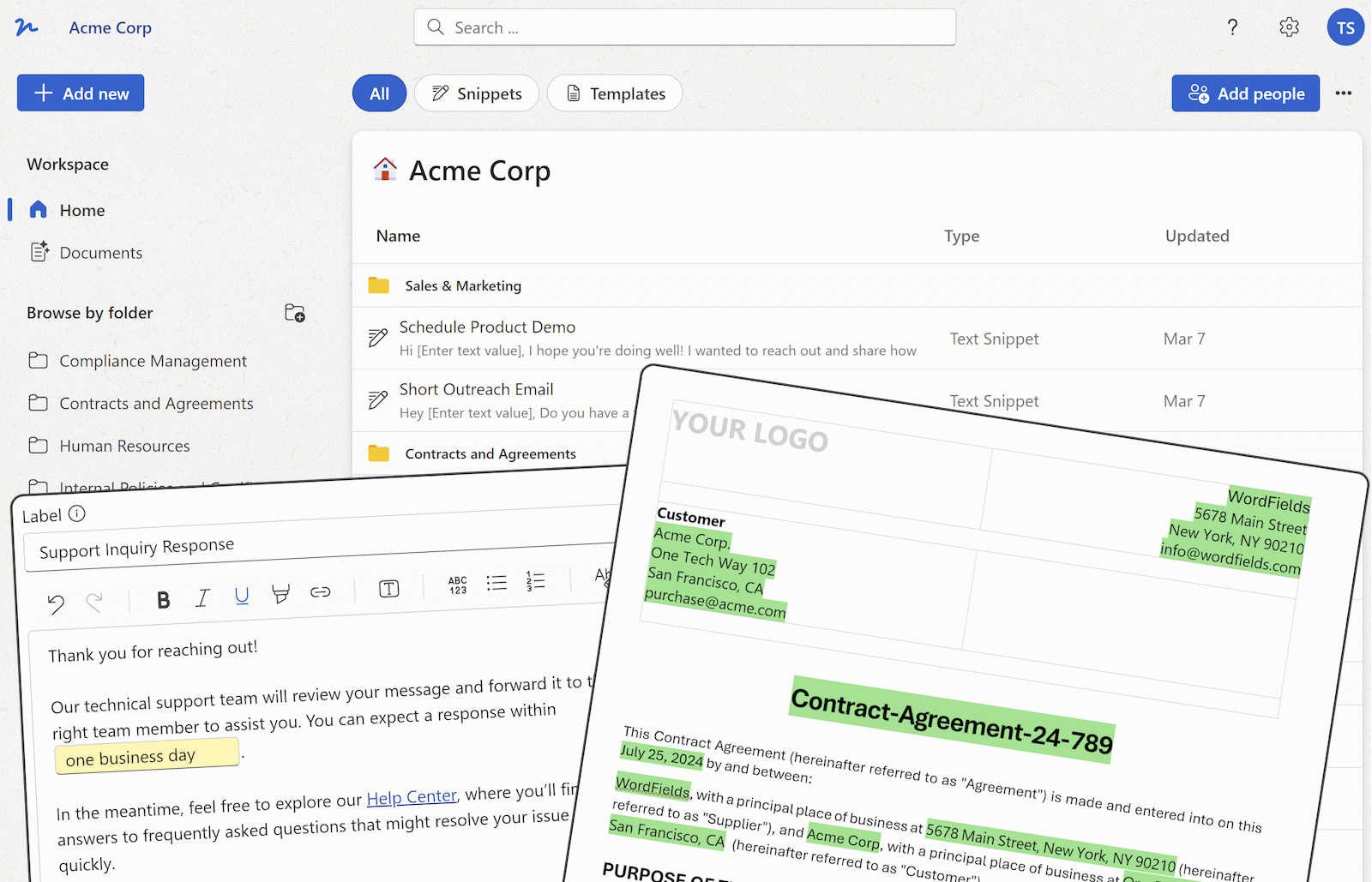
Use WordFields to fill in and insert any of these directly into Gmail or Outlook. Merge tags like [My:FullName] fill in automatically — the rep or manager just fills in the deal-specific details.
What's included
Each snippet auto-populates the following fields when used in WordFields:
- Client company name and deal context
- Discount percentage requested and approved or declined amount
- Business justification and deal specifics
- Approval conditions or alternative offer (approval and decline variants)
- Decision deadline (request variant)
- Sender name (pulled from the logged-in user automatically)
When to use each discount approval template
The request email is one of the most under-templated internal communications in a sales team. Most reps write it differently every time — some include full deal context, some send a one-line message, some escalate verbally and never document it. The result is that managers get inconsistent information, approvals take longer than they should, and there is no record of what was agreed. A shared request template in WordFields means every rep provides the same context in the same format: client, discount, justification, deadline. Managers can respond faster because they are not spending the first read trying to work out what is being asked.
The approval email is short by design. Once a manager has made the decision, the rep needs clarity, not a explanation. The most important addition is the conditions line — many approvals come with strings attached (minimum contract length, no precedent for other deals, specific product only) and those conditions need to be on the record. A verbal approval with unspoken conditions is a reliable source of future disagreement. The template makes conditions explicit without making the email feel legalistic.
The decline email is the hardest of the three to write well. Most managers default to a flat no, which leaves the rep with nothing to take back to the client. A decline that includes an alternative — a lower approved percentage, a value-add instead of a price cut, a conditional approval tied to deal terms — gives the rep a path forward and signals that the manager is trying to help close the deal, not just protect margin. If your team declines discount requests regularly without offering alternatives, you will find reps stop asking and start making commitments they cannot honour. The decline template exists to prevent both outcomes.
Frequently asked questions
What should a discount approval request email include?
A discount request email should include the client name and deal context, the specific discount being requested as a percentage or amount, the business justification — why the discount is needed and what it is expected to achieve, the impact on margin if relevant, and a clear deadline for the decision. The more specific the justification, the faster the approval. Vague requests like 'the client wants a better price' without context or deal details are the most common reason approvals stall.
How do you ask your manager for a discount approval?
Lead with the deal and the ask, not the background. Your manager does not need a narrative — they need the client name, the discount percentage, the reason, and the deadline. Keep it to three or four sentences. Include the relevant deal context such as deal size, contract length, or strategic value, and be explicit about what you are asking them to approve. If you need a decision by a specific date to meet the client's timeline, state that clearly in the first line.
How should a manager decline a discount request?
Decline clearly, give a brief reason, and where possible offer an alternative — a different discount level, a value-add instead of a price reduction, or a conditional approval tied to deal size or contract length. A flat refusal with no context leaves the rep without a path forward and creates unnecessary friction. The goal is to give the rep something they can take back to the client, not just a closed door.
Should discount approvals be done by email or in person?
Either works, but the decision should always be confirmed in writing regardless of how the conversation happens. A verbal approval that is not documented creates ambiguity — the rep may communicate a discount to the client that the manager later claims they did not fully approve. Even if the initial conversation is verbal, send a brief confirmation email immediately after so there is a clear record. The templates on this page serve that documentation function as much as they serve communication.
Related sales templates
Explore more professional document and email templates you can copy, customize, and use immediately