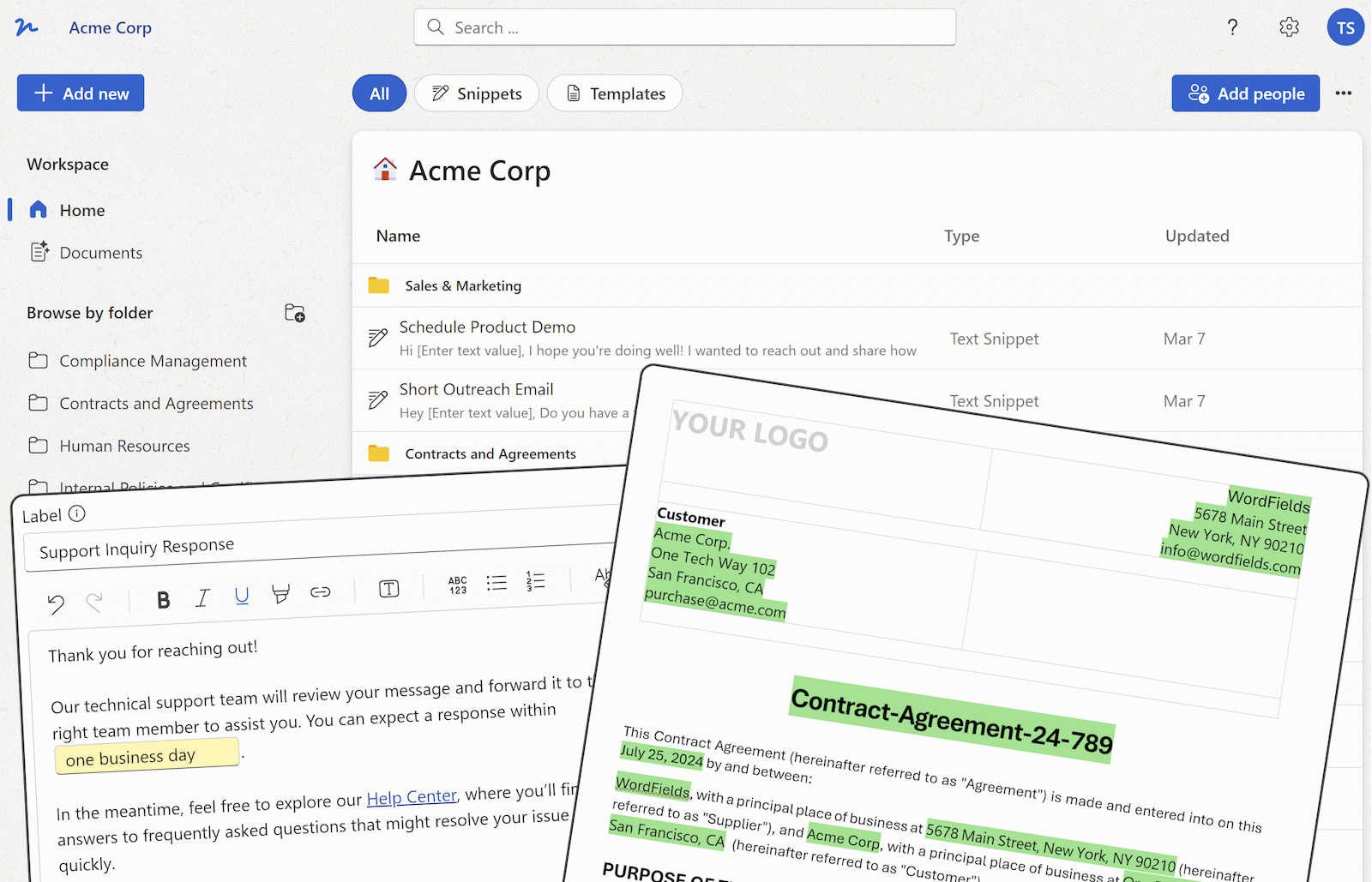
A free Word sales proposal template covering executive summary, scope of work, pricing, and next steps. Fill it out in WordFields and send a consistent, correctly formatted proposal every time.
Sales Proposal
| Prepared for | [Client company name] |
| Prepared by | [VALUE("Author.FullName")], [Your job title] |
| Date | [Document date] |
| Proposal reference | [Proposal reference number] |
| Valid until | [Proposal expiry date] |
This proposal contains confidential and proprietary information belonging to [VALUE("Organization")]. It is intended solely for the use of [=TEXT([Client Company Name], "")] and should not be shared with third parties without prior written consent.
Executive Summary
[=TEXT([Client Company Name], "")] is currently facing [Brief description of the client's core challenge or goal]. This proposal outlines how [VALUE("Organization")] will address that challenge through [Brief description of your proposed solution].
We understand that [=TEXT([Client Company Name], "")] needs [Specific outcome the client is trying to achieve]. Our proposed approach is designed to deliver [Key result or benefit], with a clear scope, a defined timeline, and transparent pricing.
Understanding of Your Needs
Based on our conversation on [Discovery call date], we understand that [=TEXT([Client Company Name], "")] requires:
- [Requirement 1]
- [Requirement 2]
- [Requirement 3 — add more as needed]
This proposal has been prepared in direct response to these requirements. If any of the above do not accurately reflect your situation, please contact us before proceeding — we are happy to revise.
Proposed Solution
[VALUE("Organization")] proposes the following scope of work:
[Detailed description of the solution, service, or product. Include methodology, key deliverables, and how it addresses the client's stated needs.]
Deliverables
- [Deliverable 1 — description and format]
- [Deliverable 2 — description and format]
- [Deliverable 3 — add or remove as needed]
Out of Scope
- [Exclusion 1]
- [Exclusion 2 — add or remove as needed]
Investment
All prices are in [Currency — e.g. USD / GBP / EUR] and exclusive of [Tax type — e.g. VAT / GST / applicable taxes] unless otherwise stated.
| Item | Description | Qty | Unit Price | Total |
|---|---|---|---|---|
| [Item 1 name] | [Item 1 description] | [Qty] | [Unit price] | [Line total] |
| [Item 2 name] | [Item 2 description] | [Qty] | [Unit price] | [Line total] |
| [Item 3 name — add or remove rows as needed] | [Item 3 description] | [Qty] | [Unit price] | [Line total] |
| Subtotal | [Subtotal] | |||
| [=TEXT([Tax Type], "")] ([Tax rate — e.g. 20]%) | [Tax amount] | |||
| Total | [Total amount] |
Payment terms: [e.g. 50% deposit required upon acceptance. Remaining balance due within 30 days of project completion.]
This pricing is valid until [=TEXT([Expiry Date], "d")]. After this date, prices may be subject to revision.
Timeline
| Phase | Description | Start Date | End Date |
|---|---|---|---|
| [Phase 1 name] | [Phase 1 description] | [Phase 1 Start] | [Phase 1 End] |
| [Phase 2 name] | [Phase 2 description] | [Phase 2 Start] | [Phase 2 End] |
| [Phase 3 name — add or remove rows as needed] | [Phase 3 description] | [Phase 3 Start] | [Phase 3 End] |
The above timeline assumes that [=TEXT([Client Company Name], "")] will provide [Any materials, access, or approvals required from the client and by when]. Delays in client-side dependencies may affect the overall schedule.
About Us
[VALUE("Organization")] [Brief description of what the company does and who it serves — two to three sentences]
Why [VALUE("Organization")]
[Two to three specific reasons you are well-suited for this engagement — client results, relevant experience, team expertise]
Relevant Experience
[Brief reference to one or two relevant past engagements or client results. Do not name clients without permission.]
Terms and Conditions
- All work will be carried out in accordance with [VALUE("Organization")]'s standard terms of service, available at [Terms URL or state provided upon request] or provided upon request.
- Acceptance of this proposal constitutes agreement to those terms unless a separate service agreement is in place.
- This proposal does not constitute a binding contract until countersigned by an authorised representative of [VALUE("Organization")].
- [Any additional terms specific to this engagement — leave blank if none]
Next Steps
To accept this proposal:
- Review the scope and pricing in full.
- Sign below and return this document to [VALUE("Author.EmailAddress")] by [=TEXT([Expiry Date], "d")].
- [VALUE("Organization")] will issue a formal agreement and invoice for the deposit within [Number of business days — e.g. two (2)] business days of acceptance.
If you have any questions before accepting, contact [VALUE("Author.FullName")] directly at [VALUE("Author.EmailAddress")] or [Sender phone number].
We look forward to working with [=TEXT([Client Company Name], "")].
| [VALUE("Organization")] | [=TEXT([Client Company Name], "")] |
| Signature: ___________________________ | Signature: ___________________________ |
| Name: [VALUE("Author.FullName")] | Name: [Client contact name] |
| Title: [=TEXT([Author Job Title], "")] | Title: [Client contact title] |
| Date: ________________________________ | Date: ________________________________ |
| Prepared for | Client company name |
| Prepared by | =VALUE("Author.FullName"), Your job title |
| Date | Document date |
| Proposal reference | Proposal reference number |
| Valid until | Proposal expiry date |
This proposal contains confidential and proprietary information belonging to =VALUE("Organization"). It is intended solely for the use of =TEXT([Client Company Name], "") and should not be shared with third parties without prior written consent.
=TEXT([Client Company Name], "") is currently facing Brief description of the client's core challenge or goal. This proposal outlines how =VALUE("Organization") will address that challenge through Brief description of your proposed solution.
We understand that =TEXT([Client Company Name], "") needs Specific outcome the client is trying to achieve. Our proposed approach is designed to deliver Key result or benefit, with a clear scope, a defined timeline, and transparent pricing.
Based on our conversation on Discovery call date, we understand that =TEXT([Client Company Name], "") requires:
- Requirement 1
- Requirement 2
- Requirement 3 — add more as needed
This proposal has been prepared in direct response to these requirements. If any of the above do not accurately reflect your situation, please contact us before proceeding — we are happy to revise.
=VALUE("Organization") proposes the following scope of work:
Detailed description of the solution, service, or product. Include methodology, key deliverables, and how it addresses the client's stated needs.
- Deliverable 1 — description and format
- Deliverable 2 — description and format
- Deliverable 3 — add or remove as needed
- Exclusion 1
- Exclusion 2 — add or remove as needed
All prices are in Currency — e.g. USD / GBP / EUR and exclusive of Tax type — e.g. VAT / GST / applicable taxes unless otherwise stated.
| Item | Description | Qty | Unit Price | Total |
|---|---|---|---|---|
| Item 1 name | Item 1 description | Qty | Unit price | Line total |
| Item 2 name | Item 2 description | Qty | Unit price | Line total |
| Item 3 name — add or remove rows as needed | Item 3 description | Qty | Unit price | Line total |
| Subtotal | Subtotal | |||
| =TEXT([Tax Type], "") (Tax rate — e.g. 20%) | Tax amount | |||
| Total | Total amount |
Payment terms: e.g. 50% deposit required upon acceptance. Remaining balance due within 30 days of project completion.
This pricing is valid until =TEXT([Expiry Date], "d"). After this date, prices may be subject to revision.
| Phase | Description | Start Date | End Date |
|---|---|---|---|
| Phase 1 name | Phase 1 description | Phase 1 Start | Phase 1 End |
| Phase 2 name | Phase 2 description | Phase 2 Start | Phase 2 End |
| Phase 3 name — add or remove rows as needed | Phase 3 description | Phase 3 Start | Phase 3 End |
The above timeline assumes that =TEXT([Client Company Name], "") will provide Any materials, access, or approvals required from the client and by when. Delays in client-side dependencies may affect the overall schedule.
=VALUE("Organization") Brief description of what the company does and who it serves — two to three sentences
Two to three specific reasons you are well-suited for this engagement — client results, relevant experience, team expertise
Brief reference to one or two relevant past engagements or client results. Do not name clients without permission.
- All work will be carried out in accordance with =VALUE("Organization")'s standard terms of service, available at Terms URL or state provided upon request or provided upon request.
- Acceptance of this proposal constitutes agreement to those terms unless a separate service agreement is in place.
- This proposal does not constitute a binding contract until countersigned by an authorised representative of =VALUE("Organization").
- Any additional terms specific to this engagement — leave blank if none
To accept this proposal:
- Review the scope and pricing in full.
- Sign below and return this document to =VALUE("Author.EmailAddress") by =TEXT([Expiry Date], "d").
- =VALUE("Organization") will issue a formal agreement and invoice for the deposit within Number of business days — e.g. two (2) business days of acceptance.
If you have any questions before accepting, contact =VALUE("Author.FullName") directly at =VALUE("Author.EmailAddress") or Sender phone number.
We look forward to working with =TEXT([Client Company Name], "").
| =VALUE("Organization") | =TEXT([Client Company Name], "") |
| Signature: ___________________________ | Signature: ___________________________ |
| Name: =VALUE("Author.FullName") | Name: Client contact name |
| Title: =TEXT([Author Job Title], "") | Title: Client contact title |
| Date: ________________________________ | Date: ________________________________ |
Use WordFields to fill in and generate a personalised sales proposal in under two minutes — client name, scope, pricing, and timeline all update from the form. Share the template across your sales team so every proposal goes out on the same approved, correctly formatted document.
What's included
This template auto-populates the following fields when used in WordFields:
- Client company name and proposal reference number
- Sender name, job title, email, and phone number (pulled from the logged-in user automatically)
- Your company name and address (pulled from your workspace automatically)
- Proposal date and expiry date
- Discovery call date and client requirements
- Scope of work, deliverables, and exclusions
- Pricing table with line items, quantities, unit prices, and totals
- Tax type and rate
- Payment terms
- Project timeline with phases, start dates, and end dates
- Next steps and acceptance instructions
When to use a sales proposal
Use a proposal when the client has a problem that needs a solution — not just a price. If a prospect is comparing costs for a commodity they already understand, send a quote. If they need to understand your approach, trust your team, and justify the spend internally to other decision-makers, they need a proposal. The distinction matters because they require different documents and different levels of effort. Conflating the two is a common reason proposals fail: a quote masquerading as a proposal lacks persuasion; a proposal used where a quote was expected wastes everyone's time.
The right moment to send is within 24 to 48 hours of a positive discovery call, while the conversation is still fresh and the client's sense of urgency is intact. Do not send before discovery — a proposal written without a clear understanding of the client's situation is a guess, and clients can tell. Include an expiry date on the pricing: it creates a natural deadline without artificial pressure and protects you from honoring prices that may become unworkable weeks later.
If your team sends proposals regularly — across multiple salespeople, accounts, or service lines — a shared template in WordFields means every proposal carries the same structure, the same approved terms, and the same formatting standards. No one edits the source document. No one sends an outdated version. The rep fills in the form, generates the file, and sends it. The difference between a team that generates five proposals a week reliably and one that scrambles to produce two is almost always a process question, not a talent question.
Frequently asked questions
What should a sales proposal include?
A sales proposal should include an executive summary that leads with the client's problem and your proposed solution, a scope of work detailing exactly what you are offering, a pricing breakdown with line items and totals, a timeline, and a clear next steps section telling the client exactly how to proceed. It should also include brief company and team credentials — not as a selling point, but to establish credibility. Most proposals fail because they lead with the seller's capabilities rather than the client's situation. Put the client's problem in the first paragraph.
What is the difference between a sales proposal and a quote?
A quote answers 'how much?' A proposal answers 'why you?' A quote is a price-focused document used when the client already knows what they want and is comparing costs. A proposal is a persuasive document used when the client has a problem and needs to be convinced that your solution is the right one — and that your business is the right partner to deliver it. For complex or high-value sales, always send a proposal. For straightforward repeat transactions, a quote is sufficient.
How long should a sales proposal be?
For most service and product sales, four to seven pages is the right length. Short enough that a busy decision-maker will read it in full, long enough to cover scope, pricing, credentials, and next steps without vagueness. Proposals for complex, high-value, or technically involved engagements can run longer — but every additional page needs to earn its place. The most common mistake is padding a short proposal with background information about your company that the client did not ask for.
When should you send a sales proposal?
Send a proposal after you have had a proper discovery conversation and understand the client's specific needs, budget range, and decision timeline. A proposal sent before discovery is a guess. A proposal sent too long after a positive meeting loses momentum — aim to send it within 24 to 48 hours of the conversation while your interaction is still fresh. Include a clear expiry date on the pricing to create a reasonable deadline without pressure.
Is a sales proposal legally binding?
A proposal is not a contract by default, but it can become one if it contains an offer, consideration, and both parties sign it. If your proposal includes a signature block and the client signs, it may be treated as a binding agreement depending on the jurisdiction and the wording. To keep the proposal as a pre-contract document, include a statement that it is subject to a formal agreement or service contract before work commences. Have your legal team review the template before using it at scale.
Can the same proposal template be used for every client?
Yes — and it should be. A shared template ensures that every proposal your team sends is correctly structured, legally reviewed, and consistently formatted. The variable sections — client name, scope, pricing, timeline, and next steps — are fillable fields that change for each engagement. The fixed sections — your company credentials, payment terms, and confidentiality clause — stay consistent. In WordFields, the entire team generates proposals from the same approved template without ever editing the source document directly.
Related sales templates
Explore more professional document and email templates you can copy, customize, and use immediately