Free Word performance review templates for managers — annual and mid-year variants with label-based ratings. Generate a personalised review document for each employee in WordFields in seconds.
Annual Performance Review
| Employee Name | [Employee full name] |
| Job Title | [Job title] |
| Department | [Department] |
| Review Period | [Review period start date] to [Review period end date] |
| Manager Name | [Manager full name] |
| Manager Job Title | [Manager job title] |
| Date of Review | [Date of review] |
| Date of Previous Review | [Date of previous review] |
Rating Scale
| Rating | Description |
|---|---|
| Exceeds Expectations (EE) | Consistently performs above the requirements of the role. |
| Meets Expectations (ME) | Performs fully and reliably within the requirements of the role. |
| Needs Improvement (NI) | Performance in this area does not meet the requirements of the role. |
Part 1 — Competency Assessment
Rate each competency and provide specific comments to support the rating.
Quality of Work
Rating: ☐ EE ☐ ME ☐ NI
Comments:
Productivity and Output
Rating: ☐ EE ☐ ME ☐ NI
Comments:
Communication
Rating: ☐ EE ☐ ME ☐ NI
Comments:
Collaboration and Teamwork
Rating: ☐ EE ☐ ME ☐ NI
Comments:
Problem Solving and Initiative
Rating: ☐ EE ☐ ME ☐ NI
Comments:
Reliability and Attendance
Rating: ☐ EE ☐ ME ☐ NI
Comments:
[Role-specific competency — add or remove as needed]
Rating: ☐ EE ☐ ME ☐ NI
Comments:
Part 2 — Goals Review
Review the goals set in the previous performance review period.
Goal 1: [Goal description]
Outcome: ☐ Achieved ☐ Partially achieved ☐ Not achieved
Comments:
Goal 2: [Goal description]
Outcome: ☐ Achieved ☐ Partially achieved ☐ Not achieved
Comments:
Goal 3: [Goal description]
Outcome: ☐ Achieved ☐ Partially achieved ☐ Not achieved
Comments:
Part 3 — Overall Performance Rating
Overall Rating: ☐ Exceeds Expectations ☐ Meets Expectations ☐ Needs Improvement
Summary of overall performance:
Part 4 — Goals for Next Review Period
Set clear, measurable goals for the next review period.
Goal 1:
Goal 2:
Goal 3:
Development and training needs:
Part 5 — Employee Comments
Space for the employee to add their own comments, including any areas of disagreement with this review.
Signatures
By signing below, both parties confirm that this review has been discussed.
| Manager | Employee |
| Signature: ___________________________ | Signature: ___________________________ |
| Name: [[Manager Full Name]] | Name: [[Employee Full Name]] |
| Date: ________________________________ | Date: ________________________________ |
Employee signature confirms the review has been received and discussed. It does not necessarily indicate agreement with the assessment.
| Employee Name | Employee full name |
| Job Title | Job title |
| Department | Department |
| Review Period | Review period start date to Review period end date |
| Manager Name | Manager full name |
| Manager Job Title | Manager job title |
| Date of Review | Date of review |
| Date of Previous Review | Date of previous review |
| Rating | Description |
|---|---|
| Exceeds Expectations (EE) | Consistently performs above the requirements of the role. |
| Meets Expectations (ME) | Performs fully and reliably within the requirements of the role. |
| Needs Improvement (NI) | Performance in this area does not meet the requirements of the role. |
Rate each competency and provide specific comments to support the rating.
Rating: ☐ EE ☐ ME ☐ NI
Comments:
Rating: ☐ EE ☐ ME ☐ NI
Comments:
Rating: ☐ EE ☐ ME ☐ NI
Comments:
Rating: ☐ EE ☐ ME ☐ NI
Comments:
Rating: ☐ EE ☐ ME ☐ NI
Comments:
Rating: ☐ EE ☐ ME ☐ NI
Comments:
Rating: ☐ EE ☐ ME ☐ NI
Comments:
Review the goals set in the previous performance review period.
Goal 1: Goal description
Outcome: ☐ Achieved ☐ Partially achieved ☐ Not achieved
Comments:
Goal 2: Goal description
Outcome: ☐ Achieved ☐ Partially achieved ☐ Not achieved
Comments:
Goal 3: Goal description
Outcome: ☐ Achieved ☐ Partially achieved ☐ Not achieved
Comments:
Overall Rating: ☐ Exceeds Expectations ☐ Meets Expectations ☐ Needs Improvement
Summary of overall performance:
Set clear, measurable goals for the next review period.
Goal 1:
Goal 2:
Goal 3:
Development and training needs:
Space for the employee to add their own comments, including any areas of disagreement with this review.
By signing below, both parties confirm that this review has been discussed.
| Manager | Employee |
| Signature: ___________________________ | Signature: ___________________________ |
| Name: =[Manager Full Name] | Name: =[Employee Full Name] |
| Date: ________________________________ | Date: ________________________________ |
Employee signature confirms the review has been received and discussed. It does not necessarily indicate agreement with the assessment.
Mid-Year Performance Review
| Employee Name | [Employee full name] |
| Job Title | [Job title] |
| Department | [Department] |
| Review Period | [Review period start date] to [Review period end date] |
| Manager Name | [Manager full name] |
| Manager Job Title | [Manager job title] |
| Date of Review | [Date of review] |
Rating Scale
| Rating | Description |
|---|---|
| Exceeds Expectations (EE) | Consistently performs above the requirements of the role. |
| Meets Expectations (ME) | Performs fully and reliably within the requirements of the role. |
| Needs Improvement (NI) | Performance in this area does not meet the requirements of the role. |
Part 1 — Progress Against Annual Goals
Review progress against the goals set at the annual review.
Goal 1: [Goal from annual review]
Progress: ☐ On track ☐ Needs attention ☐ Completed early
Comments:
Goal 2: [Goal from annual review]
Progress: ☐ On track ☐ Needs attention ☐ Completed early
Comments:
Goal 3: [Goal from annual review]
Progress: ☐ On track ☐ Needs attention ☐ Completed early
Comments:
Part 2 — Mid-Year Performance Summary
Overall mid-year rating: ☐ Exceeds Expectations ☐ Meets Expectations ☐ Needs Improvement
Key strengths demonstrated in the first half of the year:
Areas to focus on in the second half of the year:
Part 3 — Goal Adjustments
Note any goals that need to be revised, added, or removed for the second half of the year.
Revised or new goals:
Signatures
By signing below, both parties confirm that this mid-year review has been discussed.
| Manager | Employee |
| Signature: ___________________________ | Signature: ___________________________ |
| Name: [[Manager Full Name]] | Name: [[Employee Full Name]] |
| Date: ________________________________ | Date: ________________________________ |
Employee signature confirms the review has been received and discussed. It does not necessarily indicate agreement with the assessment.
| Employee Name | Employee full name |
| Job Title | Job title |
| Department | Department |
| Review Period | Review period start date to Review period end date |
| Manager Name | Manager full name |
| Manager Job Title | Manager job title |
| Date of Review | Date of review |
| Rating | Description |
|---|---|
| Exceeds Expectations (EE) | Consistently performs above the requirements of the role. |
| Meets Expectations (ME) | Performs fully and reliably within the requirements of the role. |
| Needs Improvement (NI) | Performance in this area does not meet the requirements of the role. |
Review progress against the goals set at the annual review.
Goal 1: Goal from annual review
Progress: ☐ On track ☐ Needs attention ☐ Completed early
Comments:
Goal 2: Goal from annual review
Progress: ☐ On track ☐ Needs attention ☐ Completed early
Comments:
Goal 3: Goal from annual review
Progress: ☐ On track ☐ Needs attention ☐ Completed early
Comments:
Overall mid-year rating: ☐ Exceeds Expectations ☐ Meets Expectations ☐ Needs Improvement
Key strengths demonstrated in the first half of the year:
Areas to focus on in the second half of the year:
Note any goals that need to be revised, added, or removed for the second half of the year.
Revised or new goals:
By signing below, both parties confirm that this mid-year review has been discussed.
| Manager | Employee |
| Signature: ___________________________ | Signature: ___________________________ |
| Name: =[Manager Full Name] | Name: =[Employee Full Name] |
| Date: ________________________________ | Date: ________________________________ |
Employee signature confirms the review has been received and discussed. It does not necessarily indicate agreement with the assessment.
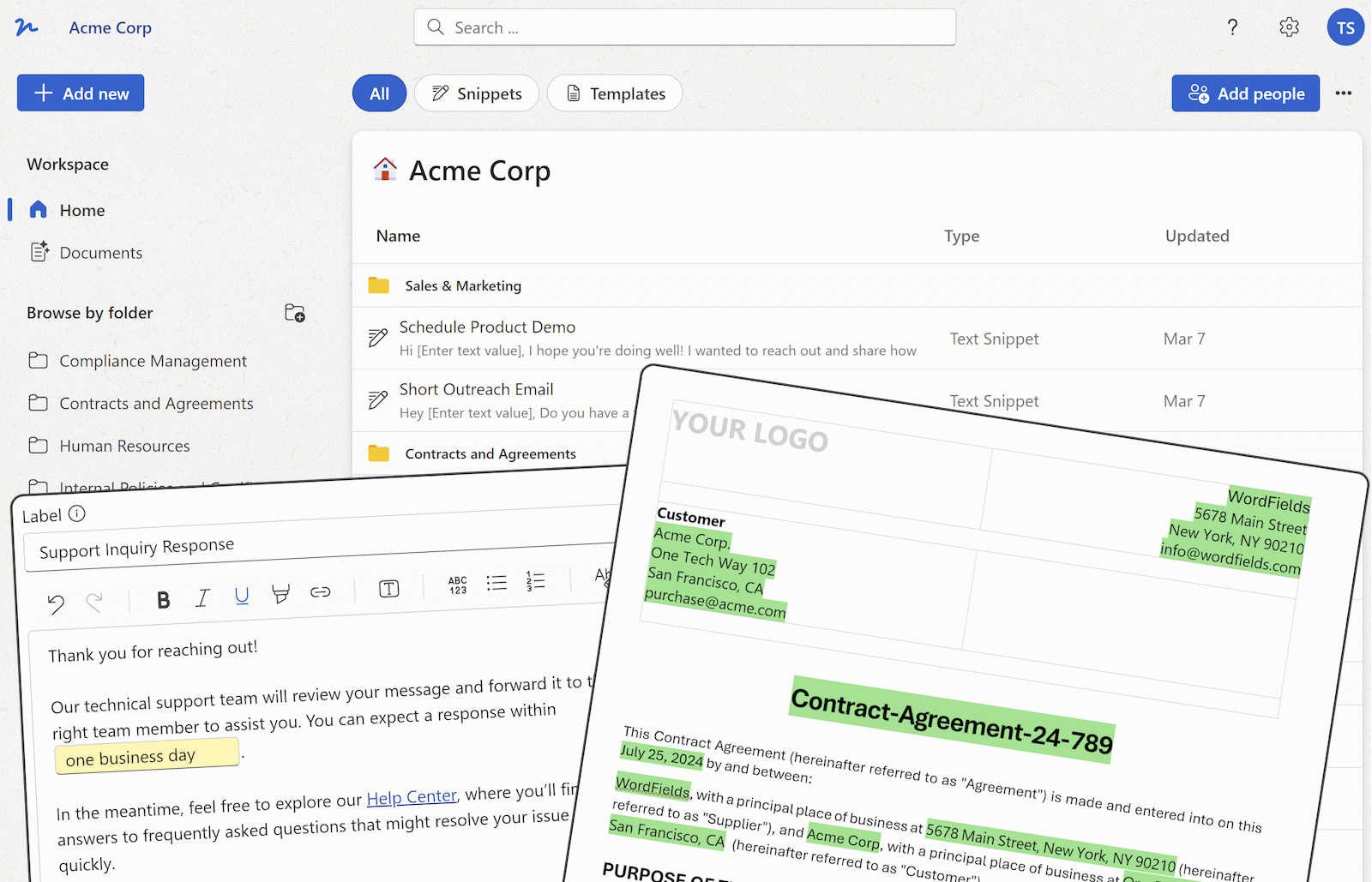
Use WordFields to generate a correctly named performance review document for each employee in seconds. Employee name, job title, department, review period, and manager details all auto-populate from the form — so every review goes out on the same approved, consistently formatted template.
What's included
Both templates auto-populate the following fields when used in WordFields:
- Employee full name, job title, and department
- Review period start and end dates
- Manager full name and job title
- Date of review
- Company name (pulled from your workspace automatically)
The annual template additionally includes a previous review date field. All competency ratings, goal outcomes, and comment sections are completed manually by the reviewing manager after the document is generated.
Annual vs mid-year — which to use
The annual review is a comprehensive assessment of the full year. It covers six core competencies plus an optional role-specific competency, a review of goals set in the previous period, an overall rating, new goals for the next year, and development needs. It is the primary document used to inform salary reviews, promotions, and development plans.
The mid-year review is a lighter checkpoint at the six-month mark. It does not re-assess competencies from scratch — it focuses on whether goals set at the annual review are on track and whether anything needs to be adjusted before year end. It is shorter by design and should take no more than 30 minutes to complete.
Run both in sequence: generate the annual review in January or whenever your review cycle begins, and the mid-year review at the halfway point. The goals set in Part 4 of the annual review feed directly into Part 1 of the mid-year review — both documents use the same field names so the connection is clear.
Frequently asked questions
What should a performance review template include?
A well-structured performance review template should include: employee and reviewer details, the review period, a competency assessment section with ratings and space for comments, a review of goals set in the previous period, new goals for the next period, an overall rating, a section for the employee's own comments, and signature lines for both parties. The annual template covers all of these in full. The mid-year template focuses on goal progress and is shorter by design.
What is the difference between an annual and a mid-year performance review?
An annual review is a comprehensive assessment of the full year — it covers competencies, goal achievement, overall performance, and sets the agenda for promotions, salary adjustments, and development plans. A mid-year review is a lighter checkpoint at the six-month mark, focused on progress against the goals set in the annual review and whether anything needs to be adjusted before year end. Both templates are on this page.
What do the ratings Exceeds Expectations, Meets Expectations, and Needs Improvement mean?
Exceeds Expectations means the employee consistently performs above the requirements of their role. Meets Expectations means they perform fully and reliably within the expectations of their role. Needs Improvement means there are specific areas where performance is not meeting the requirements of the role and action is needed. These three labels are deliberately broad so managers can apply them consistently across departments and seniority levels without needing to calibrate a numeric scale.
Who should conduct a performance review?
The employee's direct manager conducts the review in most organisations, as they have the closest visibility of day-to-day performance. HR typically owns the process — setting the schedule, distributing templates, ensuring consistency, and storing completed reviews. For senior roles, the skip-level manager or department head may also be involved. The completed review should always be signed by both the reviewing manager and the employee, regardless of whether the employee agrees with the assessment.
Can I use the same performance review template for every employee?
The structure and competency framework should be consistent across the organisation — this is what ensures fairness and comparability. In WordFields, the header fields (employee name, job title, department, review period, manager name) auto-populate each time, so you generate a correctly named, personalised document for every employee without editing the template itself. Role-specific competencies can be added as an optional section at the bottom of the template.
Is a signed performance review legally binding?
A signed performance review is not a contract, but it is an important legal document. It provides a documented record of performance discussions, agreed goals, and any concerns raised — which can be relevant in disciplinary proceedings, redundancy decisions, or employment tribunal cases. Employees should be asked to sign to acknowledge they have read and discussed the review, not necessarily that they agree with it. If an employee disagrees, their comments section gives them a formal space to record their perspective.
Related human resources templates
Explore more professional document and email templates you can copy, customize, and use immediately