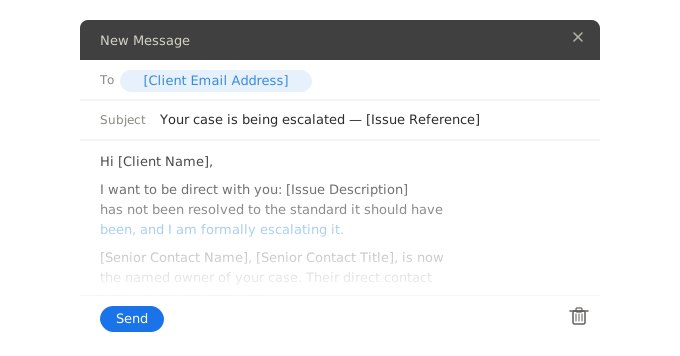
Two professional service disruption email templates for B2B support teams. Notify clients of unplanned outages and planned maintenance windows with clear impact statements, restoration timelines, and named accountability.
Hi [Client name],
I'm writing to let you know that [Service or system name] is currently experiencing a disruption. [One sentence on client-facing impact]
This began at approximately [Time and date disruption began]. [One sentence on cause, or: We are currently investigating the cause] Our team is working on restoration now.
I will update you by [Next update time — e.g. 3pm today] with either a resolution confirmation or a revised timeline. If the situation is urgent on your end before then, contact me directly at [VALUE("Author.EmailAddress")].
I'm sorry for the disruption to your operations.
[VALUE("Author.FullName")]
[VALUE("Organization")]
Hi Client name,
I'm writing to let you know that Service or system name is currently experiencing a disruption. One sentence on client-facing impact
This began at approximately Time and date disruption began. One sentence on cause, or: We are currently investigating the cause Our team is working on restoration now.
I will update you by Next update time — e.g. 3pm today with either a resolution confirmation or a revised timeline. If the situation is urgent on your end before then, contact me directly at =VALUE("Author.EmailAddress").
I'm sorry for the disruption to your operations.
=VALUE("Author.FullName")
=VALUE("Organization")
Hi [Client name],
I want to give you advance notice of scheduled maintenance on [Service or system name].
Maintenance window: [Maintenance date], [Start time] to [End time] ([Timezone — e.g. GMT])
Expected downtime: [Expected downtime duration]
Services affected: [Services that will be unavailable]
Services unaffected: [Services unaffected — remove line if all are affected]
During this window, [Any action the client should take, or remove if not required].
This maintenance is scheduled to [Brief reason for maintenance]. We have chosen this window to minimise disruption to your team.
If this timing creates a significant conflict for your operations, please let me know at [VALUE("Author.EmailAddress")] and I'll see what can be arranged.
[VALUE("Author.FullName")]
[VALUE("Organization")]
Hi Client name,
I want to give you advance notice of scheduled maintenance on Service or system name.
Maintenance window: Maintenance date, Start time to End time (Timezone — e.g. GMT)
Expected downtime: Expected downtime duration
Services affected: Services that will be unavailable
Services unaffected: Services unaffected — remove line if all are affected
During this window, Any action the client should take, or remove if not required.
This maintenance is scheduled to Brief reason for maintenance. We have chosen this window to minimise disruption to your team.
If this timing creates a significant conflict for your operations, please let me know at =VALUE("Author.EmailAddress") and I'll see what can be arranged.
=VALUE("Author.FullName")
=VALUE("Organization")
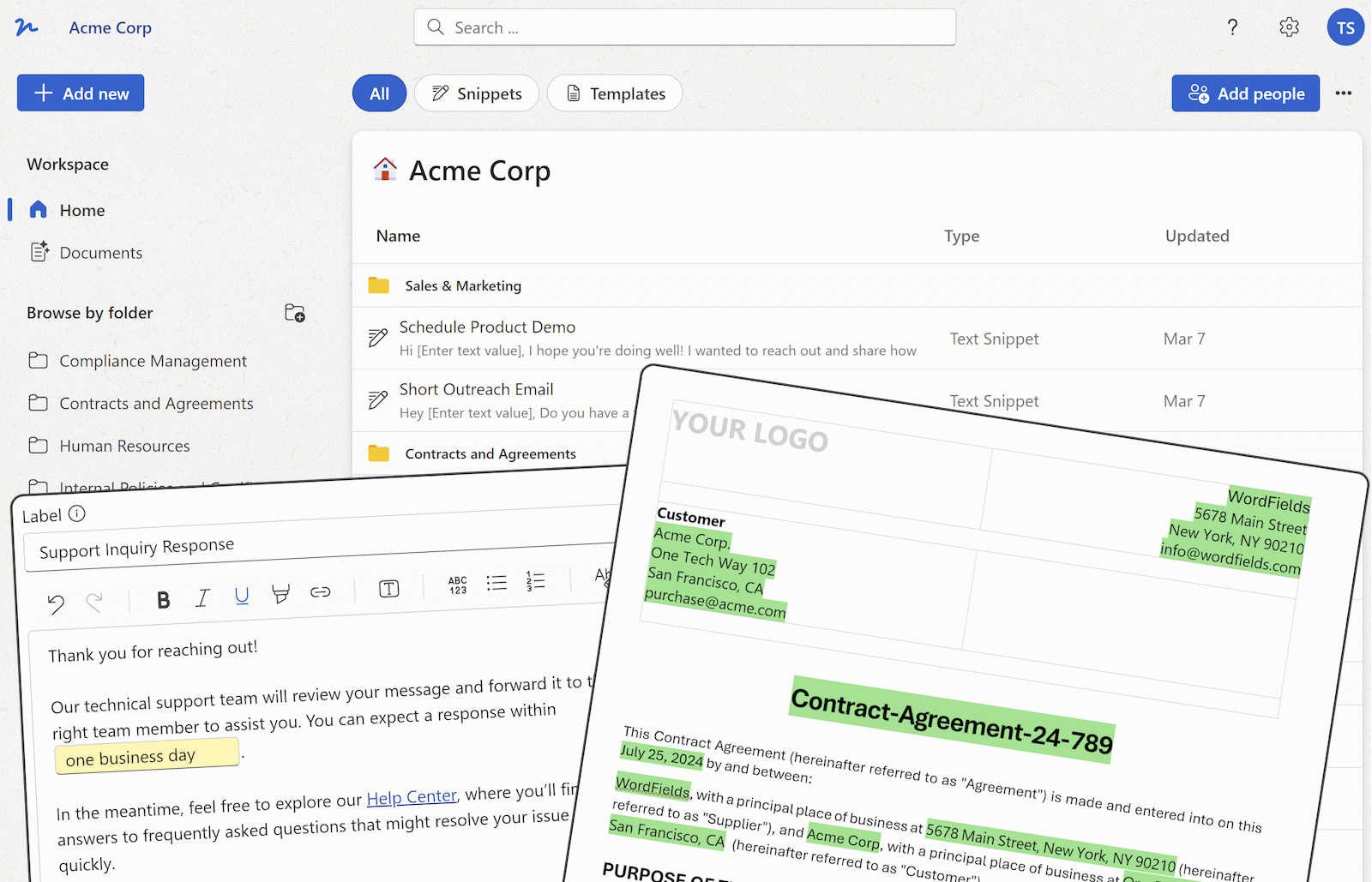
Each snippet auto-populates your name, email address, and organisation name when used in WordFields. Fill in the service and timing-specific fields at the point of use and insert directly into your email client, CRM, or helpdesk via the Chrome extension — without switching tabs.
What's included
Each snippet auto-populates the following fields when used in WordFields:
- Client name, for direct address
- Service or system name and impact description — scoped to what the client experiences, not internal system terminology
- Restoration timeline or next update commitment for unplanned disruptions; maintenance window details for planned ones
- Any required client-side actions during the disruption
- Sender name, email address, and organisation name — pulled automatically from the logged-in user and workspace, with no manual entry required
When to send a service disruption email
The unplanned disruption variant is for immediate notification when a service failure is confirmed. The fundamental rule this template encodes is that notification and resolution are separate communications — do not wait for a resolution timeline before telling the client the service is affected. Every competitor template in the SERP on this topic is written for IT teams communicating with internal users or for SaaS companies communicating with an anonymous subscriber base via a status page. Neither is the B2B context. In a B2B service relationship, the client receiving the notification is a named contact who has a team relying on the service and operational decisions to make — they need to know what is affected and who to call if the situation is urgent, not just that "our team is working on it." The template is structured to deliver those two things in under 100 words while the investigation is still underway. A post-incident summary or customer apology email should follow once the service is restored.
The planned maintenance variant is for advance notice of a scheduled window — sent with enough lead time for the client to adjust their own scheduling, brief their team, and raise any conflicts before the maintenance is locked. The structural element most planned maintenance templates omit is the distinction between affected and unaffected services: clients who know exactly which functions will be unavailable can work around the gap; clients who receive a generic "service will be unavailable" notice assume the worst. The optional line inviting the client to flag a scheduling conflict is also deliberate — in B2B relationships where the client has their own commitments around your service, it signals collaborative planning rather than one-sided notification, and it almost never results in a rescheduling request while building significant goodwill.
Frequently asked questions
What should a service disruption notification email include?
A disruption notification should state clearly what is affected and how — in terms of client impact, not internal system terminology. It should give the current status and a realistic restoration timeline or, if one is not yet known, commit to a specific time for the next update. It should name a direct contact for urgent queries and confirm what clients should or should not do during the disruption. Vague subject lines and passive constructions ('it has come to our attention that...') are the two fastest ways to lose client confidence in a notification that is already delivering bad news.
How quickly should you notify clients of a service disruption?
As soon as the disruption is confirmed and you can state what is affected, even if the cause and restoration timeline are not yet known. Waiting until you have a full picture before notifying clients consistently produces worse outcomes than notifying immediately with partial information and following up. Clients who discover a disruption before being notified lose confidence in the relationship; clients who are told proactively, even without a resolution timeline, are more likely to remain patient.
How far in advance should you send a planned maintenance notification?
For routine maintenance with limited client impact, 48 to 72 hours is the standard minimum. For maintenance that will affect core services for an extended window, five to ten business days gives clients adequate time to adjust their own scheduling and brief their teams. The window you choose should reflect the operational impact on the client — a two-hour maintenance window on a Monday morning during business hours warrants more notice than the same window at 2am on a Sunday.
What is the difference between an outage notification and a service disruption notification?
In practice the terms are used interchangeably, but a useful distinction is scope: an outage implies total unavailability of a service, while a disruption covers a broader range including degraded performance, partial unavailability, or intermittent failures that do not fully prevent use. In client-facing communications, 'disruption' is often the more accurate and less alarming term for partial failures, and it avoids overstating the situation when the client may still be able to access some functionality.
Should a disruption notification include the technical cause of the failure?
Brief factual cause if known — one sentence, in plain language. The purpose of naming the cause is to signal that the problem is understood and being addressed, not to provide a technical post-mortem. If the cause is not yet confirmed, say so directly rather than speculating. 'We are investigating the cause' is more credible than a tentative explanation that may later prove incorrect, which requires a correction on top of the original disruption.
How do you communicate when a restoration timeline extends beyond the original estimate?
Send an update as soon as the extension is confirmed — do not wait until the original timeline has already passed. State the revised timeline clearly, explain briefly why the original estimate was not met (without making excuses), and confirm what is being done. Clients who experience a missed restoration timeline on top of a disruption need acknowledgement of the compounded impact, not just a new estimate. This is the scenario where a service escalation email to a named senior contact may also be appropriate.
What should you send after the service has been restored?
A brief restoration confirmation that names the time service was restored, confirms what is now operational, includes any client-side actions needed (e.g. clearing a cache, re-authenticating), and offers a direct contact for any residual issues. For significant disruptions, a post-incident summary sent within 24 to 48 hours — covering cause, duration, resolution, and steps taken to prevent recurrence — reinforces accountability and completes the communication arc professionally.
How do you keep disruption notifications consistent across a support team?
Store approved disruption notification templates in a shared workspace accessible to all team members. Use fillable fields for the variable details — affected service, impact description, restoration timeline, next update time — so agents and managers can send a complete notification under time pressure without omitting critical information. The two most common failures in ad-hoc disruption communications are a vague impact description and a missing next-update commitment. A template with required fields eliminates both.
Related customer service email templates
Explore more professional document and email templates you can copy, customize, and use immediately