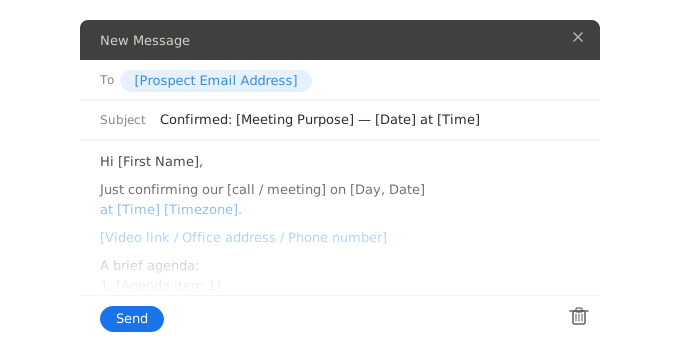
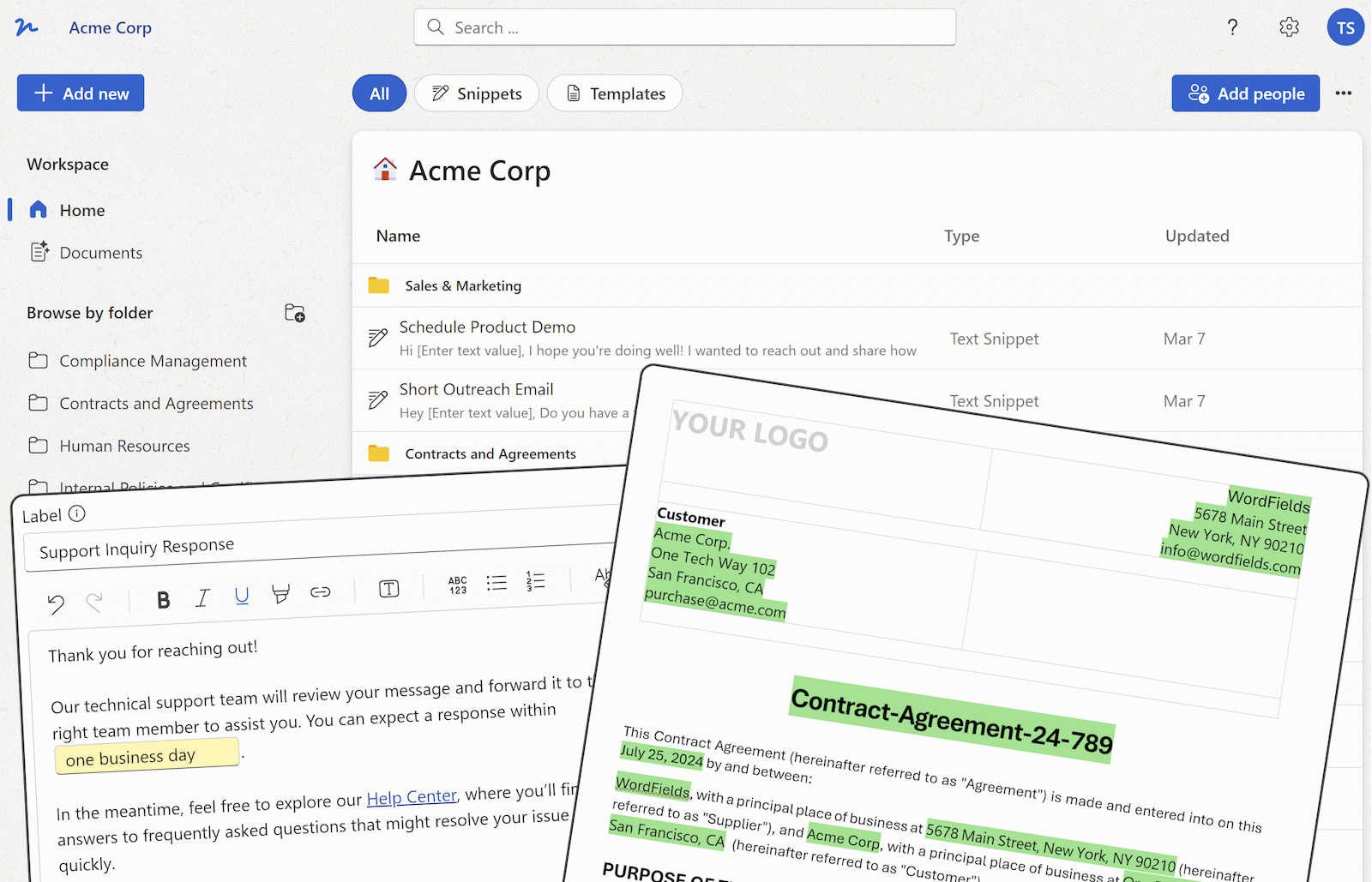
Free sales follow-up email templates for after a proposal, after a meeting, and after no response. Fill in the fields and insert directly into Gmail, Outlook, or your CRM with the WordFields Chrome extension.
Hi [Prospect first name],
I wanted to follow up on the proposal [Proposal reference or title] I sent on [Proposal send date]. I know these decisions take time, so I just wanted to make sure you had everything you needed and to offer to answer any questions before you make a decision.
If it would help to talk through anything — scope, pricing, timeline — I'm happy to jump on a call at your convenience. Here are a couple of times that work for me: [Your availability — e.g. Monday 2–4pm or Tuesday morning].
If the timing isn't right at the moment, just let me know and we can pick this up when it suits you better.
[VALUE("Author.FullName")]
[VALUE("Organization")]
[VALUE("Author.EmailAddress")]
Hi Prospect first name,
I wanted to follow up on the proposal Proposal reference or title I sent on Proposal send date. I know these decisions take time, so I just wanted to make sure you had everything you needed and to offer to answer any questions before you make a decision.
If it would help to talk through anything — scope, pricing, timeline — I'm happy to jump on a call at your convenience. Here are a couple of times that work for me: Your availability — e.g. Monday 2–4pm or Tuesday morning.
If the timing isn't right at the moment, just let me know and we can pick this up when it suits you better.
=VALUE("Author.FullName")
=VALUE("Organization")
=VALUE("Author.EmailAddress")
Hi [Prospect first name],
Thanks for taking the time to meet on [Meeting date]. It was good to learn more about [Specific challenge or topic discussed] and I hope the conversation was useful from your end too.
To recap what we covered: [One or two sentence summary of the key points discussed].
The next steps we agreed on: [Next step 1], [Next step 2].
I'll [Your committed action — e.g. send over the revised proposal / share the case study we mentioned] by [Deadline for your committed action]. In the meantime, if anything comes up, feel free to reach out directly.
[VALUE("Author.FullName")]
[VALUE("Organization")]
[VALUE("Author.EmailAddress")]
Hi Prospect first name,
Thanks for taking the time to meet on Meeting date. It was good to learn more about Specific challenge or topic discussed and I hope the conversation was useful from your end too.
To recap what we covered: One or two sentence summary of the key points discussed.
The next steps we agreed on: Next step 1, Next step 2.
I'll Your committed action — e.g. send over the revised proposal / share the case study we mentioned by Deadline for your committed action. In the meantime, if anything comes up, feel free to reach out directly.
=VALUE("Author.FullName")
=VALUE("Organization")
=VALUE("Author.EmailAddress")
Hi [Prospect first name],
I've tried reaching out a couple of times and haven't heard back, so I'll keep this brief.
If [Specific pain point or goal discussed] is still something you're working on, I'd love to help — just reply and we can pick up the conversation. If the timing isn't right or priorities have shifted, no problem at all — just let me know and I'll stop following up.
Either way, I appreciate you taking the time earlier.
[VALUE("Author.FullName")]
[VALUE("Organization")]
[VALUE("Author.EmailAddress")]
Hi Prospect first name,
I've tried reaching out a couple of times and haven't heard back, so I'll keep this brief.
If Specific pain point or goal discussed is still something you're working on, I'd love to help — just reply and we can pick up the conversation. If the timing isn't right or priorities have shifted, no problem at all — just let me know and I'll stop following up.
Either way, I appreciate you taking the time earlier.
=VALUE("Author.FullName")
=VALUE("Organization")
=VALUE("Author.EmailAddress")
Use WordFields to fill in and insert any of these directly into Gmail, Outlook, or your CRM — no tab-switching, no copy-pasting. Merge tags like [My:FullName] and [Organization:Name] fill in automatically every time.
What's included
Each snippet auto-populates the following fields when used in WordFields:
- Prospect first name
- Proposal reference and proposal date (after proposal variant)
- Meeting date and summary of discussion (after meeting variant)
- Original subject line (after no response variant)
- Next steps and committed actions
- Sender availability for a call
- Sender name, email, and organisation name (pulled from the logged-in user and workspace automatically)
When to use each follow-up template
The after-proposal email is not a re-pitch. By the time you send it, the prospect has already read your proposal — or they have not, in which case re-sending the proposal link is the most useful thing you can do. The goal of this email is to surface friction: questions about scope, concerns about price, internal approval steps they have not mentioned. Keep it short, reference the proposal specifically, and ask one clear question or offer one clear next action. If you write more than three short paragraphs, you are writing the wrong email.
The after-meeting email is about confirmation, not persuasion. Send it within 24 hours while both parties still have the same conversation in mind. A good meeting follow-up does two things: it confirms what was discussed so there is no ambiguity about what was agreed, and it states the next steps clearly so the deal does not stall between meetings. If you promised to send something — a revised proposal, a case study, a reference contact — mention it here and follow through on the timeline you give.
The after-no-response email is the hardest to write well because most people write it too long or too apologetically. A Boomerang study of 40 million emails found that messages between 50 and 125 words achieve the highest response rates — three to four sentences is the right ceiling. Give the prospect an explicit and frictionless way to say no: "if priorities have shifted, just let me know and I'll stop following up." A prospect who can decline cleanly is far more likely to respond than one who feels pressured. And a clean no is more useful than silence — it frees your time and keeps the relationship intact for when timing is better.
Frequently asked questions
When should you send a follow-up email after a proposal?
Send it two to three business days after the proposal. Any sooner feels impatient; any later and the momentum from your conversation starts to fade. The goal of this email is not to re-sell — it is to surface questions the prospect may have and confirm you are available to talk. Keep it short, reference the proposal specifically, and make it easy to reply.
How many follow-up emails should you send before giving up?
Research consistently shows that 80% of sales require at least five touchpoints, yet most salespeople stop after one or two. For a warm prospect who has received a proposal or had a meeting, a sequence of three to four follow-ups spaced a few days apart is reasonable before stepping back. The final email in the sequence should be a low-pressure close — acknowledge that timing may not be right and leave the door open clearly. Do not simply stop without sending a closing message.
What should a follow-up email after a meeting include?
A meeting follow-up should include a brief thank-you, a one or two sentence summary of what was discussed, any next steps that were agreed, and a clear CTA — usually a proposed time for the next conversation or a specific action you are asking the prospect to take. Send it within 24 hours while the meeting is still fresh for both parties. Do not make it long. The purpose is to confirm shared understanding and keep the deal moving.
How do you follow up without being annoying?
Add value or context in each follow-up rather than simply restating that you are checking in. Reference something specific — the proposal, a point raised in the meeting, a relevant deadline. Keep the email short. Give the prospect an easy way to respond, including an easy way to say not yet or not interested — a prospect who can decline cleanly is more likely to respond than one who feels trapped. Avoid phrases like 'just touching base' or 'circling back' — they signal that you have nothing new to say.
Should a follow-up email be sent as a reply or a new email?
As a reply to the original thread, almost always. Replying keeps the context visible — the prospect can scroll up and see the proposal, the previous email, or the meeting confirmation without having to search their inbox. A new email works only when the previous thread is very old or when you are deliberately re-opening contact after a long gap and want to avoid highlighting how much time has passed.
Related sales templates
Explore more professional document and email templates you can copy, customize, and use immediately