A professional internal memo template for operations and admin teams — structured with the standard TO / FROM / DATE / SUBJECT header, clear body sections, and a defined action or decision block. Download as a Word file and use immediately.
Memorandum
| To | [Recipient name, team, or department] |
| From | [VALUE("Author.FullName")], [Your job title] |
| Date | [Memo date] |
| Subject | [Concise subject — e.g. Updated expense approval process / Q2 procurement review outcomes] |
Purpose
[State the purpose in one sentence — e.g. This memo outlines changes to the expense approval process effective [date]]
Background
[One to three paragraphs providing necessary context — what prompted this communication]
Detail
[The main body of the memo — use paragraphs, numbered lists, or bullet points as appropriate]
Action Required
[State clearly what recipients must do, in what order, and by when. If informational only, state no action required.]
- [Action 1 — what, who, by when]
- [Action 2 — what, who, by when]
- [Action 3 if applicable]
Deadline: [Action deadline]
Contact
Direct any questions to [Contact name] at [Contact email or phone].
[VALUE("Author.FullName")]
[Your job title]
[VALUE("Organization")]
| To | Recipient name, team, or department |
| From | =VALUE("Author.FullName"), Your job title |
| Date | Memo date |
| Subject | Concise subject — e.g. Updated expense approval process / Q2 procurement review outcomes |
State the purpose in one sentence — e.g. This memo outlines changes to the expense approval process effective [date]
One to three paragraphs providing necessary context — what prompted this communication
The main body of the memo — use paragraphs, numbered lists, or bullet points as appropriate
State clearly what recipients must do, in what order, and by when. If informational only, state no action required.
- Action 1 — what, who, by when
- Action 2 — what, who, by when
- Action 3 if applicable
Deadline: Action deadline
Direct any questions to Contact name at Contact email or phone.
=VALUE("Author.FullName")
Your job title
=VALUE("Organization")
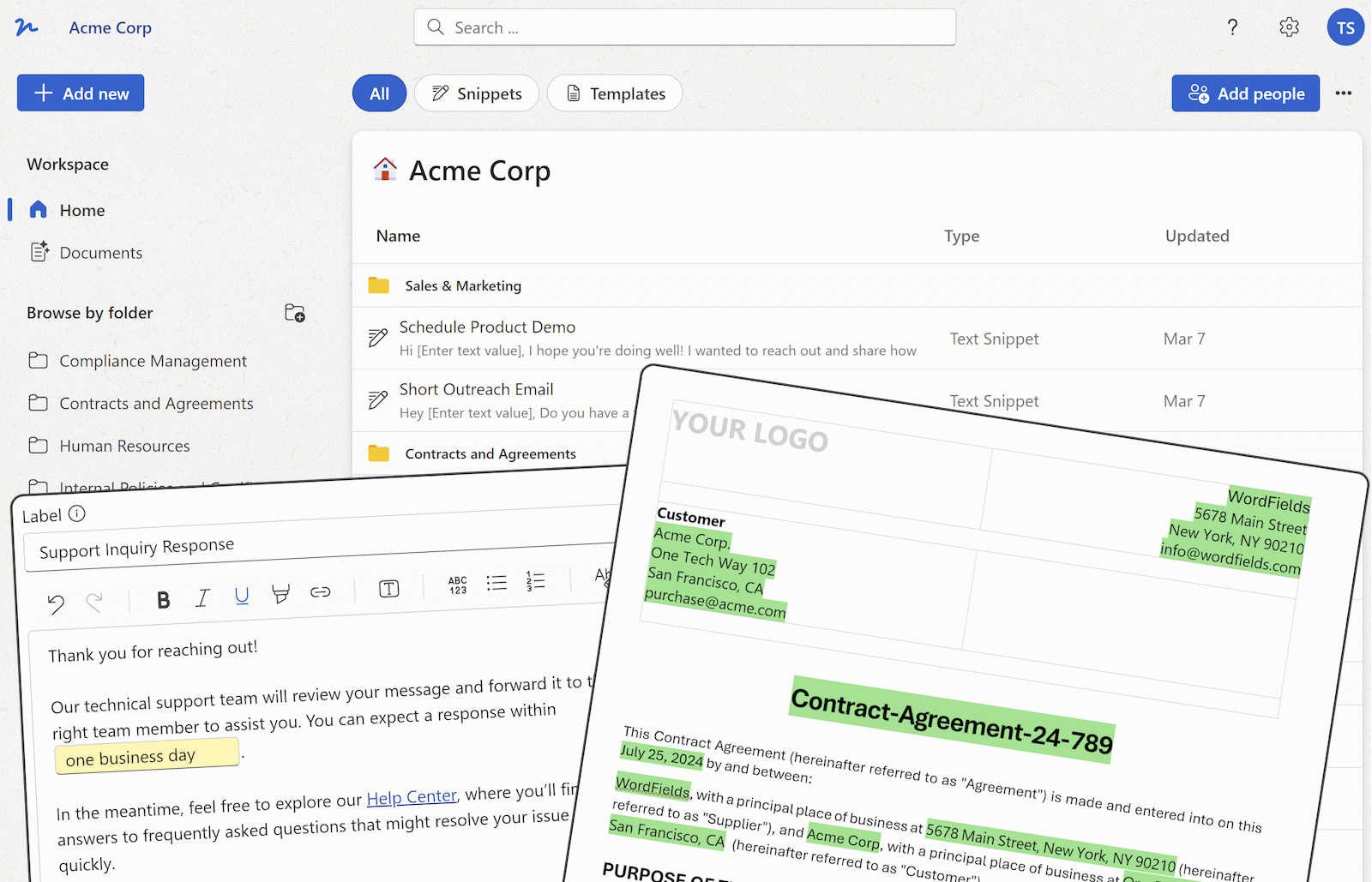
Download as a Word document and generate a completed memo using the WordFields form — recipient, sender, date, subject, and body sections all fill in from a single form without editing the source file.
What's included
Each memo auto-populates the following fields when used in WordFields:
- Recipient name or team and sender name with job title
- Date and specific subject line
- Purpose statement and background context
- Main body detail with support for numbered lists and sub-headings
- Numbered action items with individual deadlines
- Contact name and details for follow-up questions
- Organisation name (pulled from workspace settings automatically)
When to write an internal memo
Use this memo template any time a communication needs to carry formal internal standing rather than the informal weight of an email. The practical test is simple: if the communication might be referenced in an audit, cited in a performance review, attached to a compliance record, or used as evidence that a decision was communicated on a specific date, it should be a memo. Operations managers announcing procedural changes, procurement leads documenting formal decisions from supplier reviews, and admin teams issuing directives on expense or approval processes are the most frequent users.
The structured sections — purpose, background, detail, action — are not decorative. They exist because the most common failure in internal communication is burying the required action in the middle of explanatory text. A memo that leads with purpose and ends with a numbered action list is significantly more likely to produce the response it requires than an email that mixes context and instruction in a single unstructured block. The action section in particular forces the sender to define exactly what they are asking, of whom, and by when — which is the information recipients need to act and the information a manager needs to hold them accountable.
For operations and admin teams working within a quality management system, consistent use of a memo template also supports audit readiness directly. A memo generated from a WordFields template carries a consistent format, an automatic date record, and a named sender — all of which satisfy the documented information requirements under ISO 9001:2015 Clause 7.5 without any additional administrative overhead. Teams managing recurring communications such as quarterly procedural reviews, compliance updates, or formal supplier decisions can store pre-configured versions of this template in WordFields with standing fields already populated, reducing the time to issue a formal memo from an hour to minutes.
Frequently asked questions
What should an internal memo include?
An internal memo should include a standard header block with TO, FROM, DATE, and SUBJECT fields, followed by a brief opening statement of purpose, the main body with relevant detail and context, and a clear closing with any required actions and deadlines. Unlike a business letter, a memo does not include a salutation, a complimentary close, or a signature. It is a document of record — concise, structured, and focused on a single subject.
What is the correct format for a business memo?
A standard business memo is single-spaced and left-justified, with no paragraph indentation. Paragraphs are separated by a blank line. The header block sits at the top and contains TO, FROM, DATE, and SUBJECT in that order. The body follows directly below, typically in three sections: purpose (one paragraph stating why the memo is being sent), detail (the main information, context, or data), and action (what recipients are required to do and by when). The memo should be no longer than one page in most cases.
What is the difference between a memo and an email?
A memo is a formal internal document that carries official standing within an organisation — it creates a written record that can be filed, referenced in audits, and used as evidence of communication. An email is a conversational medium suitable for day-to-day correspondence. Use a memo when the communication is formal, policy-related, or needs to be documented as an official record. Use an email for routine updates, quick questions, and informal communication. Many organisations distribute memos as PDF attachments to email rather than as printed documents.
When should you use a memo instead of an email?
Use a memo when the communication needs to serve as an official record — policy announcements, procedural directives, formal decisions, compliance notices, disciplinary documentation, and significant operational changes. Memos are also appropriate when communicating to a large group across departments where a consistent, formally structured message is required. If the communication might be referenced in an audit, a legal proceeding, or a performance review, it should be a memo rather than an email.
Does an internal memo need a signature?
A memo does not require a formal signature in the way a business letter does. However, it is standard practice for the sender to initial or sign next to their name in the FROM line as a form of authentication — confirming they have reviewed and authorised the content. For memos with significant legal, financial, or compliance implications, a countersignature from a senior authoriser is advisable and in some organisations is required before distribution.
How long should a business memo be?
A memo should be no longer than one page in most cases. The purpose of a memo is to communicate a specific point efficiently — if the subject requires more than one page to explain, consider whether a report or a full briefing document is more appropriate, with a summary memo accompanying it. If a longer memo is unavoidable, use clear section headings and bullet points to aid navigation, and lead with a one-paragraph summary so recipients can understand the key point without reading the full document.
What is a memo used for in operations?
In operations, memos are commonly used to announce procedural changes, document formal decisions, notify teams of compliance requirements, record the outcome of operational reviews, issue directives on process standards, and communicate formally with internal stakeholders across departments. They provide a traceable record of when information was communicated, to whom, and by whom — which is essential for quality management, audit trails, and ISO compliance programmes.
Can I use a memo template in Word?
Yes. A Word memo template is the most practical format because it preserves the header structure, font hierarchy, and layout across different computers and printers. WordFields lets you upload a Word memo template and add fillable fields for the variable elements — recipient name, date, subject, and body content — so any team member can generate a correctly formatted memo in seconds without editing the source file directly. Generated memos can be downloaded as Word files or saved to OneDrive.
Related operations email templates
Explore more professional document and email templates you can copy, customize, and use immediately