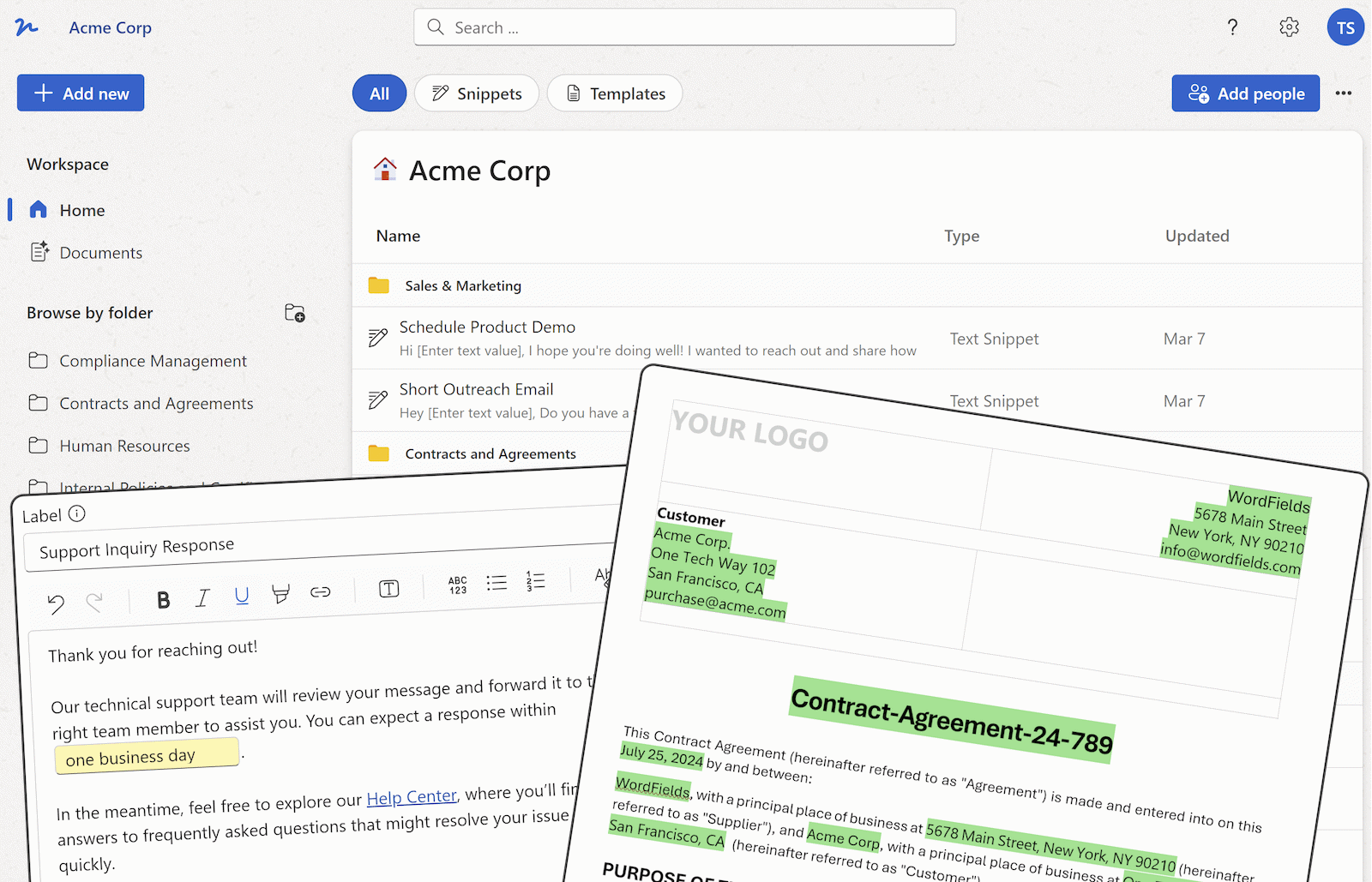
Letter of intent templates for business partnerships and acquisitions. Outline preliminary terms, signal serious intent, and keep every LOI your team issues in one shared workspace.
Letter of Intent
[Date]
[Recipient name]
[Recipient job title]
[Recipient organisation]
[Recipient address]
Dear [[Recipient Name]],
Re: Letter of intent — [The proposed arrangement — e.g. supply of packaging materials]
[VALUE("Organization")] (the "Company") is pleased to submit this letter of intent (the "LOI") to [[Recipient Organisation]] (the "Counterparty") in connection with the proposed arrangement described below. It sets out the basis on which the Company intends to proceed and confirms our mutual interest in formalising the relationship in a definitive agreement.
Purpose
The Company proposes to [e.g. engage the Counterparty as its sole supplier of packaging materials for the UK market].
Proposed terms
The Company's current understanding of the key terms is as follows.
Scope. [What each party will do or supply]
Fees. [Pricing, fees or payment terms as currently envisaged]
Term. The arrangement would commence on [Proposed start date] and continue for an initial period of [Initial term in months — e.g. 12] months, subject to the terms of the definitive agreement.
Exclusivity
In consideration of the time and resources each party will invest in progressing toward a definitive agreement, the Counterparty agrees not to enter into discussions with third parties about the subject matter of this LOI for [Exclusivity period in days — e.g. 30] days from the date of this letter (the "Exclusivity Period"), unless this LOI is terminated or both parties agree otherwise in writing.
Next steps
Following acceptance of this LOI, the parties will work in good faith to:
- share any information reasonably required to verify the basis for the proposed terms;
- negotiate and sign a definitive agreement within [Days to sign the definitive agreement — e.g. 60] days of the date of this letter; and
- complete any regulatory, internal approval or other steps required to proceed.
Confidentiality
Each party will keep the existence and terms of this LOI, and all information exchanged in connection with it, confidential, and will not disclose them to any third party without the other party's prior written consent, except as required by law.
Non-binding nature
This LOI records the parties' current intentions and is not a legally binding agreement, except that the Exclusivity, Confidentiality and Governing law sections are binding on both parties from the date it is countersigned. The terms set out above are subject to the negotiation and signature of a definitive agreement, and neither party is obliged to proceed if one is not reached.
Expiry
This LOI expires on [Date by which it must be accepted] if the Counterparty has not accepted it by then.
Governing law
This LOI is governed by the laws of [Jurisdiction — e.g. England and Wales].
We look forward to working with [[Recipient Organisation]] and hope this letter reflects the spirit of our discussions. Please confirm your acceptance by signing and returning a copy.
Yours sincerely,
| [VALUE("Author.FullName")] | |
| [Your job title] | |
| [VALUE("Organization")] | |
| [VALUE("Author.EmailAddress")] |
Accepted and agreed on behalf of [[Recipient Organisation]]:
| Signature: ___________________________ | Date: ________________________________ |
| Name: [Signatory name] | Title: [Signatory job title] |
Date
Recipient name
Recipient job title
Recipient organisation
Recipient address
Dear =[Recipient Name],
Re: Letter of intent — The proposed arrangement — e.g. supply of packaging materials
Organization (the "Company") is pleased to submit this letter of intent (the "LOI") to =[Recipient Organisation] (the "Counterparty") in connection with the proposed arrangement described below. It sets out the basis on which the Company intends to proceed and confirms our mutual interest in formalising the relationship in a definitive agreement.
The Company proposes to e.g. engage the Counterparty as its sole supplier of packaging materials for the UK market.
The Company's current understanding of the key terms is as follows.
Scope. What each party will do or supply
Fees. Pricing, fees or payment terms as currently envisaged
Term. The arrangement would commence on Proposed start date and continue for an initial period of Initial term in months — e.g. 12 months, subject to the terms of the definitive agreement.
In consideration of the time and resources each party will invest in progressing toward a definitive agreement, the Counterparty agrees not to enter into discussions with third parties about the subject matter of this LOI for Exclusivity period in days — e.g. 30 days from the date of this letter (the "Exclusivity Period"), unless this LOI is terminated or both parties agree otherwise in writing.
Following acceptance of this LOI, the parties will work in good faith to:
- share any information reasonably required to verify the basis for the proposed terms;
- negotiate and sign a definitive agreement within Days to sign the definitive agreement — e.g. 60 days of the date of this letter; and
- complete any regulatory, internal approval or other steps required to proceed.
Each party will keep the existence and terms of this LOI, and all information exchanged in connection with it, confidential, and will not disclose them to any third party without the other party's prior written consent, except as required by law.
This LOI records the parties' current intentions and is not a legally binding agreement, except that the Exclusivity, Confidentiality and Governing law sections are binding on both parties from the date it is countersigned. The terms set out above are subject to the negotiation and signature of a definitive agreement, and neither party is obliged to proceed if one is not reached.
This LOI expires on Date by which it must be accepted if the Counterparty has not accepted it by then.
This LOI is governed by the laws of Jurisdiction — e.g. England and Wales.
We look forward to working with =[Recipient Organisation] and hope this letter reflects the spirit of our discussions. Please confirm your acceptance by signing and returning a copy.
Yours sincerely,
| Author | |
| Your job title | |
| Organization | |
| Author.EmailAddress |
Accepted and agreed on behalf of =[Recipient Organisation]:
| Signature: ___________________________ | Date: ________________________________ |
| Name: Signatory name | Title: Signatory job title |
Letter of Intent — Proposed Acquisition
Strictly confidential
[Date]
[Seller contact name]
[Seller contact job title]
[Seller entity — the company or person that owns the business]
[Seller address]
Dear [[Seller Name]],
Re: Proposed acquisition of [Business being acquired]
[VALUE("Organization")] (the "Buyer") is pleased to submit this letter of intent (the "LOI") in connection with its proposed acquisition of [[Target Business Name]] (the "Business") from [[Seller Organisation]] (the "Seller") (the "Transaction"). This LOI reflects the Buyer's serious interest in proceeding and sets out the principal terms on which it intends to do so. It is non-binding in its commercial terms, except for the sections expressly identified as binding below.
Parties
The Buyer is [VALUE("Organization")], a [e.g. private limited company] with its principal place of business at [Buyer address]. The Seller is [[Seller Organisation]] of [[Seller Address]].
Proposed Transaction
Structure
The Buyer proposes to acquire [] [[Target Business Name]].
Purchase price
The Buyer proposes a total consideration of [Currency and amount — e.g. EUR 2,500,000] (the "Purchase Price"), subject to adjustment as described below and to the findings of due diligence. The Purchase Price is subject to a [] adjustment at closing, under a mechanism to be agreed in the definitive agreement.
Payment
The Purchase Price will be paid as follows:
[One line per element — e.g. 80% in cash at closing; 20% deferred for 12 months, subject to the Business meeting the revenue targets to be agreed]
Assets and liabilities
[What is included and which liabilities the Buyer will or will not assume — e.g. all trading assets, contracts, IP and goodwill; the Buyer assumes no liabilities other than trade creditors in the ordinary course]
Conditions to closing
Completion of the Transaction is subject to:
- satisfactory completion of the Buyer's due diligence;
- signature of a definitive purchase agreement in form and substance acceptable to both parties; and
- receipt of any regulatory, lender, landlord or board approvals required by either party.
Due diligence
Following acceptance of this LOI, the Seller will give the Buyer and its advisers reasonable access to the financial, legal, operational and other records of the Business. The Buyer intends to complete due diligence within [Days — e.g. 45] days of the date of this LOI.
Exclusivity (binding)
In consideration of the time and costs the Buyer will incur in due diligence, the Seller agrees that for [No-shop period in days — e.g. 60] days from the date of this LOI (the "Exclusivity Period") it will not solicit, encourage or enter into discussions or negotiations with any other party about the sale of the Business or any material part of it.
Confidentiality (binding)
The existence and terms of this LOI and all information disclosed in the course of due diligence are strictly confidential to both parties and will not be disclosed to any third party without prior written consent, except as required by law. This section survives termination of this LOI.
Costs
Each party bears its own legal, financial advisory and other costs in connection with the Transaction and this LOI, unless otherwise agreed in the definitive agreement.
Non-binding nature
Apart from the Exclusivity, Confidentiality, Costs and Governing law sections, this LOI is not legally binding and does not commit either party to complete the Transaction. Neither party is obliged to proceed if a definitive agreement is not signed.
Governing law (binding)
This LOI and its binding sections are governed by the laws of [Jurisdiction — e.g. England and Wales].
Expiry
This LOI expires on [Date by which it must be accepted] if the Seller has not accepted it in writing by then.
We look forward to working constructively with you toward completing this Transaction. Please confirm your acceptance by signing and returning a copy of this letter.
Yours sincerely,
| [VALUE("Author.FullName")] | |
| [Your job title] | |
| [VALUE("Organization")] | |
| [VALUE("Author.EmailAddress")] |
Accepted and agreed on behalf of [[Seller Organisation]]:
| Signature: ___________________________ | Date: ________________________________ |
| Name: [Signatory name] | Title: [Signatory job title] |
Strictly confidential
Date
Seller contact name
Seller contact job title
Seller entity — the company or person that owns the business
Seller address
Dear =[Seller Name],
Re: Proposed acquisition of Business being acquired
Organization (the "Buyer") is pleased to submit this letter of intent (the "LOI") in connection with its proposed acquisition of =[Target Business Name] (the "Business") from =[Seller Organisation] (the "Seller") (the "Transaction"). This LOI reflects the Buyer's serious interest in proceeding and sets out the principal terms on which it intends to do so. It is non-binding in its commercial terms, except for the sections expressly identified as binding below.
The Buyer is Organization, a e.g. private limited company with its principal place of business at Buyer address. The Seller is =[Seller Organisation] of =[Seller Address].
The Buyer proposes to acquire Select =[Target Business Name].
The Buyer proposes a total consideration of Currency and amount — e.g. EUR 2,500,000 (the "Purchase Price"), subject to adjustment as described below and to the findings of due diligence. The Purchase Price is subject to a Select adjustment at closing, under a mechanism to be agreed in the definitive agreement.
The Purchase Price will be paid as follows:
One line per element — e.g. 80% in cash at closing; 20% deferred for 12 months, subject to the Business meeting the revenue targets to be agreed
What is included and which liabilities the Buyer will or will not assume — e.g. all trading assets, contracts, IP and goodwill; the Buyer assumes no liabilities other than trade creditors in the ordinary course
Completion of the Transaction is subject to:
- satisfactory completion of the Buyer's due diligence;
- signature of a definitive purchase agreement in form and substance acceptable to both parties; and
- receipt of any regulatory, lender, landlord or board approvals required by either party.
Following acceptance of this LOI, the Seller will give the Buyer and its advisers reasonable access to the financial, legal, operational and other records of the Business. The Buyer intends to complete due diligence within Days — e.g. 45 days of the date of this LOI.
In consideration of the time and costs the Buyer will incur in due diligence, the Seller agrees that for No-shop period in days — e.g. 60 days from the date of this LOI (the "Exclusivity Period") it will not solicit, encourage or enter into discussions or negotiations with any other party about the sale of the Business or any material part of it.
The existence and terms of this LOI and all information disclosed in the course of due diligence are strictly confidential to both parties and will not be disclosed to any third party without prior written consent, except as required by law. This section survives termination of this LOI.
Each party bears its own legal, financial advisory and other costs in connection with the Transaction and this LOI, unless otherwise agreed in the definitive agreement.
Apart from the Exclusivity, Confidentiality, Costs and Governing law sections, this LOI is not legally binding and does not commit either party to complete the Transaction. Neither party is obliged to proceed if a definitive agreement is not signed.
This LOI and its binding sections are governed by the laws of Jurisdiction — e.g. England and Wales.
This LOI expires on Date by which it must be accepted if the Seller has not accepted it in writing by then.
We look forward to working constructively with you toward completing this Transaction. Please confirm your acceptance by signing and returning a copy of this letter.
Yours sincerely,
| Author | |
| Your job title | |
| Organization | |
| Author.EmailAddress |
Accepted and agreed on behalf of =[Seller Organisation]:
| Signature: ___________________________ | Date: ________________________________ |
| Name: Signatory name | Title: Signatory job title |
These templates are a starting point. Have a legal professional review any agreement before signing.
What's included
Each template auto-populates the following fields when used in WordFields:
- Date of the letter and expiry date
- Counterparty or seller names, titles, organisation and address
- Subject and purpose of the arrangement, or the business being acquired
- Scope, fees and term, or the purchase price, its adjustment basis, how it is paid, and the assets and liabilities included
- Exclusivity or no-shop period, and the time allowed for the definitive agreement or due diligence
- Governing law
- Signatory name and title for the acceptance
- Sender name, job title, email, and organisation name (pulled from the logged-in user and workspace automatically)
When to use
Business Partnership / Vendor LOI: Use this template when your organisation wants to formally signal intent to engage a supplier, enter a commercial partnership, or begin a collaboration — before the time and cost of drafting a full contract is justified. The primary function here is alignment: getting both parties on record regarding the shape of the arrangement so that the subsequent contract negotiation starts from a shared reference point rather than from scratch. This is particularly useful in procurement, vendor onboarding, and agency engagement contexts where informal conversations have progressed to a point where both sides are ready to commit to good-faith negotiations. The LOI pairs naturally with a non-disclosure agreement issued at the same time to protect information shared during the discussion phase, and leads naturally into a service agreement once the formal terms are agreed.
Business Acquisition LOI: Use this template when your organisation is the buyer in a business acquisition and has completed enough preliminary assessment to propose a purchase price and deal structure. The acquisition LOI performs a specific operational function: it triggers the formal due diligence phase and — through the no-shop clause in Clause 5 — protects the buyer's position while that process is underway. The no-shop and confidentiality clauses are intentionally drafted as binding even though the commercial terms are not; this is standard market practice and the buyer's main protection during a period when they are investing significant time and cost. The document is structured as a letter from the buyer to the seller, which is the conventional format for acquisition LOIs. For teams that regularly evaluate acquisition targets, storing this template in a shared WordFields workspace ensures every LOI goes out to a consistent standard regardless of who on the team is leading the process.
Frequently asked questions
What is a letter of intent in business?
A letter of intent (LOI) is a document that outlines the preliminary terms of a proposed business arrangement before a formal contract is drafted. It signals that both parties are serious about proceeding and establishes a shared understanding of the key terms under discussion. LOIs are typically non-binding in most respects, though specific provisions such as confidentiality and exclusivity clauses are often made binding from the outset.
Is a letter of intent legally binding?
Most LOIs are intentionally non-binding in their commercial terms — they are a framework for negotiation, not a final agreement. However, specific clauses within an LOI, such as confidentiality obligations, exclusivity or no-shop provisions, and governing law, are commonly drafted as binding from the date of signing. The LOI should explicitly state which provisions are binding and which are not. A legal professional should review the document before it is signed.
What should be included in a letter of intent?
A business LOI should identify the parties, state the purpose and proposed terms of the arrangement, set out any exclusivity or no-shop provisions, include a confidentiality clause, specify a timeline for completing due diligence or finalising the formal agreement, and state clearly which provisions are binding. For an acquisition LOI, the proposed purchase price and deal structure are also essential inclusions.
What is the difference between a letter of intent and a memorandum of understanding?
In practice, the two documents serve similar purposes and are sometimes used interchangeably. An LOI tends to be used in the context of a proposed transaction — a purchase, acquisition, or commercial deal — and is typically structured as a letter from one party to the other. A memorandum of understanding (MOU) is more commonly used for partnerships, joint ventures, or collaborative arrangements, and is usually structured as a mutual agreement between the parties rather than a letter from one party to another.
What is a no-shop clause in a letter of intent?
A no-shop clause (also called an exclusivity provision) is a binding term in an acquisition LOI that prevents the seller from soliciting or entertaining offers from other buyers for a specified period. It gives the buyer time to complete due diligence without the risk of being outbid. No-shop periods typically run from 30 to 90 days. Violating a no-shop clause can expose the seller to damages claims, even if the LOI is otherwise non-binding.
When should a letter of intent be used instead of going straight to a contract?
An LOI is appropriate when the deal involves enough complexity or sensitivity that both parties need to confirm alignment on the key terms before investing time and legal fees in drafting a full contract. For acquisitions, an LOI gates the due diligence process. For partnerships and vendor arrangements, it creates a shared reference point that reduces the scope for disagreement when the formal contract is being negotiated. For straightforward service engagements, proceeding directly to a contract is usually more efficient.
How does WordFields help teams issue letters of intent consistently?
WordFields stores your LOI templates in a shared workspace so the whole team works from one approved version. Open the template, fill in the form — counterparty name, proposed terms, exclusivity period, and deadline — and download a completed Word document in seconds. No reformatting from scratch, no version confusion, and no risk of someone issuing an outdated template.
Related legal & compliance templates
Explore more professional document and email templates you can copy, customize, and use immediately