Three contract renewal email templates for procurement and operations teams — renewing on existing terms, proposing changes at renewal, and an internal renewal reminder. Structured to prompt a decision before the deadline closes.
Hi [Supplier contact name],
I'm writing to initiate the renewal of our [Contract name] (ref: [Contract reference number]), which is due to expire on [Contract expiry date].
We have been satisfied with [Supplier company name]'s performance during the current term and would like to renew on the existing terms for a further [Renewal period — e.g. 12 months / 2 years], effective from [New start date].
Please confirm by [Response deadline] whether you are able to proceed on this basis. If you anticipate any changes to pricing or terms for the renewal period, please share these at the same time so we can review them ahead of the expiry date.
[VALUE("Author.FullName")]
[VALUE("Author.EmailAddress")]
[VALUE("Organization")]
Hi Supplier contact name,
I'm writing to initiate the renewal of our Contract name (ref: Contract reference number), which is due to expire on Contract expiry date.
We have been satisfied with Supplier company name's performance during the current term and would like to renew on the existing terms for a further Renewal period — e.g. 12 months / 2 years, effective from New start date.
Please confirm by Response deadline whether you are able to proceed on this basis. If you anticipate any changes to pricing or terms for the renewal period, please share these at the same time so we can review them ahead of the expiry date.
=VALUE("Author.FullName")
=VALUE("Author.EmailAddress")
=VALUE("Organization")
Hi [Supplier contact name],
Our [Contract name] (ref: [Contract reference number]) is due to expire on [Contract expiry date]. We would like to renew for a further [Proposed renewal period], subject to the following proposed amendments:
- [Amendment 1 — e.g. Pricing: requesting a rate of [amount] for the renewal term]
- [Amendment 2 — e.g. Payment terms: propose moving from Net 30 to Net 45]
- [Amendment 3 — e.g. SLA: request a revised on-time delivery target of 98%]
These proposals reflect [Brief reason — e.g. our current usage levels / market benchmarking / volume commitments]. We are open to discussing these further and would welcome a call if useful.
Please respond by [Response deadline] so we have sufficient time to finalise terms before the expiry date.
[VALUE("Author.FullName")]
[VALUE("Author.EmailAddress")]
[VALUE("Organization")]
Hi Supplier contact name,
Our Contract name (ref: Contract reference number) is due to expire on Contract expiry date. We would like to renew for a further Proposed renewal period, subject to the following proposed amendments:
- Amendment 1 — e.g. Pricing: requesting a rate of [amount] for the renewal term
- Amendment 2 — e.g. Payment terms: propose moving from Net 30 to Net 45
- Amendment 3 — e.g. SLA: request a revised on-time delivery target of 98%
These proposals reflect Brief reason — e.g. our current usage levels / market benchmarking / volume commitments. We are open to discussing these further and would welcome a call if useful.
Please respond by Response deadline so we have sufficient time to finalise terms before the expiry date.
=VALUE("Author.FullName")
=VALUE("Author.EmailAddress")
=VALUE("Organization")
Hi [Stakeholder name],
The [Contract name] with [Supplier company name] (ref: [Contract reference number]) expires on [Contract expiry date]. The notice deadline to avoid auto-renewal is [Notice deadline].
Current contract value: [Annual or total contract value]
Performance summary: [One sentence — e.g. performance has been satisfactory / delivery issues in Q3 / using X% of contracted volume]
Decision needed: []
Please confirm the decision by [Decision deadline] so I can contact the supplier and initiate the appropriate process. If you need a usage review or performance data before deciding, let me know and I will pull this together.
[VALUE("Author.FullName")]
[VALUE("Author.EmailAddress")]
[VALUE("Organization")]
Hi Stakeholder name,
The Contract name with Supplier company name (ref: Contract reference number) expires on Contract expiry date. The notice deadline to avoid auto-renewal is Notice deadline.
Current contract value: Annual or total contract value
Performance summary: One sentence — e.g. performance has been satisfactory / delivery issues in Q3 / using X% of contracted volume
Decision needed: Select
Please confirm the decision by Decision deadline so I can contact the supplier and initiate the appropriate process. If you need a usage review or performance data before deciding, let me know and I will pull this together.
=VALUE("Author.FullName")
=VALUE("Author.EmailAddress")
=VALUE("Organization")
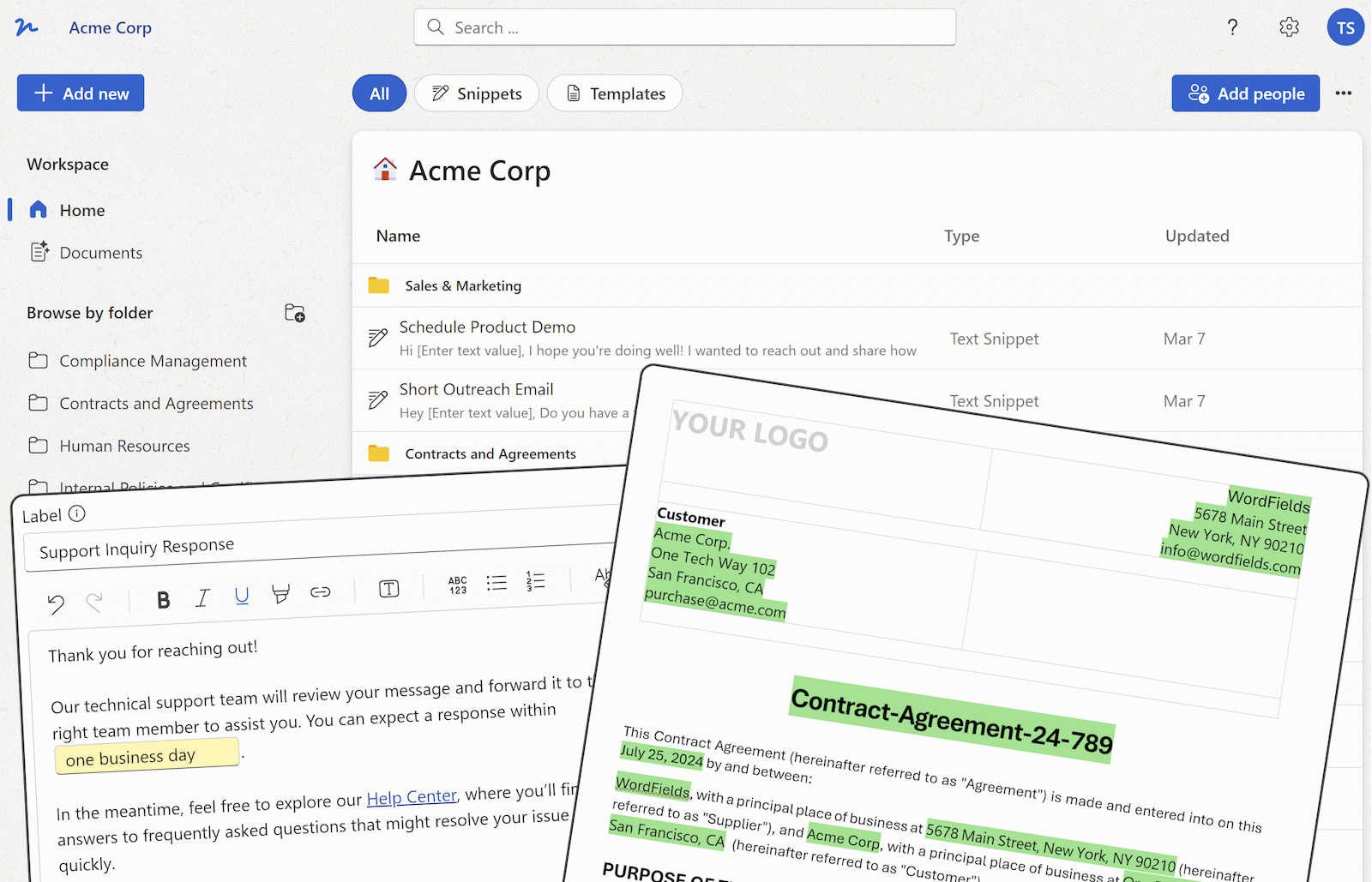
Your name, email address, and organisation name fill in automatically via WordFields merge tags — no manual edits before sending. Use the Chrome extension to insert directly into Gmail, Outlook, or your procurement system without switching tabs.
What's included
Each snippet auto-populates the following fields when used in WordFields:
- Contract name, reference number, and expiry date
- Supplier company name and contact name
- Proposed renewal period and new start date
- Proposed amendments to pricing, payment terms, or SLAs (changes variant)
- Contract value, performance summary, and notice deadline (internal variant)
- Response or decision deadline
- Sender name, email, and organisation name (pulled from the logged-in user and workspace automatically)
When to send a contract renewal email
Use the renewing on existing terms template when you have reviewed the contract, assessed supplier performance, and are satisfied that the current terms remain fit for purpose. Send it at least 60 days before expiry — 90 days for any contract above a material value threshold — so the supplier has time to confirm and so your organisation has a written record that the renewal was initiated deliberately rather than triggered by an auto-renewal clause. Procurement managers and operations leads handling routine annual renewals are the primary users. Storing a version of this template per supplier in WordFields, pre-filled with the contract name and reference, means a renewal email can be sent in minutes from a diary reminder rather than drafted from scratch each time.
Use the renewal with proposed changes template when you intend to renew but want to renegotiate before committing to another term. The numbered amendment list is not a negotiating tactic — it is a clarity mechanism. Suppliers can respond to specific numbered proposals faster than to a general request to "discuss terms," and the list creates a written record of exactly what was proposed and when. Send this template at the 90-day mark at minimum. Renegotiations that start too close to the expiry date put the buyer in a weak position: the supplier knows the deadline is imminent and that disrupting the relationship now carries a high cost. Starting at 90 days restores leverage and gives both parties time to reach an agreement without pressure.
Use the internal renewal reminder template to flag upcoming renewals to the stakeholder who owns the budget or approval decision. This is the most commonly missed step in most organisations' renewal processes — the person managing the contract assumes the decision-maker knows the renewal is coming, and the decision-maker assumes someone else is tracking it. The template's notice deadline field is the critical element: it makes explicit that there is a hard date by which a decision is required, not just a preference for one. Operations and procurement teams managing multiple concurrent supplier contracts should store this template in WordFields and use it as a standard 90-day trigger — sent internally to the relevant budget owner as soon as a renewal window opens.
Frequently asked questions
How far in advance should you send a contract renewal email?
Send the initial renewal email at least 90 days before the contract expiry date for any agreement that may need renegotiation or involves a significant supplier relationship. For straightforward renewals on existing terms, 60 days is the minimum. Sending too close to the expiry date leaves no room to negotiate, review alternatives, or get internal approval — and if the contract has an auto-renewal clause with a 30-day notice period, missing that window locks you into another full term automatically.
What should a contract renewal email include?
A contract renewal email should state the contract name and reference number, the current expiry date, whether you are proposing to renew on the same terms or with changes, any proposed amendments to pricing or terms, a deadline for the supplier's response, and a named contact for questions. Keep the email brief — the detail belongs in an attached renewal agreement or a meeting. The email's purpose is to open the renewal conversation and create a written record that the process was initiated.
What is the difference between a contract renewal and a contract extension?
A contract extension adds time to an existing contract without changing any of its terms — it is typically executed with a short letter or amendment rather than a new contract. A contract renewal starts a new contract period and gives both parties the opportunity to renegotiate terms, pricing, scope, and duration. If you want to change anything about the arrangement, use a renewal. If you only need more time on the existing terms, an extension is simpler and faster.
How do you renegotiate terms in a contract renewal email?
State clearly that you wish to renew but propose specific changes before doing so. Be precise — name the clause or term you want to change, state what you are proposing instead, and give a brief reason. Avoid vague requests like 'we would like better pricing.' Instead, reference your current rate and propose a specific figure or percentage. Suppliers respond to concrete proposals. If you have multiple changes, list them so the supplier can address each one. Send this email at least 60 to 90 days before expiry to leave adequate time for negotiation.
What happens if you miss a contract renewal deadline?
If a contract has an auto-renewal clause, missing the notice deadline typically means the contract renews automatically on the existing terms for another full period — often a year. If the contract does not auto-renew, it may simply lapse, leaving both parties without a formal agreement and potentially disrupting the supply of goods or services. Either outcome is avoidable with a tracking system and a standard renewal communication process. For any contract with a notice period, diarise the notice deadline as well as the expiry date.
Who should send a contract renewal email?
The person with day-to-day ownership of the supplier relationship should send the renewal email — typically a procurement manager, operations lead, or contract manager. For high-value or strategically important contracts, it is good practice for a senior manager to be copied or to co-sign the email. Internal renewal reminders — flagging an upcoming expiry to a finance or legal team — should come from whoever owns the contract management process, with clear ownership of the next action assigned before the email is sent.
Can a contract be renewed automatically without an email?
Yes, if the contract contains an auto-renewal clause — sometimes called an evergreen clause — it will renew automatically on the expiry date unless written notice of cancellation is given within the notice period specified in the contract. This means auto-renewal can happen without any email being sent or received. Always check the renewal terms in every supplier contract and diarise both the notice deadline and the expiry date. A formal renewal email, even for auto-renewing contracts, creates a documented record that you reviewed the terms before renewal — which is essential for audit and compliance purposes.
Should you review supplier performance before renewing a contract?
Yes, every time. Contract renewal is the most effective leverage point in a supplier relationship — once the contract is signed, your ability to negotiate changes is significantly reduced. Before initiating renewal, review on-time delivery rates, quality metrics, responsiveness, and any performance concerns raised during the term. If performance has been strong, reference it in the renewal email to reinforce the relationship. If there have been concerns, address them as part of the renewal negotiation rather than carrying unresolved issues into the next term.
Related operations email templates
Explore more professional document and email templates you can copy, customize, and use immediately