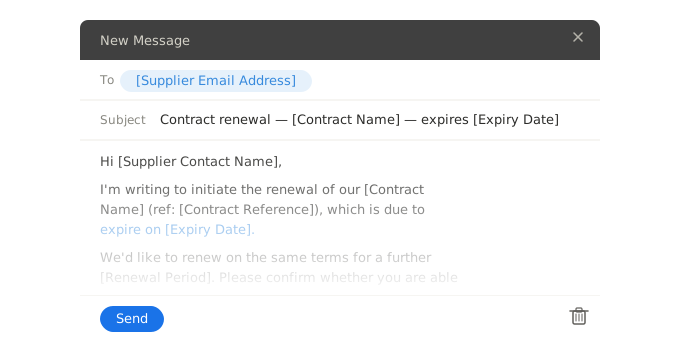
Three approval request email templates for operations and admin teams — budget approval, vendor approval, and policy exception. Structured to give decision-makers everything they need to say yes without a follow-up.
Hi [Approver name],
I'm requesting approval to spend [Amount — e.g. £5,000] on [Budget item or project name]. This falls under [Cost centre or budget line] and needs to be committed by [Decision deadline] to [Reason — e.g. meet the contract deadline / avoid a price increase].
Summary:
- Total amount: [[Amount]]
- Budget line: [Cost centre or budget line]
- Spend breakdown: []
- Expected outcome: [One sentence — e.g. reduces manual processing time by 30%]
- Consequence of delay: [One sentence — e.g. vendor rate increases after [date], project milestone moves]
Supporting documents are attached. Please confirm your approval by [=TEXT([Decision Deadline], "d")] or let me know if you need anything further.
[VALUE("Author.FullName")]
[VALUE("Author.EmailAddress")]
[VALUE("Organization")]
Hi Approver name,
I'm requesting approval to spend Amount — e.g. £5,000 on Budget item or project name. This falls under Cost centre or budget line and needs to be committed by Decision deadline to Reason — e.g. meet the contract deadline / avoid a price increase.
Summary:
- Total amount: =[Amount]
- Budget line: Cost centre or budget line
- Spend breakdown: Select
- Expected outcome: One sentence — e.g. reduces manual processing time by 30%
- Consequence of delay: One sentence — e.g. vendor rate increases after [date], project milestone moves
Supporting documents are attached. Please confirm your approval by =TEXT([Decision Deadline], "d") or let me know if you need anything further.
=VALUE("Author.FullName")
=VALUE("Author.EmailAddress")
=VALUE("Organization")
Hi [Approver name],
I'm requesting approval to onboard [Vendor name] as a new supplier for [Service or product category]. This is needed by [Decision deadline] to [Reason — e.g. meet the project start date / replace an expiring contract].
Vendor summary:
- Vendor: [[Vendor Name]]
- Service / product: [Brief description of what is being procured]
- Contract value: [Contract value — e.g. £10,000] over [Contract term — e.g. 12 months]
- Alternatives considered: [Two or three options evaluated and why this vendor was selected]
- Procurement / legal review: []
Vendor proposal and due diligence documentation are attached. Please confirm approval by [=TEXT([Decision Deadline], "d")] so we can begin the onboarding process.
[VALUE("Author.FullName")]
[VALUE("Author.EmailAddress")]
[VALUE("Organization")]
Hi Approver name,
I'm requesting approval to onboard Vendor name as a new supplier for Service or product category. This is needed by Decision deadline to Reason — e.g. meet the project start date / replace an expiring contract.
Vendor summary:
- Vendor: =[Vendor Name]
- Service / product: Brief description of what is being procured
- Contract value: Contract value — e.g. £10,000 over Contract term — e.g. 12 months
- Alternatives considered: Two or three options evaluated and why this vendor was selected
- Procurement / legal review: Select
Vendor proposal and due diligence documentation are attached. Please confirm approval by =TEXT([Decision Deadline], "d") so we can begin the onboarding process.
=VALUE("Author.FullName")
=VALUE("Author.EmailAddress")
=VALUE("Organization")
Hi [Approver name],
I'm requesting a time-limited exception to [Policy name] for [Your name, team, or project].
The standard policy requires [One sentence describing the policy requirement]. In this specific case, [One or two sentences explaining why the policy cannot be applied as written].
Proposed exception:
- What I'm asking: [Specific deviation from the policy]
- Duration: [Exception start date] to [Exception end date], or until [Condition that ends the exception]
- Risk mitigation: [What is in place to manage any risk the exception creates]
This is a one-time request and not intended to set a precedent for the policy. I'm happy to discuss further if useful. Please confirm your decision by [Decision deadline].
[VALUE("Author.FullName")]
[VALUE("Author.EmailAddress")]
[VALUE("Organization")]
Hi Approver name,
I'm requesting a time-limited exception to Policy name for Your name, team, or project.
The standard policy requires One sentence describing the policy requirement. In this specific case, One or two sentences explaining why the policy cannot be applied as written.
Proposed exception:
- What I'm asking: Specific deviation from the policy
- Duration: Exception start date to Exception end date, or until Condition that ends the exception
- Risk mitigation: What is in place to manage any risk the exception creates
This is a one-time request and not intended to set a precedent for the policy. I'm happy to discuss further if useful. Please confirm your decision by Decision deadline.
=VALUE("Author.FullName")
=VALUE("Author.EmailAddress")
=VALUE("Organization")
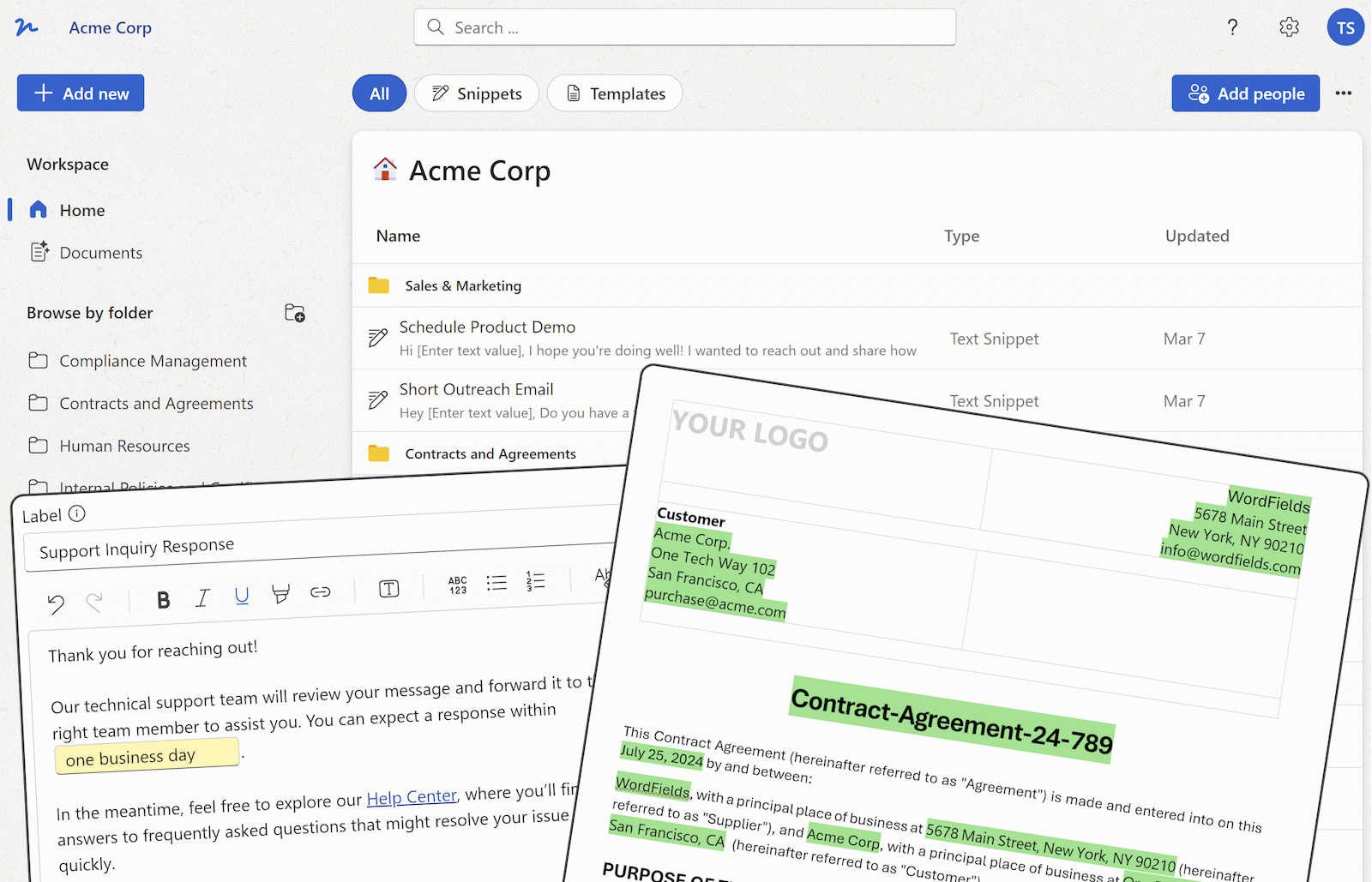
Your name, email address, and organisation name fill in automatically via WordFields merge tags — no manual edits before sending. Use the Chrome extension to insert directly into Gmail, Outlook, or your internal systems without switching tabs.
What's included
Each snippet auto-populates the following fields when used in WordFields:
- Approver name and specific request being approved
- Amount, cost centre, and spend breakdown (budget variant)
- Vendor name, contract value, and alternatives considered (vendor variant)
- Policy name, proposed exception, duration, and risk mitigation (policy exception variant)
- Decision deadline and consequence of delay
- Sender name, email, and organisation name (pulled from the logged-in user and workspace automatically)
When to use each approval request template
Use the budget approval template any time a spend commitment requires sign-off before it can be made — a new software subscription, a project cost overage, a campaign budget, or an unplanned equipment purchase. The template forces the requester to state the consequence of delay, which is the single most effective element of a budget approval email. Approvers prioritise requests they understand the urgency of. An amount with a deadline and a stated consequence gets reviewed faster than an amount with a vague ask. Operations managers, project leads, and department heads requesting finance approval will use this most frequently.
Use the vendor approval template when proposing a new supplier relationship that requires internal sign-off before onboarding can begin. This sits upstream of the supplier onboarding sequence — the approval happens first, internally, before any communication goes to the supplier. The alternatives-considered field is not optional padding: it signals to the approver that due diligence has been done and that the recommendation is based on comparison, not convenience. Procurement leads and operations managers working within organisations that require formal vendor selection sign-off will reach for this variant whenever a new supplier relationship is proposed, regardless of contract value.
Use the policy exception template when operational circumstances make it impossible or impractical to follow a company policy as written, and a documented, time-limited deviation is the appropriate solution. The template's structure — what the policy requires, why it cannot apply here, what the proposed alternative is, and how long the exception lasts — mirrors the information a manager needs to grant an exception responsibly. The explicit statement that the request is not intended to set a precedent is important: it frames the exception as a specific case rather than an invitation to revise the policy, which is a separate and much larger conversation. Admin teams handling supplier payment terms, HR teams managing flexible working requests, and operations leads dealing with compliance constraints are the most common users of this variant.
Frequently asked questions
What should an approval request email include?
An approval request email should include what you are requesting, why it is needed, the cost or impact, any relevant supporting detail or attached documents, and a clear deadline for the decision. The goal is to give the approver everything they need to say yes or no without sending a follow-up question. Most approval delays are caused by missing context, not slow decision-making — a complete, well-structured request removes that friction entirely.
How do you write an email asking for approval from a manager?
Lead with the specific ask in the subject line — for example, 'Approval needed: [budget / vendor / request name]'. In the first line of the body, state exactly what you need approved and by when. Follow with the business justification in two to three sentences, then list any key figures, options considered, or supporting documents. Close with a single, direct call to action. Do not bury the request in background information. Managers approve requests faster when the decision is the first thing they see, not the last.
How do you write a budget approval request email?
State the total amount, the budget line or cost centre it will be drawn from, and the business outcome it enables. Include the spend breakdown as a summary in the email body or as an attached document, and note whether the spend is within an existing budget or requires additional allocation. Specify the decision deadline and what happens if approval is delayed — for example, a contract expiry date or a project milestone that depends on the funds being released.
What is a policy exception request email?
A policy exception request email asks a manager or authority to permit a one-time or time-limited deviation from an established company policy. It should state which policy applies, why the standard policy cannot be followed in this specific case, the proposed alternative, the duration of the exception, and any risk mitigation in place. The request should acknowledge the policy rather than argue against it — the goal is to demonstrate that you understand the rule and are making a specific, justified case for an exception, not a precedent-setting change.
How do you politely follow up on an approval request?
Reply to the original approval request thread rather than starting a new email. Reference the original request date, restate what is being approved and the deadline, and note the impact of any further delay. Keep the follow-up to two or three sentences — it is a prompt, not a second pitch. If the approval is genuinely time-sensitive, say so explicitly rather than implying it. Most approvers respond to a clear, specific nudge faster than to a vague check-in.
What is the difference between a budget approval email and a purchase order email?
A budget approval email is an internal request to authorize spending — it seeks a decision before any commitment is made to a supplier. A purchase order email is an external document sent to a supplier to confirm a specific order once budget has already been approved. The two emails operate at different stages of the procurement process: budget approval happens first, internally; the purchase order follows, externally. Sending a PO without prior budget approval is a common source of finance team disputes.
How specific should the justification be in an approval request email?
Specific enough that the approver does not need to ask a follow-up question. For budget requests, include the exact amount, the cost breakdown, and the expected return or outcome. For vendor approvals, name the vendor, the contract value, and the alternatives considered. For policy exceptions, state the specific policy clause, the reason it cannot apply in this case, and the proposed alternative. Generic justifications like 'this is needed for the project' or 'we believe this is the best option' slow approvals down because they invite clarifying questions.
Who should be cc'd on an approval request email?
CC only the people who need to be aware of the decision or who will be involved in executing it once approval is granted — for example, a finance contact on a budget request, or a procurement lead on a vendor approval. Avoid cc'ing people as a pressure tactic or for visibility purposes. Unnecessary recipients signal that the request lacks direct authority and can slow the approver's response by implying the decision is more complex or political than it needs to be.
Related operations email templates
Explore more professional document and email templates you can copy, customize, and use immediately