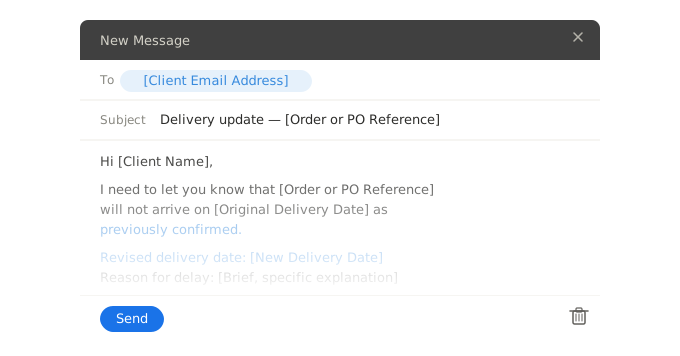
Two professional service escalation email templates for B2B support teams. Notify a client when their issue is being formally escalated to a senior contact, and update them on progress once the senior owner has investigated.
Hi [Client name],
I want to be direct with you: [Issue reference or description] has not been resolved to the standard it should have been through standard support, and I am formally escalating it.
From this point, [Senior contact name], [Title], is taking personal ownership of your case. [[Senior Contact]] will contact you directly by [Contact deadline — e.g. end of business today] and will be your single point of contact until this is resolved.
You can reach [[Senior Contact]] directly at [Senior contact email or phone] if you need to before then.
I'm sorry this has reached this point. The escalation is a commitment to a different level of attention, not just a different name.
[VALUE("Author.FullName")]
[VALUE("Organization")] | [VALUE("Author.EmailAddress")]
Hi Client name,
I want to be direct with you: Issue reference or description has not been resolved to the standard it should have been through standard support, and I am formally escalating it.
From this point, Senior contact name, Title, is taking personal ownership of your case. =[Senior Contact] will contact you directly by Contact deadline — e.g. end of business today and will be your single point of contact until this is resolved.
You can reach =[Senior Contact] directly at Senior contact email or phone if you need to before then.
I'm sorry this has reached this point. The escalation is a commitment to a different level of attention, not just a different name.
=VALUE("Author.FullName")
=VALUE("Organization") | =VALUE("Author.EmailAddress")
Hi [Client name],
Re: [Issue reference or description]
Following the escalation raised on [Escalation date], I'm writing with an update from [Senior contact name or team]'s investigation.
Here is what we have established: [Summary of findings — what was causing the issue, what was missed or went wrong, and what the current status is]
Here is what is happening next: [Concrete next step and who owns it], with a resolution target of [Resolution date or window].
[Any immediate interim measure already in place — leave blank to omit]
I want to confirm that this case remains a named priority and will not fall through the cracks again. You will hear from us by [Next update commitment — e.g. Friday at 5pm] whether or not resolution is complete.
[VALUE("Author.FullName")]
[VALUE("Organization")] | [VALUE("Author.EmailAddress")]
Hi Client name,
Re: Issue reference or description
Following the escalation raised on Escalation date, I'm writing with an update from Senior contact name or team's investigation.
Here is what we have established: Summary of findings — what was causing the issue, what was missed or went wrong, and what the current status is
Here is what is happening next: Concrete next step and who owns it, with a resolution target of Resolution date or window.
Any immediate interim measure already in place — leave blank to omit
I want to confirm that this case remains a named priority and will not fall through the cracks again. You will hear from us by Next update commitment — e.g. Friday at 5pm whether or not resolution is complete.
=VALUE("Author.FullName")
=VALUE("Organization") | =VALUE("Author.EmailAddress")
Each snippet auto-populates your name, email address, and organisation name when used in WordFields. Fill in the case-specific fields at the point of use and insert directly into your email client, CRM, or helpdesk via the Chrome extension — without switching tabs.
What's included
Each snippet auto-populates the following fields when used in WordFields:
- Client name, for direct address
- Issue reference or description, tying the escalation to the specific case the client will recognise immediately
- Senior contact name, title, and direct details — making accountability concrete rather than institutional
- Timeline commitments for contact, next update, and resolution
- Sender name, email address, and organisation name — pulled automatically from the logged-in user and workspace, with no manual entry required
When to send a service escalation email
The escalation notification is sent at the moment the decision to escalate is made — not after the senior contact has already begun work. The single most damaging pattern in escalated support cases is the client discovering the escalation only when a new and previously unknown person contacts them, with no prior notification. That sequence signals internal disorganization, not elevated attention. This template reverses it: the client is told proactively who is now responsible, what that person's direct contact details are, and when they will be in touch. The line "the escalation is a commitment to a different level of attention, not just a different name" addresses the client's primary concern in an escalation scenario — that the escalation is procedural rather than substantive — directly and without evasion. This page covers client-facing escalations from a support team to its clients; internal escalations between team members and managers belong in the Operations escalation email.
The escalation update is the second communication in the escalation arc and the one most commonly skipped. Once an issue is escalated and a senior contact named, teams often treat the change of ownership as the resolution and stop communicating proactively. For the client, the silence that follows an escalation notification is indistinguishable from the silence that preceded it — and they have now escalated their expectations along with the issue. The update template is structured around what was found (not a vague summary of the investigation, but a factual account of the cause or contributing factors), what is happening next (named action and owner), and a renewed update commitment. The phrase "this case remains a named priority and will not fall through the cracks again" is positioned specifically to address the client's stated or unstated fear — that the escalation will lose momentum — before they have to raise it themselves.
Frequently asked questions
What is a client-facing escalation email?
A client-facing escalation email is sent by a support team to the client to notify them that their issue is being formally escalated — that is, ownership is moving from the current support agent or team to a senior contact with greater authority or expertise. It is distinct from an internal escalation email (sent between team members) and from a client escalation to you (where the client expresses frustration and demands senior attention). The client-facing escalation email is a proactive communication that names who now owns the issue and sets a new timeline.
When should a support team escalate a client issue and notify the client?
Escalate and notify when: an issue has exceeded the expected resolution timeline without a clear path to resolution; the issue requires authority or expertise beyond the current team's scope; the client has expressed that standard support is insufficient; or the potential impact on the client's operations crosses a threshold that warrants senior ownership. Notification should happen at the point of escalation, not after the senior contact has already begun work — the client should hear from you proactively, not discover the escalation when a new person contacts them unexpectedly.
How is a client-facing escalation email different from a complaint response?
A complaint response addresses the substance of a complaint and provides resolution or next steps within the existing support relationship. An escalation email specifically communicates a change in ownership — a senior contact is now named, accountable, and in communication with the client. The escalation email does not need to resolve the issue; its purpose is to re-establish accountability and signal that the appropriate level of resource is now engaged.
What should a service escalation email include?
The escalation email should name the issue being escalated with enough specificity that the client recognises it immediately. It should name the senior contact who now owns the issue, confirm that contact's direct details, and commit to a concrete timeline for the next communication — not 'we will be in touch shortly' but a specific date and time. It should acknowledge the impact the issue has had without re-litigating the original complaint or over-apologising. Brevity and clarity are more important than length.
Should the original support agent continue to be the client's contact after escalation?
This depends on the escalation structure. For hierarchical escalation — where a senior colleague takes full ownership — the client's primary contact changes and should be clearly named in the escalation email. For functional escalation — where a specialist is brought in alongside the existing agent — the original agent may remain the coordination point. The escalation email should make this explicit: ambiguity about who owns the issue after escalation is one of the most common sources of client frustration in escalated cases.
How do you maintain client confidence during an escalation?
By communicating proactively at every stage — the escalation notification, a progress update once the senior contact has investigated, and a resolution confirmation once the issue is closed. Clients lose confidence not when issues are escalated but when escalation disappears into silence. The escalation update email is as important as the escalation notification itself: it closes the loop, confirms what the investigation found, and demonstrates that the escalation produced action rather than just a change in name.
What is the difference between the escalation email in the Operations cluster and this one?
The escalation email in the Operations cluster is an internal communication — used when a team member or manager needs to escalate a stalled issue, supplier failure, or cross-departmental blocker within the organisation. The service escalation email in this cluster is client-facing — it is sent to the client to notify them of a formal escalation on your team's side. One goes inward; the other goes outward to the client relationship.
How do you keep escalation emails consistent across a support team?
Store approved escalation email templates in a shared workspace accessible to all agents and managers. Use fillable fields for the variable details — client name, issue reference, senior contact name, next update time — so the email can be sent quickly under pressure without omitting critical elements. The most common failure in ad-hoc escalation communications is either failing to name the senior contact's direct details or giving a vague rather than specific follow-up timeline. Both erode the very confidence the escalation is meant to restore.
Related customer service email templates
Explore more professional document and email templates you can copy, customize, and use immediately