Two professional support acknowledgement email templates for B2B teams. Confirm receipt of a support request and communicate when an issue requires active investigation — with named ownership and a clear response timeline.
Hi [Client name],
Thank you for getting in touch. We've received your request regarding [Issue description] and it's been picked up by our support team.
[Assigned team member or team] is handling this. You can expect a full response by [Response deadline].
If anything changes on your end or you have additional information to add, reply directly to this email and it will go straight to the right person.
[VALUE("Author.FullName")]
[VALUE("Organization")] | [VALUE("Author.EmailAddress")]
Hi Client name,
Thank you for getting in touch. We've received your request regarding Issue description and it's been picked up by our support team.
Assigned team member or team is handling this. You can expect a full response by Response deadline.
If anything changes on your end or you have additional information to add, reply directly to this email and it will go straight to the right person.
=VALUE("Author.FullName")
=VALUE("Organization") | =VALUE("Author.EmailAddress")
Hi [Client name],
We've received your report regarding [Issue description] and I want you to know it's being treated as a priority.
This is not a straightforward fix and I don't want to give you a timeline I can't stand behind. [Assigned owner or team] is investigating now. I will update you with our findings by [Next update deadline] — not with a resolution necessarily, but with a clear picture of what we're dealing with and what comes next.
In the meantime: [Interim step, workaround, or reassurance — delete if none applies].
Please contact me directly at [VALUE("Author.EmailAddress")] if the situation changes on your end or if you need to escalate.
[VALUE("Author.FullName")]
[VALUE("Organization")]
Hi Client name,
We've received your report regarding Issue description and I want you to know it's being treated as a priority.
This is not a straightforward fix and I don't want to give you a timeline I can't stand behind. Assigned owner or team is investigating now. I will update you with our findings by Next update deadline — not with a resolution necessarily, but with a clear picture of what we're dealing with and what comes next.
In the meantime: Interim step, workaround, or reassurance — delete if none applies.
Please contact me directly at =VALUE("Author.EmailAddress") if the situation changes on your end or if you need to escalate.
=VALUE("Author.FullName")
=VALUE("Organization")
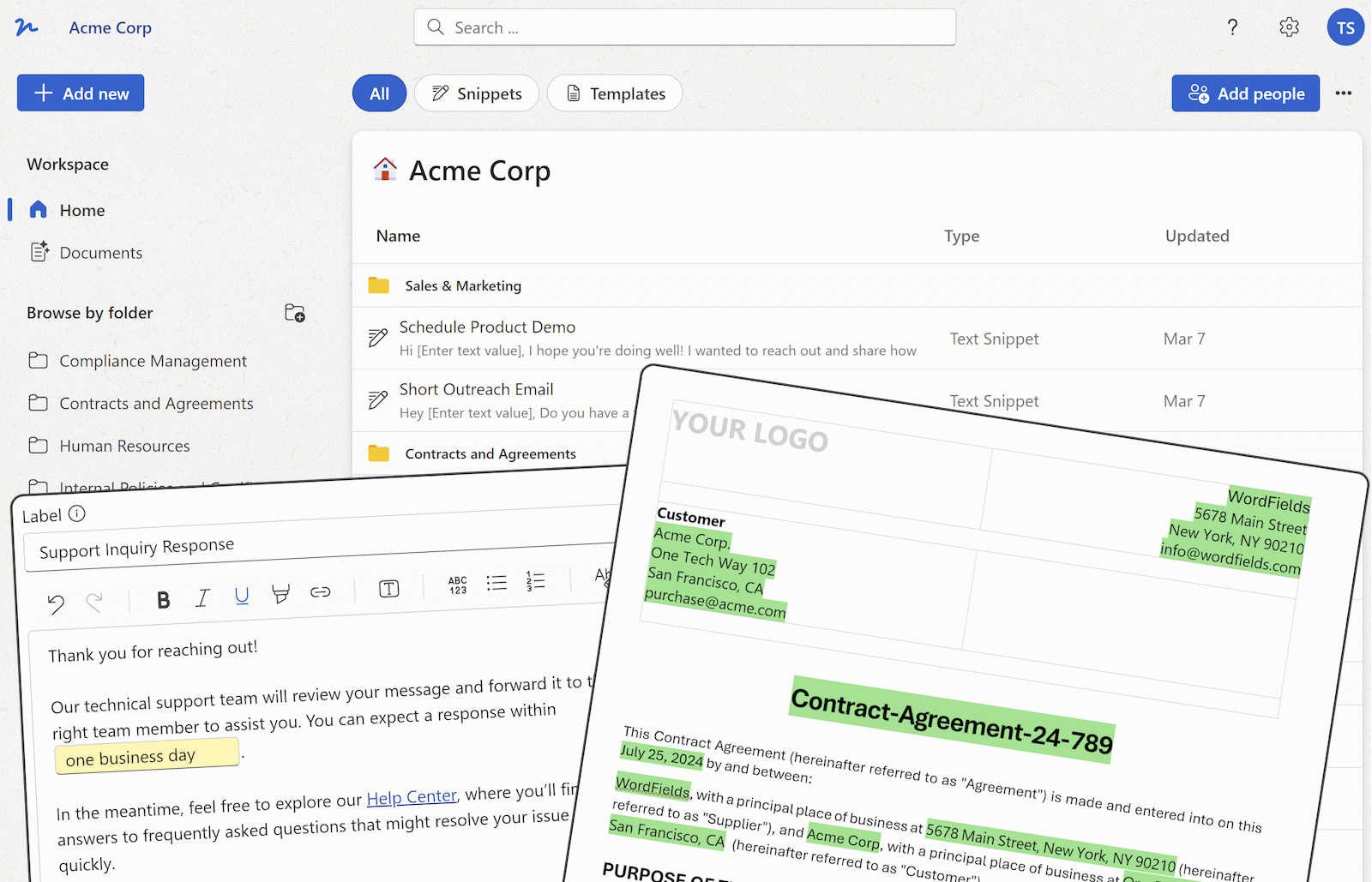
Each snippet auto-populates your name, email address, and organisation name when used in WordFields. Fill in the request-specific fields at the point of use and insert directly into your email client, helpdesk, or CRM via the Chrome extension — without switching tabs.
What's included
Each snippet auto-populates the following fields when used in WordFields:
- Client name, for direct address
- Issue description, confirming the request has been read and understood — not just received
- Assigned owner or team, so the client knows who holds accountability from this point forward
- A specific next update deadline — not "as soon as possible," but a named date and time
- Sender name, email address, and organisation name — pulled automatically from the logged-in user and workspace, with no manual entry required
When to send a support acknowledgement email
The standard acknowledgement is for requests where the issue is understood, the right person or team has been identified, and a response timeline can be stated with confidence. This variant does one specific job: it tells the client their request has landed with the right person, not in a queue with no visible owner. In B2B support, the gap between "we received your email" and "here is who is handling it and when you'll hear back" is the gap between a client who waits patiently and one who sends a chase email 30 minutes later. The template closes that gap in under 60 words. Most teams send this type of acknowledgement without a template — which means the assigned owner and next update time are frequently omitted under volume pressure. Making those fields required at point of use prevents the omission.
The under investigation variant is the harder and more important template to get right. It applies when a client has reported something that cannot be resolved quickly — a technical failure requiring root cause analysis, a data discrepancy requiring reconciliation, a service disruption whose scope is not yet known. The most common failure mode in these situations is giving a confident resolution timeline before the investigation has established what is actually wrong. When that estimate misses, the client's frustration is compounded: they feel misled twice, once by the failure and once by the promise. This template explicitly separates the next update commitment from the resolution commitment — "I will update you with our findings by [time], not with a resolution necessarily, but with a clear picture of what we're dealing with." That single structural choice eliminates an entire category of follow-up complaints while also giving the support team realistic room to investigate properly.
Frequently asked questions
What should a support acknowledgement email include?
A support acknowledgement should confirm that the request has been received, identify the issue specifically so the client knows it has been read rather than auto-filed, name the person or team responsible for the next step, and give a concrete timeline for the next communication. Avoid vague commitments like 'as soon as possible' — clients need a specific date or time window to manage their own expectations.
Why is it important to acknowledge a support request quickly?
A fast acknowledgement separates the receipt of a request from its resolution, which reduces client anxiety without requiring the resolution to be immediate. Research from Harvard Business Review shows that customers who receive a fast initial response are more willing to wait longer for a full resolution. In B2B contexts, the acknowledgement also signals to the client's team that the issue is being tracked — preventing escalations that arise not because the issue is unresolvable but because the client assumed no one was working on it.
What is the difference between a support acknowledgement email and a complaint response email?
A support acknowledgement confirms receipt and sets expectations for the resolution timeline — it is sent before the resolution is known. A complaint response addresses the substance of a complaint and provides the resolution or next step — it is sent once the issue has been investigated. In practice, acknowledgements buy time for proper investigation; complaint responses close the loop. Both are necessary in any multi-step support interaction.
How do you acknowledge a support request that will take time to investigate?
Confirm receipt and name the issue specifically. State that investigation is underway and commit to a date for the next update — not a resolution date, just the next communication. Name the person responsible so the client has a direct contact. Avoid language that implies the issue is straightforward if it is not — clients who are told 'we'll look into it' and then wait a week with no update feel misled even if the investigation was genuinely complex.
Should a support acknowledgement email be automated or personal?
For high-volume, low-complexity requests, automated acknowledgements are appropriate and expected. For complex, high-value, or sensitive requests, a personal acknowledgement from a named team member is significantly more effective. The test is simple: does the client need to feel that a person has read and understood their issue, or is confirmation of receipt sufficient? In B2B environments where clients have account relationships, a personal acknowledgement on non-trivial issues is the standard that protects those relationships.
What is an appropriate SLA for support acknowledgement?
Industry benchmarks suggest one hour for standard support requests and under 30 minutes for urgent or high-priority issues during business hours. The acknowledgement SLA and the resolution SLA are separate commitments — confusing them is a common source of both client frustration and internal miscommunication. A team can have a 30-minute acknowledgement SLA and a 24-hour resolution SLA on the same ticket type, and both are valid.
How do you maintain consistent acknowledgement emails across a support team?
Store approved acknowledgement templates in a shared workspace accessible to all agents. Use fillable fields for the variable details — client name, issue description, assigned owner, next update date — so agents personalise at point of use without rewriting from scratch. The two most common failures in ad-hoc acknowledgements are omitting the assigned owner and giving a vague rather than specific next update time. A template with required fields eliminates both under pressure.
When should a support acknowledgement be sent by a manager rather than an agent?
When the issue is high-severity, involves a named account, or arrives in the context of an existing complaint or dispute. In those cases, the seniority of the acknowledgement sender signals the level of priority being assigned — a client who has already escalated once and receives an automated acknowledgement from a general support queue will escalate again immediately. A named manager acknowledging in person resets that dynamic.
Related customer service email templates
Explore more professional document and email templates you can copy, customize, and use immediately