Free sales introduction email templates for warm outreach — after a LinkedIn connection, after meeting at an event, and when introducing yourself as a new account rep. Fill in the fields and insert directly into Gmail or Outlook.
Hi [Prospect first name],
Thanks for connecting. I noticed [One specific detail from their profile — a recent role change, a post they published, a shared interest].
I work with [Type of company or role you help] on [Specific problem or outcome you address]. It looked like there might be some relevant overlap — happy to share more if useful.
Would a 20-minute call be worth it? I am flexible on timing.
[VALUE("Author.FullName")]
[VALUE("Organization")]
[VALUE("Author.EmailAddress")]
Hi Prospect first name,
Thanks for connecting. I noticed One specific detail from their profile — a recent role change, a post they published, a shared interest.
I work with Type of company or role you help on Specific problem or outcome you address. It looked like there might be some relevant overlap — happy to share more if useful.
Would a 20-minute call be worth it? I am flexible on timing.
=VALUE("Author.FullName")
=VALUE("Organization")
=VALUE("Author.EmailAddress")
Hi [Prospect first name],
It was good to meet you at [Event name] on [Event date]. I enjoyed our conversation about [Specific topic discussed — one sentence, shows you were paying attention].
As I mentioned, we help [Type of company you help] with [Specific outcome you deliver]. I would love to continue the conversation and share a bit more about how we work.
Are you free for a call [Suggested timing — e.g. this week / next week]?
[VALUE("Author.FullName")]
[VALUE("Organization")]
[VALUE("Author.EmailAddress")]
Hi Prospect first name,
It was good to meet you at Event name on Event date. I enjoyed our conversation about Specific topic discussed — one sentence, shows you were paying attention.
As I mentioned, we help Type of company you help with Specific outcome you deliver. I would love to continue the conversation and share a bit more about how we work.
Are you free for a call Suggested timing — e.g. this week / next week?
=VALUE("Author.FullName")
=VALUE("Organization")
=VALUE("Author.EmailAddress")
Hi [Client first name],
I wanted to reach out to introduce myself. I am [VALUE("Author.FullName")] and I will be your main point of contact at [VALUE("Organization")] going forward, [e.g. taking over from [previous rep name] / as we expand our team].
I have already been briefed on your account and I am up to speed on [One specific detail about their account or previous engagement — shows you have done your homework].
I would love to schedule a short call in the next week or two to get properly acquainted and make sure we are set up well for [e.g. the next phase / the coming months]. Does [Proposed day and time] work for you?
[VALUE("Author.FullName")]
[VALUE("Author.EmailAddress")]
[VALUE("Organization")]
Hi Client first name,
I wanted to reach out to introduce myself. I am =VALUE("Author.FullName") and I will be your main point of contact at =VALUE("Organization") going forward, e.g. taking over from [previous rep name] / as we expand our team.
I have already been briefed on your account and I am up to speed on One specific detail about their account or previous engagement — shows you have done your homework.
I would love to schedule a short call in the next week or two to get properly acquainted and make sure we are set up well for e.g. the next phase / the coming months. Does Proposed day and time work for you?
=VALUE("Author.FullName")
=VALUE("Author.EmailAddress")
=VALUE("Organization")
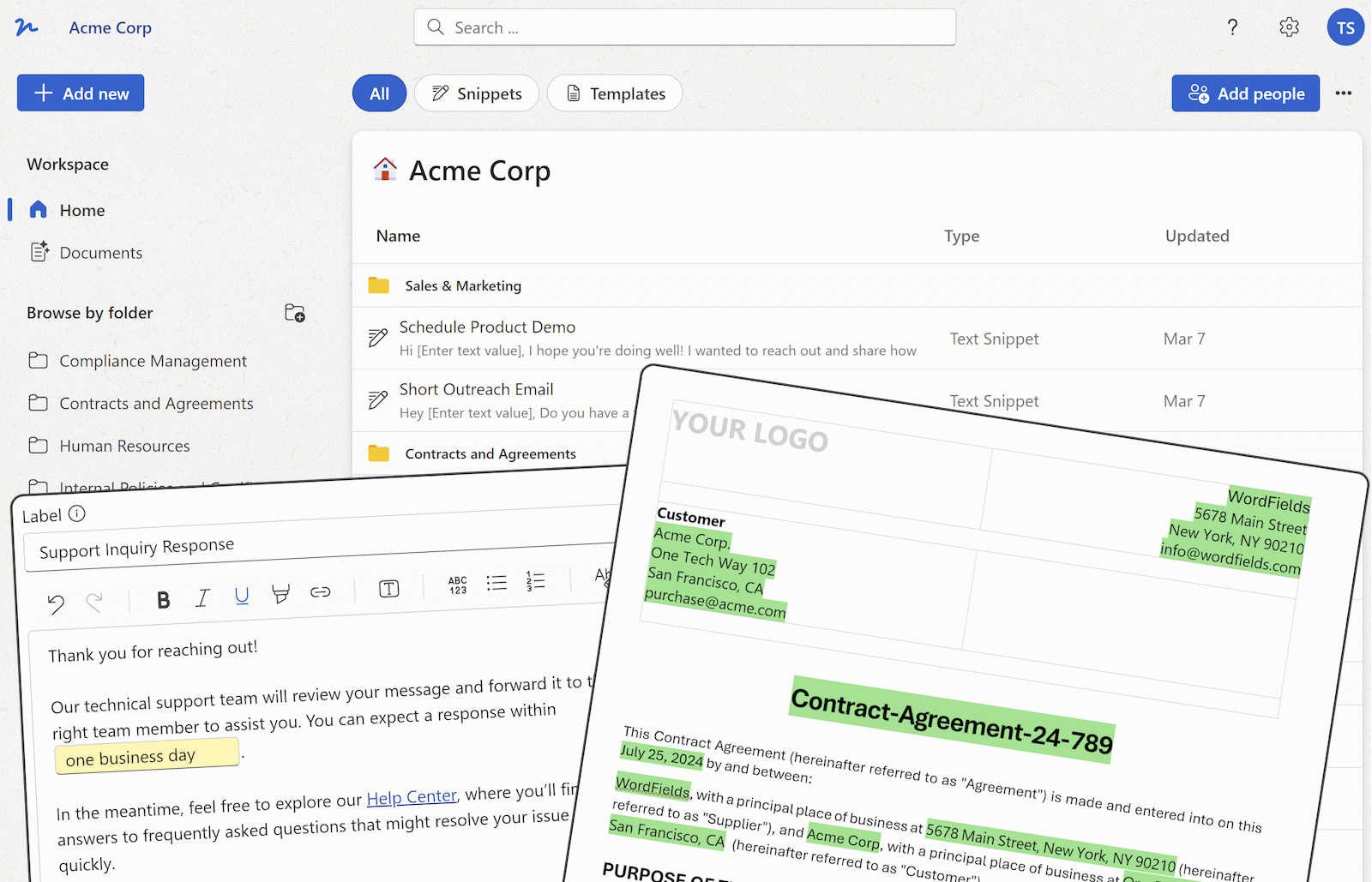
Use WordFields to fill in and insert any of these directly into Gmail, Outlook, or your CRM — no tab-switching, no copy-pasting. Merge tags like [My:FullName] and [Organization:Name] fill in automatically every time.
What's included
Each snippet auto-populates the following fields when used in WordFields:
- Prospect first name
- Shared context detail — profile observation, event name and topic discussed, or previous rep name
- Your value proposition and the type of company or role you work with
- Account-specific detail (new rep variant)
- Proposed call timing
- Sender name, email, and organisation name (pulled from the logged-in user and workspace automatically)
When to use each introduction email template
The LinkedIn connection email works because it has a built-in opening — they accepted your request, which is a mild signal of interest. Do not waste it by sending a generic message about synergies. Reference something specific from their profile in the first line: a post they wrote, a recent promotion, a company initiative visible in their activity. One specific detail signals that you looked at their profile properly rather than sending the same message to everyone. Keep the email short and end with a single, low-pressure ask. The goal is a call, not a commitment.
The post-event email has a short window. Send it within 24 to 48 hours while the conversation is still fresh for both of you. Reference something specific from what you discussed — not just "it was great to meet you" — because that proves the connection was real and not transactional. If you exchanged cards with twenty people at a conference and sent the same email to all of them, most recipients will notice. The ones who remember you as someone who listened are the ones who reply.
The new account rep introduction is one of the most important emails in a sales team's library and one of the least standardised. When a rep leaves or an account is reassigned, clients feel the uncertainty of the transition. A prompt, warm, well-briefed introduction email closes that gap immediately. The most important element is the one specific account detail — it tells the client that the handover was handled properly and that they will not have to re-explain their situation from scratch. If your team experiences rep turnover, having a shared template for this in WordFields means every client gets the same professional, reassuring introduction regardless of who sends it.
Frequently asked questions
What is the difference between a sales introduction email and a cold outreach email?
A cold outreach email is sent to someone with no prior connection — they do not know you exist and have no reason to open your email. A sales introduction email is sent when some warm context already exists: you met at an event, connected on LinkedIn, share a mutual contact, or are taking over an existing account. The tone is warmer, the barrier to engagement is lower, and you can reference the shared context in the opening line rather than having to earn attention from scratch. If there is no shared context at all, use the cold outreach template instead.
How do you introduce yourself in a sales email?
Lead with the shared context, not your job title. 'I enjoyed your talk at the conference last week' lands better than 'My name is X and I am a sales manager at Y.' The recipient already knows their own name and does not need you to state yours before explaining why you are relevant to them. Keep the introduction to one sentence, move immediately to why you are reaching out, and end with a single clear ask. The email should be under 125 words.
How soon should you send an introduction email after meeting someone?
Within 24 to 48 hours of the meeting or connection. The longer you wait, the weaker the shared context becomes — after a week, a conference introduction feels stale and the opening line loses its natural warmth. For LinkedIn connections, send the introduction email within a day or two of the connection being accepted, while your profile is still visible in their recent activity. For new account introductions, send it on your first day in the role or as close to it as possible.
What should a new account rep introduction email include?
Acknowledge the transition clearly — the client already has a relationship with your company and deserves to know who their new point of contact is. Name your predecessor if appropriate, briefly introduce yourself, confirm that you have been briefed on their account so they do not feel they are starting from scratch, and propose a short call to get acquainted. Keep it warm and low-pressure. The goal is continuity, not a new sales pitch.
Should a sales introduction email include a pitch?
No — not in the first email. The purpose of a sales introduction email is to open a conversation, not close a deal. Pitching in the first message signals that you are more interested in selling than in understanding whether there is a genuine fit. Introduce yourself, reference the shared context, explain briefly what you do and who you help, and ask a single low-pressure question or propose a short call. Save the pitch for when you have had that conversation.
Related sales templates
Explore more professional document and email templates you can copy, customize, and use immediately