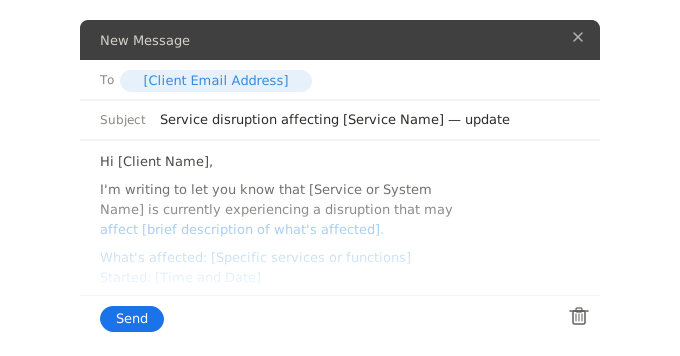
Two professional refund email templates for B2B support teams. Confirm billing error refunds and issue service credits with clear, consistent communication that protects the client relationship.
Hi [Client name],
Following our review of [Invoice reference], we have confirmed a billing error and processed a refund of [Refund amount] to [Payment method — e.g. the bank account on file / your card ending in XXXX].
You should see this reflected within [Processing timeline — e.g. 3–5 business days]. If it does not appear by [Expected date for funds to appear], please reply to this email and I will escalate directly with our finance team.
I'm sorry for the error and for any disruption this caused to your accounts. A corrected invoice has been [] for your records.
If you have any questions, please come to me directly.
[VALUE("Author.FullName")]
[VALUE("Organization")] | [VALUE("Author.EmailAddress")]
Hi Client name,
Following our review of Invoice reference, we have confirmed a billing error and processed a refund of Refund amount to Payment method — e.g. the bank account on file / your card ending in XXXX.
You should see this reflected within Processing timeline — e.g. 3–5 business days. If it does not appear by Expected date for funds to appear, please reply to this email and I will escalate directly with our finance team.
I'm sorry for the error and for any disruption this caused to your accounts. A corrected invoice has been Select for your records.
If you have any questions, please come to me directly.
=VALUE("Author.FullName")
=VALUE("Organization") | =VALUE("Author.EmailAddress")
Hi [Client name],
In recognition of [Service failure or incident description] on [Date or period of the incident], we have applied a service credit of [Credit amount] to your account.
This credit will appear against your next invoice and can be applied to [Applicable services or terms for the credit]. You do not need to take any action — it will be reflected automatically.
I want to be clear that [[Incident]] fell short of what we committed to, and this credit is an acknowledgement of that, not a substitute for fixing the underlying issue. [Brief statement of what has been resolved or improved].
If you have any questions about how the credit works or want to discuss the incident further, I'm available at [VALUE("Author.EmailAddress")].
[VALUE("Author.FullName")]
[VALUE("Organization")]
Hi Client name,
In recognition of Service failure or incident description on Date or period of the incident, we have applied a service credit of Credit amount to your account.
This credit will appear against your next invoice and can be applied to Applicable services or terms for the credit. You do not need to take any action — it will be reflected automatically.
I want to be clear that =[Incident] fell short of what we committed to, and this credit is an acknowledgement of that, not a substitute for fixing the underlying issue. Brief statement of what has been resolved or improved.
If you have any questions about how the credit works or want to discuss the incident further, I'm available at =VALUE("Author.EmailAddress").
=VALUE("Author.FullName")
=VALUE("Organization")
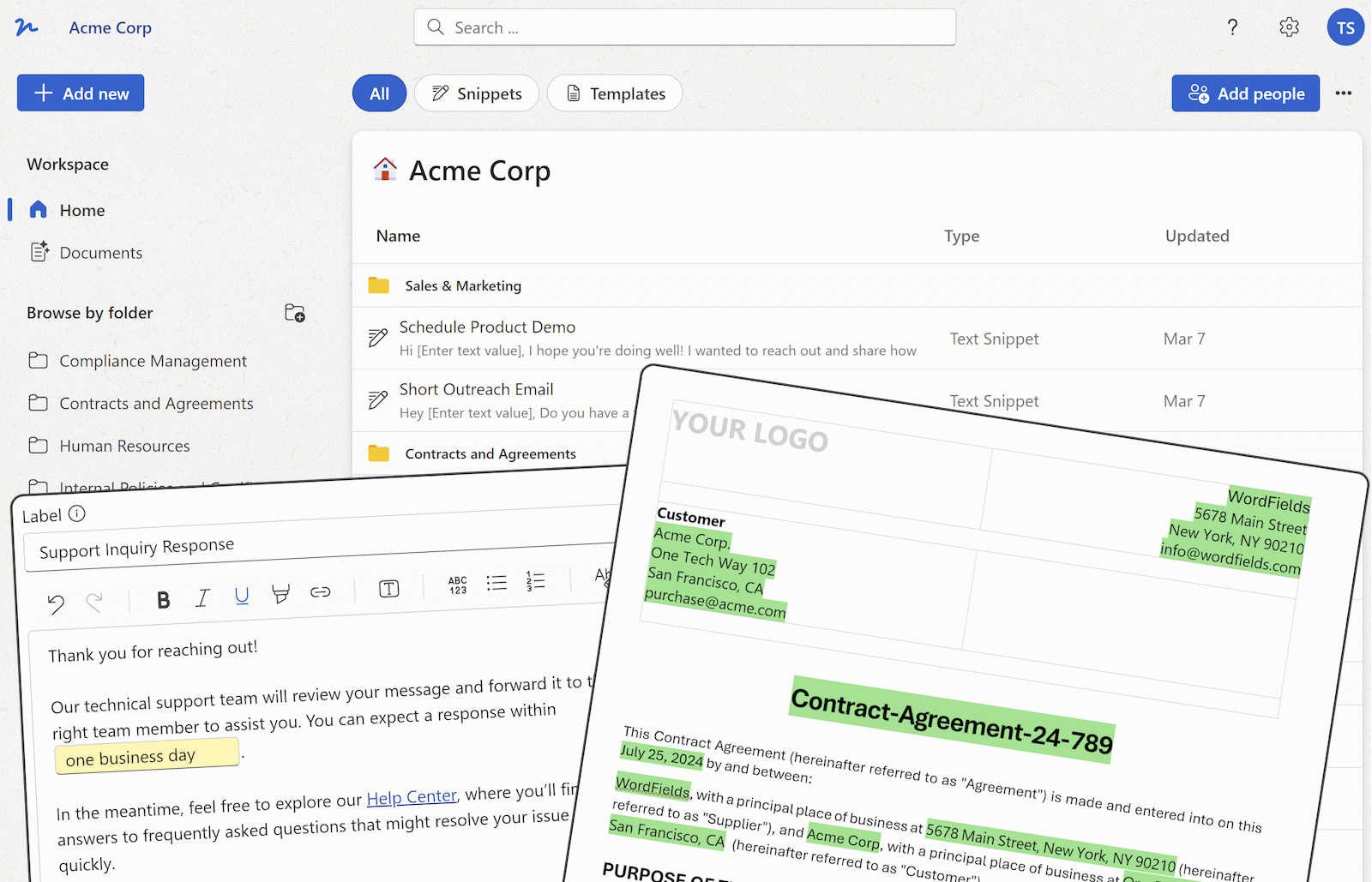
Each snippet auto-populates your name, email address, and organisation name when used in WordFields. Fill in the transaction-specific fields at the point of use and insert directly into your email client, CRM, or helpdesk via the Chrome extension — without switching tabs.
What's included
Each snippet auto-populates the following fields when used in WordFields:
- Client name, for direct address
- Invoice or account reference, so the communication is tied to a specific transaction rather than a general apology
- Refund or credit amount, payment method, and expected processing timeline — the details a finance team needs to reconcile the transaction
- Sender name, email address, and organisation name — pulled automatically from the logged-in user and workspace, with no manual entry required
When to send a refund email
The billing error refund confirmation is sent after the investigation is complete and the refund has been processed — not during it. This distinction matters: a refund confirmation email is a transactional record, not an apology or an update. Its function is to give the client's finance team the information they need to reconcile the correction against their records: the amount, the method, and the timeline. In B2B contexts where payments are made by bank transfer or against purchase orders, the email should confirm the destination account details were verified before the refund was initiated, or prompt the client to confirm them — a refund sent to an outdated account significantly compounds the original error. This page covers the confirmation step; the investigation and dispute handling sit in the complaint response email templates.
The service credit variant applies in a structurally different situation: the failure was operational rather than financial, and the remedy is a forward-looking credit against future invoices rather than a return of funds already paid. Service credits are the standard remedy in managed services, SaaS, and professional services engagements where a service level agreement (SLA) was missed or a significant disruption occurred. The template is built around two things most service credit emails get wrong: it names the specific incident the credit is in recognition of — so the client can connect it to their records and understands it is not a goodwill gesture but an acknowledgement of a defined failure — and it explicitly states that the credit does not substitute for fixing the underlying issue. That second element is what separates a credit email that restores confidence from one that reads as a commercial deflection.
Frequently asked questions
What should a refund email to a customer include?
A refund email should confirm the specific amount being refunded, the method and timeline for the refund, a reference to the original invoice or transaction so there is no ambiguity about which charge is being addressed, and a direct contact for any follow-up questions. In B2B contexts, include the invoice or account reference explicitly — finance teams processing the confirmation need it for reconciliation.
How do you write a professional refund email to a business client?
Lead with the confirmation — state that the refund has been processed or is being processed before any explanation or apology. Business clients reading a refund email primarily want to know the amount, the method, and the timeline. Acknowledge the error or reason briefly, but keep it secondary to the transactional information. Close with a named contact rather than a generic support address, particularly for accounts where the client has an established relationship with a specific team member.
What is the difference between a refund and a service credit in B2B?
A refund returns money already paid, typically to the original payment method. A service credit applies a value to the client's account for use against future invoices — it does not return funds. In B2B, service credits are commonly offered when the failure was operational rather than financial, such as a service outage or missed SLA, and where the client relationship is ongoing. The communication for each is different: a refund requires payment details and processing timelines; a credit requires confirmation of the amount, how it appears on the account, and when it can be applied.
How long does a B2B refund typically take to process?
Bank transfer refunds typically process within 3–5 business days once initiated, though this depends on both parties' banking arrangements. Credit card refunds can take 5–10 business days to appear on a statement. In B2B contexts where payment was made by invoice or bank transfer, confirm the destination account details proactively to avoid delays — a refund sent to a closed or changed account adds significant time and friction to resolution.
Should you apologise in a refund email?
Yes, briefly — but the apology should not dominate the email. The primary purpose of a refund email is transactional: confirming the amount, method, and timeline. An apology that takes up more space than the refund confirmation itself signals that you're prioritising your own discomfort over the client's need for clear information. Acknowledge the error in one sentence, then move directly to the confirmation.
What is the correct tone for a refund email to an unhappy client?
Direct, factual, and calm — without being cold. Avoid over-apologising or using language that escalates the emotional register of the exchange. The client wants the situation resolved; excessive sentiment can read as stalling. State what happened, what is being done, and what the client should expect next. If the client is very unhappy, offer a direct call rather than trying to manage the relationship entirely by email.
How do you issue a service credit by email?
Confirm the credit amount, how it appears on the client's account or next invoice, and the timeframe within which it can be applied. State clearly what the credit is in recognition of — the specific incident or failure — so the client can connect it to their records. If the credit has an expiry or conditions, state them explicitly rather than referencing terms and conditions without detail.
How do you keep refund emails consistent across a support team?
Store approved refund email templates in a shared workspace accessible to all agents. Use fillable fields for the variable details — client name, invoice reference, refund amount, processing timeline — so agents personalise at point of use without rewriting from scratch or omitting critical details. When refund policies or processing timelines change, update the template once and every agent immediately works from the revised version, eliminating the risk of agents communicating outdated timeframes.
Related customer service email templates
Explore more professional document and email templates you can copy, customize, and use immediately