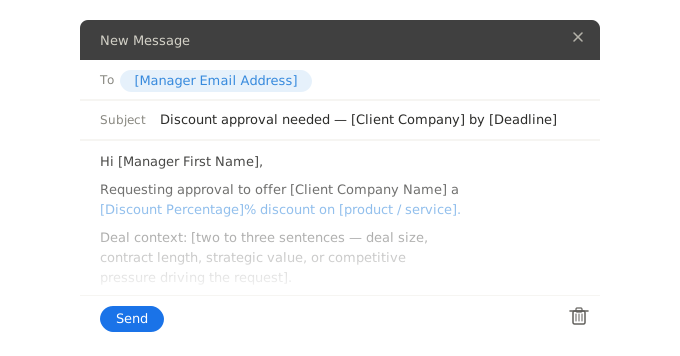
Free cold outreach email templates for sales prospecting — cold introduction, trigger-based outreach, and referral. Fill in the fields and insert directly into Gmail, Outlook, or your CRM with the WordFields Chrome extension.
Hi [Prospect first name],
[One personalised sentence about them — their role, company, something they published. Not about you.]
We help [Type of company you help] with [Prospect company name (also used in subject)]. [One concrete result or proof point — a metric, a named outcome, a type of client you have helped]
Worth a 15-minute call to see if it is relevant? Happy to work around your schedule.
[VALUE("Author.FullName")]
[VALUE("Organization")]
[VALUE("Author.EmailAddress")]
Hi Prospect first name,
One personalised sentence about them — their role, company, something they published. Not about you.
We help Type of company you help with Prospect company name (also used in subject). One concrete result or proof point — a metric, a named outcome, a type of client you have helped
Worth a 15-minute call to see if it is relevant? Happy to work around your schedule.
=VALUE("Author.FullName")
=VALUE("Organization")
=VALUE("Author.EmailAddress")
Hi [Prospect first name],
I noticed [Specific trigger — e.g. you recently raised a Series A / you are hiring three sales managers / you just launched X]. That often means [Implication of the trigger relevant to your offer].
We work with companies at this stage to [Specific outcome you deliver]. [One sentence on how — concrete, not vague].
Would it make sense to have a quick call this week?
[VALUE("Author.FullName")]
[VALUE("Organization")]
[VALUE("Author.EmailAddress")]
Hi Prospect first name,
I noticed Specific trigger — e.g. you recently raised a Series A / you are hiring three sales managers / you just launched X. That often means Implication of the trigger relevant to your offer.
We work with companies at this stage to Specific outcome you deliver. One sentence on how — concrete, not vague.
Would it make sense to have a quick call this week?
=VALUE("Author.FullName")
=VALUE("Organization")
=VALUE("Author.EmailAddress")
Hi [Prospect first name],
[Mutual connection name] suggested I get in touch — [One sentence on the context: what you discussed, why they made the connection].
We [One sentence on what you do and who you help — outcome-focused, not feature-focused].
[[Mutual Connection]] thought it might be worth a conversation. Would a 20-minute call work for you this week?
[VALUE("Author.FullName")]
[VALUE("Organization")]
[VALUE("Author.EmailAddress")]
Hi Prospect first name,
Mutual connection name suggested I get in touch — One sentence on the context: what you discussed, why they made the connection.
We One sentence on what you do and who you help — outcome-focused, not feature-focused.
=[Mutual Connection] thought it might be worth a conversation. Would a 20-minute call work for you this week?
=VALUE("Author.FullName")
=VALUE("Organization")
=VALUE("Author.EmailAddress")
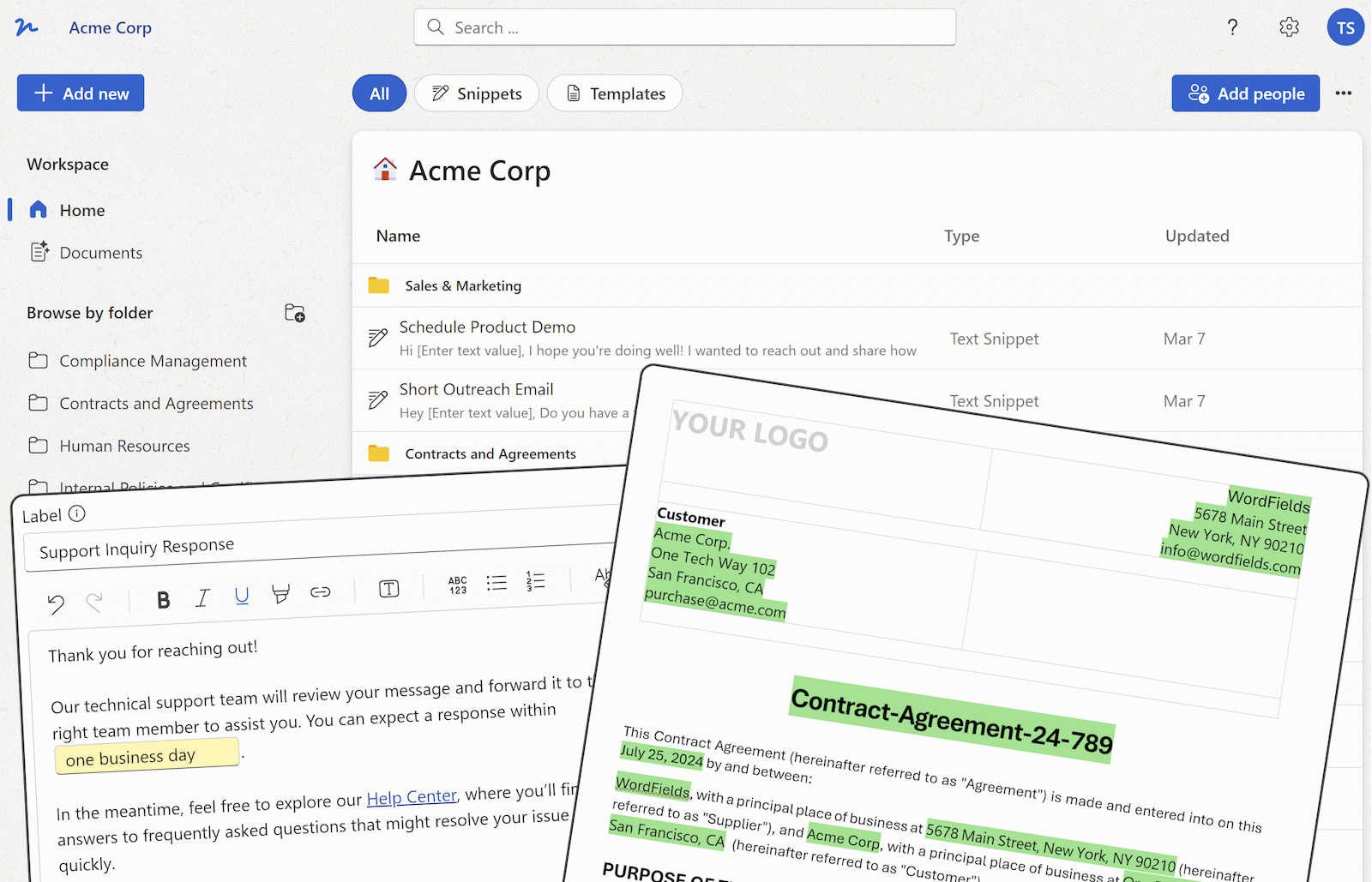
Use WordFields to fill in and insert any of these directly into Gmail, Outlook, or your CRM — no tab-switching, no copy-pasting. Merge tags like [My:FullName] and [Organization:Name] fill in automatically every time.
What's included
Each snippet auto-populates the following fields when used in WordFields:
- Prospect first name and company name
- Personalised opening detail (role, trigger event, or mutual connection)
- Your value proposition and proof point
- Call to action and availability
- Sender name, email, and organisation name (pulled from the logged-in user and workspace automatically)
When to use each cold outreach template
The cold introduction is the default starting point — use it when you have no prior connection and no specific trigger, but have done enough research to write a genuinely relevant opening line. The single biggest lever in cold email is the first sentence. It should be about the prospect, not about you. If you find yourself writing "My name is X and I work at Y" as the opener, delete it and start with something you observed about them. Everything else in the email is secondary to that first line earning the next.
The trigger-based template is the highest-converting of the three because it answers the implicit question every cold email recipient asks — why now? A funding announcement, a new leadership hire, a job posting, a product launch, or a press mention all give you a specific and timely reason to reach out that does not feel manufactured. The most effective triggers are ones that genuinely imply a need your product or service addresses. Reaching out to a company that just posted five sales roles because you help onboard sales teams is relevant. Reaching out to the same company to sell unrelated software on the same trigger is noise.
The referral template has one non-negotiable rule: only use it if the mutual connection has actually agreed to make the introduction. Using someone's name without their knowledge is a fast way to damage two relationships at once. When the referral is genuine, this template consistently outperforms cold introduction because the social proof of a shared contact removes a significant amount of the skepticism that cold emails have to overcome from a standing start.
Frequently asked questions
What should a cold outreach email include?
A cold outreach email needs three things: a reason for reaching out that is relevant to the recipient (not just to you), a clear and specific value proposition that addresses a problem they likely have, and a single low-friction call to action — typically a question or a request for a short call, not a direct ask to buy. Keep it under 125 words. The most common mistake is leading with your company background rather than the prospect's situation. If the first sentence is about you, rewrite it.
How do you write a cold email that doesn't sound like spam?
Personalise the opening line to something specific about the recipient — their company, a recent hire, a product launch, a piece of content they published. Generic openers like 'I hope this email finds you well' or 'My name is X and I work at Y' are the fastest way to get archived. The subject line should not mention your product or company. Keep the body to two or three short paragraphs. End with a question, not a pitch. The goal of a cold email is to start a conversation, not close a deal.
What is a trigger-based cold email?
A trigger-based email uses a real event — a funding round, a new hire, a job posting, a product launch, a news mention — as the reason for reaching out. It works because it gives the prospect a specific, timely reason to engage rather than a generic pitch. For example, a company posting multiple sales roles is a signal they are scaling their sales team and may need tools or services that support that growth. Trigger-based outreach consistently outperforms generic cold emails because the context makes it feel relevant rather than intrusive.
When is the best time to send a cold email?
Tuesday through Thursday morning, sent in the recipient's local timezone, consistently outperforms other send times across most industries. Monday mornings are crowded with backlog; Friday afternoons are mentally checked out. Aim for the 8–10am window when inboxes are being actively processed. That said, timing is a minor variable compared to relevance and personalisation — a well-written email sent at the wrong time will outperform a generic email sent at the optimal time.
How many cold emails should you send before giving up?
A sequence of four to six emails spaced three to seven days apart is the standard for most B2B outreach. Research consistently shows that most replies come after the second or third email, not the first. The final email in the sequence should be a clean close — acknowledge they may not be interested and give them an easy way to say so. Do not send the same email repeatedly; each touchpoint should add a new angle, a piece of social proof, or a relevant resource.
Related sales templates
Explore more professional document and email templates you can copy, customize, and use immediately