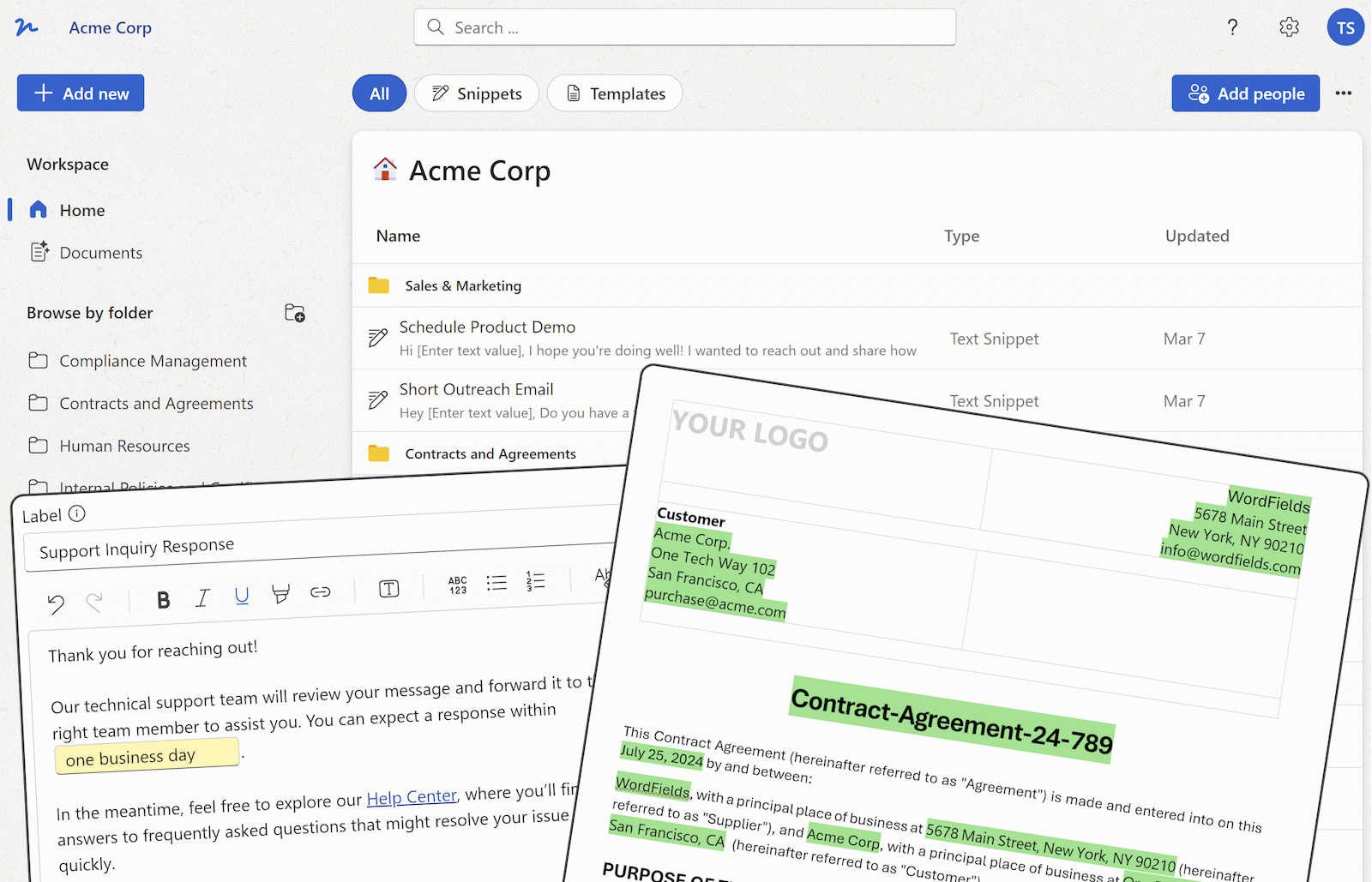
A free Word quote template covering line-item pricing, payment terms, and validity period. Fill it out in WordFields and send a consistent, correctly formatted quote every time.
Quote
| Quote number | [Quote number] |
| Date | [Document date] |
| Valid until | [Quote expiry date] |
| Prepared by | [VALUE("Author.FullName")], [Your job title] |
| Prepared for | [Client contact name], [Client company name] |
Scope
[Brief description of the work, product, or service being quoted. One to three sentences confirming what is included and what is not.]
Pricing
All prices are in [Currency — e.g. USD / GBP / EUR] and exclusive of [Tax type — e.g. VAT / GST / applicable taxes] unless otherwise stated.
| Item | Description | Qty | Unit Price | Total |
|---|---|---|---|---|
| [Item 1 name] | [Description] | [Qty] | [Unit price] | [Line total] |
| [Item 2 name] | [Description] | [Qty] | [Unit price] | [Line total] |
| [Item 3 name — add or remove rows as needed] | [Description] | [Qty] | [Unit price] | [Line total] |
| Subtotal | [Subtotal] | |||
| [=TEXT([Tax Type], "")] ([Tax rate — e.g. 20]%) | [Tax amount] | |||
| Total | [Total amount] |
Payment terms: [e.g. Payment due within 30 days of invoice date. A 50% deposit is required prior to commencement.]
Accepted payment methods: [e.g. bank transfer, credit card, cheque]
Terms and Conditions
- This quote is valid until [=TEXT([Expiry Date], "d")]. After this date the pricing above may be subject to change.
- Acceptance of this quote constitutes agreement to [VALUE("Organization")]'s standard terms of service, available at [Terms URL or state provided upon request] or provided upon request.
- Any changes to the scope of work after acceptance may affect the quoted price. Any variations will be agreed in writing before additional work proceeds.
- [Any additional terms specific to this engagement — leave blank if none]
How to accept
To proceed, please sign below and return this document to [VALUE("Author.EmailAddress")] by [=TEXT([Expiry Date], "d")], or reply to confirm acceptance by email. If you have any questions, contact [VALUE("Author.FullName")] at [VALUE("Author.EmailAddress")] or [Sender phone number].
| [VALUE("Organization")] | [=TEXT([Client Company Name], "")] |
| Signature: ___________________________ | Signature: ___________________________ |
| Name: [VALUE("Author.FullName")] | Name: [Client contact name] |
| Title: [=TEXT([Author Job Title], "")] | Title: [Client contact title] |
| Date: ________________________________ | Date: ________________________________ |
| Quote number | Quote number |
| Date | Document date |
| Valid until | Quote expiry date |
| Prepared by | =VALUE("Author.FullName"), Your job title |
| Prepared for | Client contact name, Client company name |
Brief description of the work, product, or service being quoted. One to three sentences confirming what is included and what is not.
All prices are in Currency — e.g. USD / GBP / EUR and exclusive of Tax type — e.g. VAT / GST / applicable taxes unless otherwise stated.
| Item | Description | Qty | Unit Price | Total |
|---|---|---|---|---|
| Item 1 name | Description | Qty | Unit price | Line total |
| Item 2 name | Description | Qty | Unit price | Line total |
| Item 3 name — add or remove rows as needed | Description | Qty | Unit price | Line total |
| Subtotal | Subtotal | |||
| =TEXT([Tax Type], "") (Tax rate — e.g. 20%) | Tax amount | |||
| Total | Total amount |
Payment terms: e.g. Payment due within 30 days of invoice date. A 50% deposit is required prior to commencement.
Accepted payment methods: e.g. bank transfer, credit card, cheque
- This quote is valid until =TEXT([Expiry Date], "d"). After this date the pricing above may be subject to change.
- Acceptance of this quote constitutes agreement to =VALUE("Organization")'s standard terms of service, available at Terms URL or state provided upon request or provided upon request.
- Any changes to the scope of work after acceptance may affect the quoted price. Any variations will be agreed in writing before additional work proceeds.
- Any additional terms specific to this engagement — leave blank if none
To proceed, please sign below and return this document to =VALUE("Author.EmailAddress") by =TEXT([Expiry Date], "d"), or reply to confirm acceptance by email. If you have any questions, contact =VALUE("Author.FullName") at =VALUE("Author.EmailAddress") or Sender phone number.
| =VALUE("Organization") | =TEXT([Client Company Name], "") |
| Signature: ___________________________ | Signature: ___________________________ |
| Name: =VALUE("Author.FullName") | Name: Client contact name |
| Title: =TEXT([Author Job Title], "") | Title: Client contact title |
| Date: ________________________________ | Date: ________________________________ |
Use WordFields to fill in and generate a client quote in under a minute — line items, totals, payment terms, and expiry date all update from the form. Share the template with your whole team so every quote goes out on the same approved document.
What's included
This template auto-populates the following fields when used in WordFields:
- Quote number and issue date
- Expiry date
- Client name, company name, address, and email
- Sender name, job title, email, and phone number (pulled from the logged-in user automatically)
- Your company name, address, and contact details (pulled from your workspace automatically)
- Scope description
- Line-item pricing table with quantities, unit prices, and totals
- Tax type and rate
- Subtotal and total
- Payment terms and accepted payment methods
- Acceptance instructions
When to use a quote
Use a quote when the client already knows what they want and is ready to see a price — not when they need to be persuaded that your solution is the right one. That earlier stage is where a proposal belongs. A quote answers a specific question: how much will this cost, exactly? It assumes the scope conversation has already happened. If you send a quote before that conversation, you are pricing a problem you do not yet fully understand, and you will either under-price the work or produce a quote that does not match what the client actually needs.
Include an expiry date on every quote without exception. Thirty days is standard for most service businesses. A quote without an expiry date can be accepted months later, at prices that may no longer reflect your costs or capacity. The expiry date also creates a quiet urgency — it is not a pressure tactic, it is a commercial boundary that any serious client will recognise as normal practice.
If your team sends quotes regularly — across multiple salespeople, service lines, or territories — a shared template in WordFields means every quote carries the same structure, the same terms, and the same formatting. No one builds a quote in a personal spreadsheet and emails it as an attachment. No one forgets the tax line or omits the expiry date. The quote goes out correctly formatted, every time, whoever sends it.
Frequently asked questions
What should a quote include?
A professional quote should include your company name and contact details, the client's name and contact details, a unique quote number, the date of issue, and an expiry date. The core of the document is an itemised list of products or services with quantities, unit prices, and line totals, followed by a subtotal, any applicable tax, and the total amount. Payment terms, a brief scope note, and a signature or acceptance block should also be included. Missing any of these creates ambiguity that can delay sign-off or cause disputes later.
What is the difference between a quote and an estimate?
A quote is a fixed price commitment — once accepted by the client, you are bound to honour it. An estimate is an informed approximation of cost that may change once the full scope is understood. Use a quote when you know exactly what is required and can price it precisely. Use an estimate for early-stage enquiries where scope is still being defined. If no validity period is stated on an estimate, it may remain valid for up to 12 months depending on jurisdiction, so always include an expiry date on both documents.
How long should a quote be valid for?
Thirty days is the most common validity period and works well for most service and product businesses. It gives the client time to make a decision while protecting you from material cost changes or capacity shifts. For businesses with volatile input costs — construction, manufacturing, commodity-based services — a shorter window of 14 days is reasonable. Always state the expiry date explicitly on the quote rather than just a number of days, so there is no room for misinterpretation.
Is a quote legally binding?
Yes — once a client accepts a quote, it generally becomes a binding agreement and you are obligated to deliver at the stated price. This is the key distinction between a quote and an estimate. Because a quote can be legally binding, you should only issue one after thoroughly understanding the scope and confirming your costs. Include a clear expiry date to prevent an old quote from being accepted months later at prices that no longer reflect your costs. Have your legal team review the terms before using the template at scale.
What is the difference between a quote and a proposal?
A quote answers 'how much?' A proposal answers 'why you?' A quote is a price-focused document used when the client already understands what they need and is ready to compare costs. A proposal is a persuasive document used earlier in the sales process to define the problem, present your solution, and make the case for your business. For straightforward or repeat transactions, send a quote. For complex, high-value, or competitive engagements where the client needs to be convinced, send a proposal first.
Related sales templates
Explore more professional document and email templates you can copy, customize, and use immediately