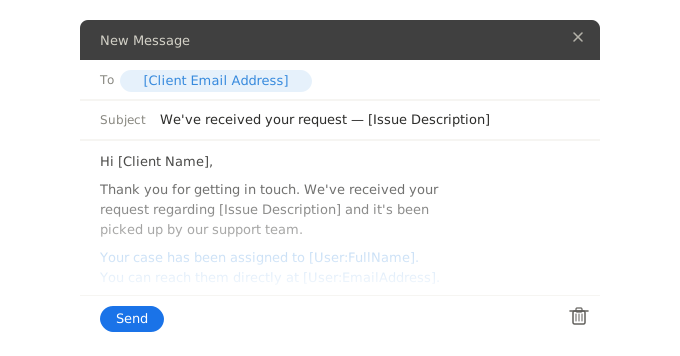
Two professional shipping delay email templates for B2B teams. Notify clients of delayed physical goods or project deliverables with clear revised timelines and direct accountability.
Hi [Client name],
I need to let you know that [Order or PO reference] will not arrive on [Original Date] as confirmed.
The revised delivery date is [New Date]. The delay is due to [Brief factual cause — e.g. a logistics disruption at the origin warehouse / a carrier capacity issue on this route]. [One sentence on what is being done to expedite or contain the impact — leave blank if not applicable]
I understand this may affect your own planning or downstream operations. If you need to discuss the impact or adjust any arrangements on your end, please contact me directly at [VALUE("Author.EmailAddress")] and I will respond the same day.
I'm sorry for the disruption.
[VALUE("Author.FullName")]
[VALUE("Organization")]
Hi Client name,
I need to let you know that Order or PO reference will not arrive on Original Date as confirmed.
The revised delivery date is New Date. The delay is due to Brief factual cause — e.g. a logistics disruption at the origin warehouse / a carrier capacity issue on this route. One sentence on what is being done to expedite or contain the impact — leave blank if not applicable
I understand this may affect your own planning or downstream operations. If you need to discuss the impact or adjust any arrangements on your end, please contact me directly at =VALUE("Author.EmailAddress") and I will respond the same day.
I'm sorry for the disruption.
=VALUE("Author.FullName")
=VALUE("Organization")
Hi [Client name],
I want to give you an honest update on [Deliverable name], which was due on [Original Deadline].
We will not meet that date. The revised completion date is [New Deadline]. The reason is [Brief factual cause — e.g. a resourcing issue on our side / a dependency that has not resolved as expected]. [One sentence on what has changed to make the new date reliable]
I want to be clear about whether this affects anything else: [State whether other milestones or dependencies are affected, or confirm they are not]
I'm sorry for the impact on your planning. If you'd prefer to discuss this rather than manage it by email, reply and I'll arrange a call at a time that works for you.
[VALUE("Author.FullName")]
[VALUE("Organization")] | [VALUE("Author.EmailAddress")]
Hi Client name,
I want to give you an honest update on Deliverable name, which was due on Original Deadline.
We will not meet that date. The revised completion date is New Deadline. The reason is Brief factual cause — e.g. a resourcing issue on our side / a dependency that has not resolved as expected. One sentence on what has changed to make the new date reliable
I want to be clear about whether this affects anything else: State whether other milestones or dependencies are affected, or confirm they are not
I'm sorry for the impact on your planning. If you'd prefer to discuss this rather than manage it by email, reply and I'll arrange a call at a time that works for you.
=VALUE("Author.FullName")
=VALUE("Organization") | =VALUE("Author.EmailAddress")
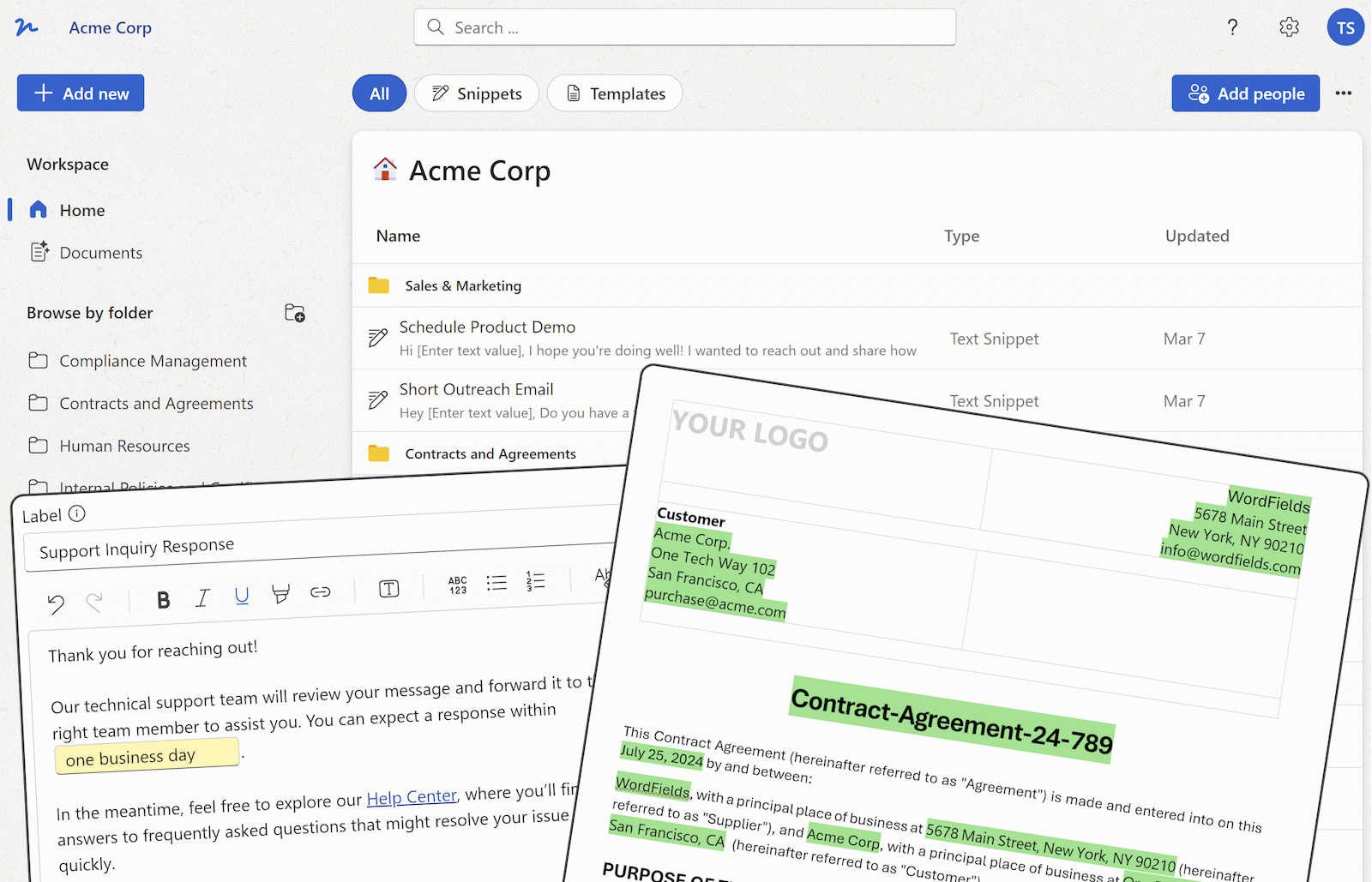
Each snippet auto-populates your name, email address, and organisation name when used in WordFields. Fill in the order or deliverable-specific fields at the point of use and insert directly into your email client, CRM, or project management tool via the Chrome extension — without switching tabs.
What's included
Each snippet auto-populates the following fields when used in WordFields:
- Client name, for direct address
- Order reference, PO number, or deliverable name — so the notification is tied to a specific item the client can act on immediately within their own systems
- Original date and revised date — the two pieces of information every delay notification must contain
- Cause, kept to one factual sentence — enough for the client to understand without making the explanation the dominant content of the email
- Sender name, email address, and organisation name — pulled automatically from the logged-in user and workspace, with no manual entry required
When to send a shipping delay email
The physical goods delay variant is for B2B supply relationships — a manufacturer notifying a procurement contact, a distributor notifying a reseller, a vendor notifying an operations team. The entire SERP on this topic is built around ecommerce parcels and discount codes. That is not the B2B context. In a B2B goods delay, the client receiving the notification is typically a procurement manager, operations lead, or logistics coordinator who needs the revised date to manage their own production schedule, stock levels, or fulfilment commitments downstream. The template is structured accordingly: the revised date and order reference are the primary content; the apology and cause are secondary. Offering a discount code to a procurement contact managing a manufacturing line is not appropriate — what they need is a reliable new date and a direct contact to escalate to if it moves again.
The project deliverable or service output variant covers the equivalent situation in professional services, managed services, agency work, or any engagement where the client is expecting a defined output by a defined date. The structural difference from the goods delay is the cascade question: a missed milestone in a project often affects other milestones, and clients need to know whether the delay is contained or whether it shifts their downstream planning. The template explicitly prompts the sender to address this — state whether other milestones are affected, or confirm they are not — because omitting it forces the client to ask, which compounds the original disruption. The offer of a call in the closing line is also deliberate: deliverable delays in professional services often need a conversation, not just an email, particularly where the client has their own stakeholders to manage.
Frequently asked questions
How do you inform a client of a delivery delay professionally?
Lead with the delay notification in your first sentence — don't bury it after a long explanation. State the revised delivery date clearly, explain the cause briefly without deflecting blame to third parties, and confirm what you are doing to manage the impact. In B2B contexts, reference the specific order, purchase order number, or project deliverable so the client can act on the information within their own systems immediately.
What should a shipping delay email to a business client include?
A B2B delay notification should include the specific order or deliverable reference, the original expected date, the revised date, a brief factual explanation of the cause, any interim measures being taken to minimise impact, and a direct contact for escalation or questions. Avoid vague timelines like 'as soon as possible' — clients need a concrete date to manage their own planning and downstream commitments.
When should you notify a client about a shipping or delivery delay?
As soon as you have confirmed the delay and can provide a revised date — even a provisional one. Notifying clients before they are due to receive the order or deliverable is significantly better than notifying them after it has already missed the deadline. Proactive notification gives the client time to adjust their own plans; reactive notification after a missed deadline compounds the problem and signals that you are not monitoring your own delivery performance.
How do you write a delay notification for a project deliverable?
State the specific deliverable, the original deadline, and the revised date in the opening. Explain the cause factually without over-elaborating or making the explanation longer than the update itself. Confirm whether the delay affects any other milestones or dependencies in the project, and state what you are doing to contain the impact. Close with a direct contact and offer a call if the delay has downstream implications for the client's own planning.
Should you apologise in a shipping delay email?
Yes, briefly. The apology should be one sentence and should not crowd out the practical information — the revised date, the cause, and the next step. A delay notification that is primarily apologetic rather than informative does not help the client manage the situation. Acknowledge the impact, apologise directly, then move to the operational substance.
How do you handle a repeat delay to the same client?
Acknowledge the pattern explicitly — do not write the same template as if it were the first delay. State what is being done differently this time and why the revised date is reliable. In B2B contexts, a second or third delay on the same order or project typically warrants escalation: the notification should come from a senior contact, not the same support agent, and should offer a call rather than relying on email alone to restore confidence.
What is the difference between a shipping delay email and a delivery delay notification?
In B2B contexts the distinction is one of scope rather than terminology. A shipping delay email typically relates to physical goods in transit — the order has been dispatched but will not arrive as scheduled. A delivery delay notification more broadly covers any committed output that will not be received on time, including project deliverables, service outputs, or software releases. Both require the same structural elements: reference, original date, revised date, cause, and next step.
How do you keep delay notifications consistent across a support team?
Store approved delay notification templates in a shared workspace where all team members access the same current version. Use fillable fields for the variable details — client name, order or deliverable reference, original date, revised date, cause — so agents personalise at point of use without rewriting from scratch. This prevents agents under time pressure from omitting the revised date or cause, which are the two most common failures in ad-hoc delay notifications.
Related customer service email templates
Explore more professional document and email templates you can copy, customize, and use immediately