Two professional feedback request email templates for B2B support teams. Gather CSAT after a resolved support interaction and request candid feedback after a complaint or service failure.
Hi [Client name],
Now that we've resolved [Issue description], I'd welcome a moment of your time.
On a scale of 1 to 5, how satisfied were you with how we handled this?
1 — Very dissatisfied
2 — Dissatisfied
3 — Neutral
4 — Satisfied
5 — Very satisfied
Just reply with a number — that's all I need. If there's anything specific you'd like to add, I'm glad to hear it, but a single number is genuinely useful on its own.
Thank you for letting us know.
[VALUE("Author.FullName")]
[VALUE("Organization")] | [VALUE("Author.EmailAddress")]
Hi Client name,
Now that we've resolved Issue description, I'd welcome a moment of your time.
On a scale of 1 to 5, how satisfied were you with how we handled this?
1 — Very dissatisfied
2 — Dissatisfied
3 — Neutral
4 — Satisfied
5 — Very satisfied
Just reply with a number — that's all I need. If there's anything specific you'd like to add, I'm glad to hear it, but a single number is genuinely useful on its own.
Thank you for letting us know.
=VALUE("Author.FullName")
=VALUE("Organization") | =VALUE("Author.EmailAddress")
Hi [Client name],
I want to ask you something directly, and I'd rather have an honest answer than a polite one.
[Issue description] was not a good experience for you, and I want to understand how we came across in handling it — not just whether the issue was resolved, but whether the way we responded gave you confidence in working with us.
Was there anything about how we communicated, or how long things took, that we should have done differently?
You don't need to soften it. Knowing where we genuinely fell short is more useful to us than a positive response that leaves a problem unaddressed.
[VALUE("Author.FullName")]
[VALUE("Organization")] | [VALUE("Author.EmailAddress")]
Hi Client name,
I want to ask you something directly, and I'd rather have an honest answer than a polite one.
Issue description was not a good experience for you, and I want to understand how we came across in handling it — not just whether the issue was resolved, but whether the way we responded gave you confidence in working with us.
Was there anything about how we communicated, or how long things took, that we should have done differently?
You don't need to soften it. Knowing where we genuinely fell short is more useful to us than a positive response that leaves a problem unaddressed.
=VALUE("Author.FullName")
=VALUE("Organization") | =VALUE("Author.EmailAddress")
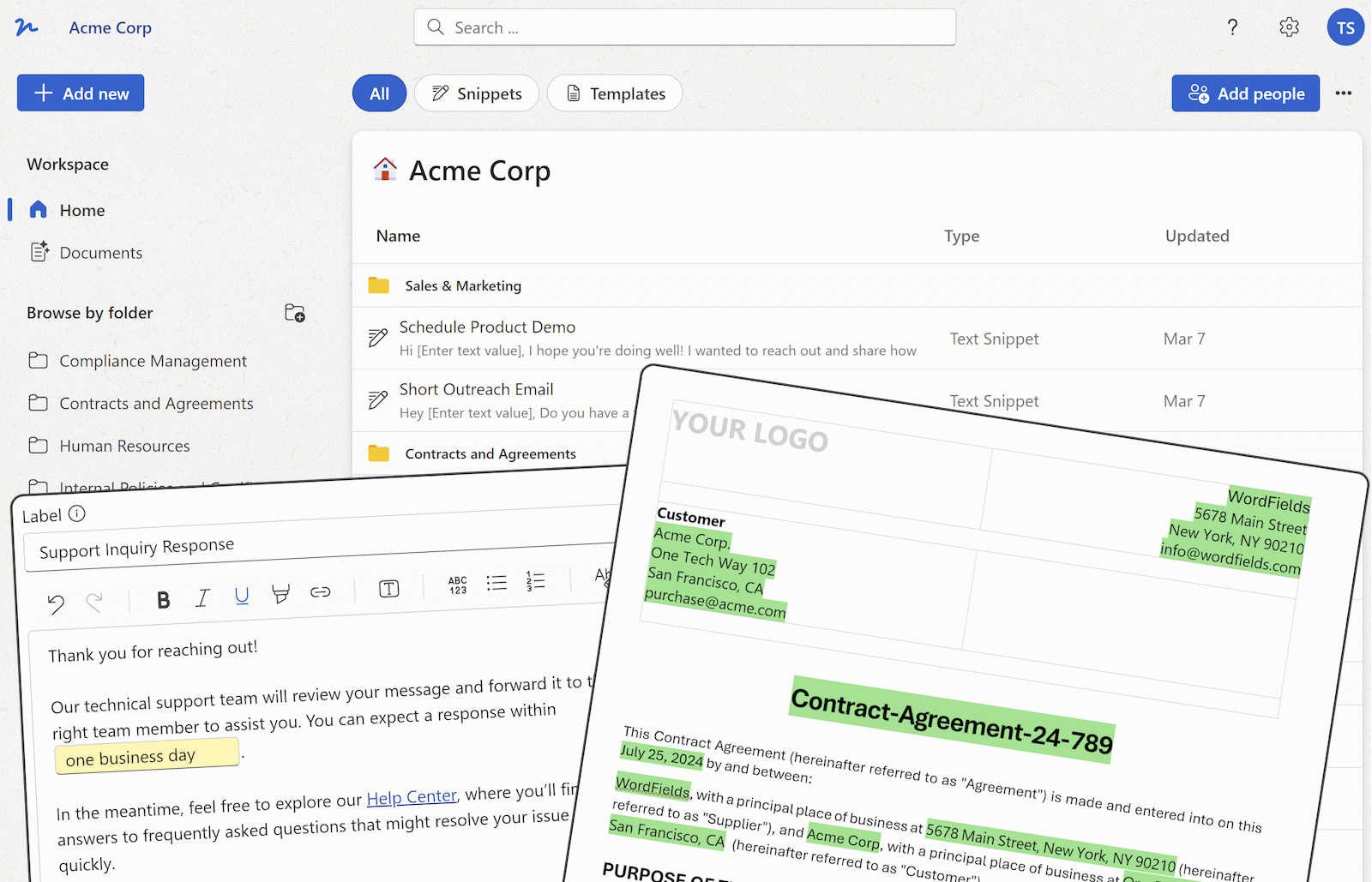
Each snippet auto-populates your name, email address, and organisation name when used in WordFields. Fill in the issue-specific fields at the point of use and insert directly into your email client, CRM, or helpdesk via the Chrome extension — without switching tabs.
What's included
Each snippet auto-populates the following fields when used in WordFields:
- Client name, for direct address
- Issue description, anchoring the feedback request to the specific interaction rather than a general satisfaction question
- Sender name, email address, and organisation name — pulled automatically from the logged-in user and workspace, with no manual entry required
When to send a feedback request email
The post-support CSAT request is sent 24 to 48 hours after a standard support issue has been resolved. Its purpose is narrow: measure satisfaction with that specific interaction, not the product, not the overall relationship, not a net promoter score. The in-email 1-to-5 scale with reply instructions removes the friction of an external survey link, which B2B contacts frequently ignore. The line "a single number is genuinely useful on its own" is deliberate — it removes the implicit pressure to compose a detailed response that many contacts feel when asked for feedback, and it increases response rate on interactions where the client has limited time. This variant is for volume: standard resolved tickets where the team needs a consistent signal on support quality without creating relationship friction.
The candid feedback request after a complaint operates entirely differently and should not be used for standard interactions. It applies after a complaint, serious apology, or service failure — situations where a client's confidence in the relationship has been tested and where a standard CSAT survey would read as tone-deaf or metric-driven. The template is built around the premise that honest qualitative feedback from a client who experienced a failure is more strategically valuable than a high CSAT score from a client who had no problems. The opening — "I'd rather have an honest answer than a polite one" — signals that the request is genuine rather than procedural. The closing — "knowing where we genuinely fell short is more useful to us than a positive response that leaves a problem unaddressed" — explicitly invites criticism, which is the single most effective way to get it. Clients who have been through a difficult interaction and are offered a genuine invitation to be direct typically provide the most actionable feedback a support team will ever receive.
Frequently asked questions
When should you send a feedback request email after a support interaction?
Send a feedback request 24 to 48 hours after the issue has been resolved — long enough for the client to have tested the resolution, not so long that the interaction feels distant. For high-impact or sensitive interactions like complaints or service failures, wait slightly longer — three to five days — to allow the relationship to stabilise before asking the client to reflect on their experience.
How do you ask a client for feedback without it feeling like a survey blast?
Reference the specific interaction rather than sending a generic satisfaction request. Name the issue that was resolved, the person who handled it, and ask a direct question rather than routing the client to an external survey link as the first and only ask. In B2B contexts, a personal email from a named team member asking one specific question receives a significantly higher response rate than an automated survey invitation addressed to no one in particular.
What is CSAT and how is it measured in a feedback email?
CSAT (Customer Satisfaction Score) measures a customer's satisfaction with a specific interaction, typically on a scale of 1 to 5 or by asking whether they were satisfied or not. In a feedback request email, the CSAT question is usually the primary ask — a single, simple rating — followed by an optional open question for qualitative context. Keeping the CSAT ask to one question in the email body, rather than embedding a full survey, increases response rates in B2B contexts where contacts have limited time.
Should you ask for feedback after a complaint or service failure?
Yes — but the timing and framing are different. Sending a standard CSAT survey immediately after a complaint resolution is tactically poor; it signals that your team's primary concern is the metric, not the client. Instead, ask for candid feedback on how the situation was handled, acknowledge that the experience was not ideal, and make clear that the purpose is genuine improvement rather than a satisfaction score. Clients who experienced a failure and were then asked for honest feedback typically respond with more valuable qualitative insight than those who had a smooth experience.
What is the difference between a feedback request email and a follow-up email?
A follow-up email's primary purpose is operational — confirming the fix held and giving the client a route back to support. A feedback request email's primary purpose is informational — gathering the client's assessment of the interaction for internal improvement or measurement. A follow-up serves the client's immediate needs; a feedback request serves your team's improvement process. They can be combined in a single email if the situation allows, but leading with a satisfaction survey when a client's issue may not be fully resolved is the wrong sequencing.
How do you write a feedback request that actually gets a response?
Ask one question, not several. Reference the specific interaction so the client knows it is not a generic campaign email. Keep the email under 100 words. Make the response frictionless — ask a question the client can answer with one or two sentences in a reply rather than requiring them to open a survey link. In B2B contexts, the single highest driver of feedback response rate is the perceived authenticity of the request: a short email from a named person asking a specific question outperforms a designed survey template every time.
What should you do with the feedback once it is received?
Acknowledge receipt promptly — even a one-line reply showing the feedback has been noted maintains the relationship. For qualitative feedback, log it against the relevant issue or account so patterns are visible over time. For negative feedback, treat it as an escalation signal: follow up directly rather than closing the loop with a generic acknowledgement. The return on asking for feedback is zero if the responses are not read, acted on, or used to improve the team's templates and processes.
How do you keep feedback request emails consistent across a support team?
Store approved feedback request templates in a shared workspace accessible to all agents. Use fillable fields for the variable details — client name, issue reference, agent name — so agents personalise at point of use without rewriting from scratch. The most common failure in ad-hoc feedback requests is either omitting the issue reference (making the email feel generic) or asking multiple questions (reducing response rate). A template with the right structure prevents both.
Related customer service email templates
Explore more professional document and email templates you can copy, customize, and use immediately