A free Word statement of work template covering project scope, deliverables, milestones, payment terms, and acceptance criteria. Fill it out in WordFields and send a consistently formatted SOW every time.
Statement of Work
| Project title | [Project title] |
| SOW reference | [SOW reference number] |
| Date | [Document date] |
| Version | [Version number — e.g. 1.0] |
| Service provider | [VALUE("Organization")] |
| Address | [Organization address] |
| Contact | [VALUE("Author.FullName")], [Your job title] |
| [VALUE("Author.EmailAddress")] |
| Client | [Client company name] |
| Address | [Client address] |
| Contact | [Client contact name], [Client contact title] |
| [Client contact email] |
Project Overview
[Two to three sentences describing the project at a high level — what it is, why it is being undertaken, and what it is intended to achieve]
Background
[Brief background on the client's situation, the challenge or opportunity, and any relevant history between the parties]
Objectives
The objectives of this engagement are:
- [Objective 1 — specific and measurable where possible]
- [Objective 2]
- [Objective 3 — add or remove as needed]
Scope of Work
In scope
[VALUE("Organization")] will perform the following work under this agreement:
- [Deliverable or activity 1 — be specific. Vague scope descriptions are the primary cause of disputes.]
- [Deliverable or activity 2]
- [Deliverable or activity 3]
- [Deliverable or activity 4 — add or remove as needed]
Out of scope
The following items are explicitly excluded from this statement of work:
- [Exclusion 1]
- [Exclusion 2]
- [Exclusion 3 — add or remove as needed]
Any work not listed under the in-scope section is considered out of scope and will require a change request.
Assumptions
This statement of work is prepared on the following assumptions:
- [Assumption 1 — e.g. client will provide access to X by Y date]
- [Assumption 2]
- [Assumption 3 — add or remove as needed]
If any of the above assumptions prove incorrect, the scope, timeline, or cost may need to be revised by mutual agreement.
Deliverables
| Deliverable | Description | Acceptance Criteria | Deadline |
|---|---|---|---|
| [Deliverable 1 name] | [Description] | [How completion will be verified] | [Deliverable 1 Deadline] |
| [Deliverable 2 name] | [Description] | [How completion will be verified] | [Deliverable 2 Deadline] |
| [Deliverable 3 name — add or remove rows as needed] | [Description] | [How completion will be verified] | [Deliverable 3 Deadline] |
The client will review each deliverable within [Number of business days for client review] business days of receipt. If no written feedback is provided within that period, the deliverable will be considered accepted.
Project Timeline
| Milestone | Description | Due Date |
|---|---|---|
| Project kickoff | [Kickoff description] | [Kickoff Date] |
| [Milestone 1 name] | [Milestone 1 description] | [Milestone 1 Date] |
| [Milestone 2 name] | [Milestone 2 description] | [Milestone 2 Date] |
| Final delivery | [Final delivery description] | [Final Delivery Date] |
The timeline above is contingent on timely receipt of materials, feedback, and approvals from [=TEXT([Client Company Name], "")]. Delays in client dependencies may require a revised schedule by mutual agreement.
Roles and Responsibilities
[VALUE("Organization")] responsibilities
- [Service provider responsibility 1]
- [Service provider responsibility 2]
- [Service provider responsibility 3 — add or remove as needed]
[=TEXT([Client Company Name], "")] responsibilities
- [Client responsibility 1 — e.g. provide access to systems, personnel, or data required]
- [Client responsibility 2]
- [Client responsibility 3 — add or remove as needed]
Change Request Process
Any request for work outside the agreed scope must be submitted as a formal change request. The process is as follows:
- [=TEXT([Client Company Name], "")] submits a written change request describing the additional work required.
- [VALUE("Organization")] assesses the change and responds within [Number of business days to respond to change requests] business days with an impact assessment covering scope, timeline, and cost.
- Both parties agree in writing before any out-of-scope work commences.
- Approved changes are documented as an addendum to this statement of work.
Verbal agreements to perform out-of-scope work are not binding under this agreement.
Fees and Payment
Project fee
The total fee for the work described above is [Total fee amount] [Currency — e.g. USD / GBP / EUR], exclusive of [Tax type — e.g. VAT / GST / applicable taxes].
Payment schedule
| Milestone | Amount Due | Due Date |
|---|---|---|
| [Payment milestone 1 — e.g. project commencement] | [Amount due] | [Payment 1 Date] |
| [Payment milestone 2] | [Amount due] | [Payment 2 Date] |
| [Payment milestone 3 — e.g. final delivery] | [Amount due] | [Payment 3 Date] |
Payment terms
Invoices are due within [Number of days invoices are due] days of issue. Late payments may incur interest at [Late payment interest rate — e.g. 1.5%]% per month or the maximum rate permitted by applicable law, whichever is lower.
Expenses
[Expense terms — e.g. out-of-pocket expenses are not included in the fee above. Any reimbursable expenses will be submitted with receipts and invoiced at cost.]
Confidentiality
Both parties agree to treat as confidential any proprietary information disclosed during this engagement and not to disclose it to third parties without prior written consent. This obligation survives termination of this agreement.
Intellectual Property
[Select and describe the IP arrangement: either all deliverables transfer to the client upon full payment, or the service provider retains ownership and grants the client a licence. Delete the inapplicable option.]
Term and Termination
This agreement commences on [Project start date] and concludes on [Project end date] or upon acceptance of all deliverables, whichever is earlier.
Either party may terminate this agreement with [Notice period in days] days written notice. In the event of termination, [=TEXT([Client Company Name], "")] shall pay for all work completed to the date of termination at the agreed rates.
Governing Law
This agreement is governed by the laws of [Governing jurisdiction — e.g. England and Wales / the State of New York]. Any disputes arising under this agreement shall be subject to the exclusive jurisdiction of the courts of [=TEXT([Governing Law], "")].
Signatures
By signing below, both parties agree to the terms of this statement of work.
| [VALUE("Organization")] | [=TEXT([Client Company Name], "")] |
| Signature: ___________________________ | Signature: ___________________________ |
| Name: [VALUE("Author.FullName")] | Name: [=TEXT([Client Contact Name], "")] |
| Title: [=TEXT([Author Job Title], "")] | Title: [=TEXT([Client Contact Title], "")] |
| Date: ________________________________ | Date: ________________________________ |
| Project title | Project title |
| SOW reference | SOW reference number |
| Date | Document date |
| Version | Version number — e.g. 1.0 |
| Service provider | =VALUE("Organization") |
| Address | Organization address |
| Contact | =VALUE("Author.FullName"), Your job title |
| =VALUE("Author.EmailAddress") |
| Client | Client company name |
| Address | Client address |
| Contact | Client contact name, Client contact title |
| Client contact email |
Two to three sentences describing the project at a high level — what it is, why it is being undertaken, and what it is intended to achieve
Brief background on the client's situation, the challenge or opportunity, and any relevant history between the parties
The objectives of this engagement are:
- Objective 1 — specific and measurable where possible
- Objective 2
- Objective 3 — add or remove as needed
=VALUE("Organization") will perform the following work under this agreement:
- Deliverable or activity 1 — be specific. Vague scope descriptions are the primary cause of disputes.
- Deliverable or activity 2
- Deliverable or activity 3
- Deliverable or activity 4 — add or remove as needed
The following items are explicitly excluded from this statement of work:
- Exclusion 1
- Exclusion 2
- Exclusion 3 — add or remove as needed
Any work not listed under the in-scope section is considered out of scope and will require a change request.
This statement of work is prepared on the following assumptions:
- Assumption 1 — e.g. client will provide access to X by Y date
- Assumption 2
- Assumption 3 — add or remove as needed
If any of the above assumptions prove incorrect, the scope, timeline, or cost may need to be revised by mutual agreement.
| Deliverable | Description | Acceptance Criteria | Deadline |
|---|---|---|---|
| Deliverable 1 name | Description | How completion will be verified | Deliverable 1 Deadline |
| Deliverable 2 name | Description | How completion will be verified | Deliverable 2 Deadline |
| Deliverable 3 name — add or remove rows as needed | Description | How completion will be verified | Deliverable 3 Deadline |
The client will review each deliverable within Number of business days for client review business days of receipt. If no written feedback is provided within that period, the deliverable will be considered accepted.
| Milestone | Description | Due Date |
|---|---|---|
| Project kickoff | Kickoff description | Kickoff Date |
| Milestone 1 name | Milestone 1 description | Milestone 1 Date |
| Milestone 2 name | Milestone 2 description | Milestone 2 Date |
| Final delivery | Final delivery description | Final Delivery Date |
The timeline above is contingent on timely receipt of materials, feedback, and approvals from =TEXT([Client Company Name], ""). Delays in client dependencies may require a revised schedule by mutual agreement.
- Service provider responsibility 1
- Service provider responsibility 2
- Service provider responsibility 3 — add or remove as needed
- Client responsibility 1 — e.g. provide access to systems, personnel, or data required
- Client responsibility 2
- Client responsibility 3 — add or remove as needed
Any request for work outside the agreed scope must be submitted as a formal change request. The process is as follows:
- =TEXT([Client Company Name], "") submits a written change request describing the additional work required.
- =VALUE("Organization") assesses the change and responds within Number of business days to respond to change requests business days with an impact assessment covering scope, timeline, and cost.
- Both parties agree in writing before any out-of-scope work commences.
- Approved changes are documented as an addendum to this statement of work.
Verbal agreements to perform out-of-scope work are not binding under this agreement.
The total fee for the work described above is Total fee amount Currency — e.g. USD / GBP / EUR, exclusive of Tax type — e.g. VAT / GST / applicable taxes.
| Milestone | Amount Due | Due Date |
|---|---|---|
| Payment milestone 1 — e.g. project commencement | Amount due | Payment 1 Date |
| Payment milestone 2 | Amount due | Payment 2 Date |
| Payment milestone 3 — e.g. final delivery | Amount due | Payment 3 Date |
Invoices are due within Number of days invoices are due days of issue. Late payments may incur interest at Late payment interest rate — e.g. 1.5%% per month or the maximum rate permitted by applicable law, whichever is lower.
Expense terms — e.g. out-of-pocket expenses are not included in the fee above. Any reimbursable expenses will be submitted with receipts and invoiced at cost.
Both parties agree to treat as confidential any proprietary information disclosed during this engagement and not to disclose it to third parties without prior written consent. This obligation survives termination of this agreement.
Select and describe the IP arrangement: either all deliverables transfer to the client upon full payment, or the service provider retains ownership and grants the client a licence. Delete the inapplicable option.
This agreement commences on Project start date and concludes on Project end date or upon acceptance of all deliverables, whichever is earlier.
Either party may terminate this agreement with Notice period in days days written notice. In the event of termination, =TEXT([Client Company Name], "") shall pay for all work completed to the date of termination at the agreed rates.
This agreement is governed by the laws of Governing jurisdiction — e.g. England and Wales / the State of New York. Any disputes arising under this agreement shall be subject to the exclusive jurisdiction of the courts of =TEXT([Governing Law], "").
By signing below, both parties agree to the terms of this statement of work.
| =VALUE("Organization") | =TEXT([Client Company Name], "") |
| Signature: ___________________________ | Signature: ___________________________ |
| Name: =VALUE("Author.FullName") | Name: =TEXT([Client Contact Name], "") |
| Title: =TEXT([Author Job Title], "") | Title: =TEXT([Client Contact Title], "") |
| Date: ________________________________ | Date: ________________________________ |
These templates are a starting point. Have a legal professional review any agreement before signing.
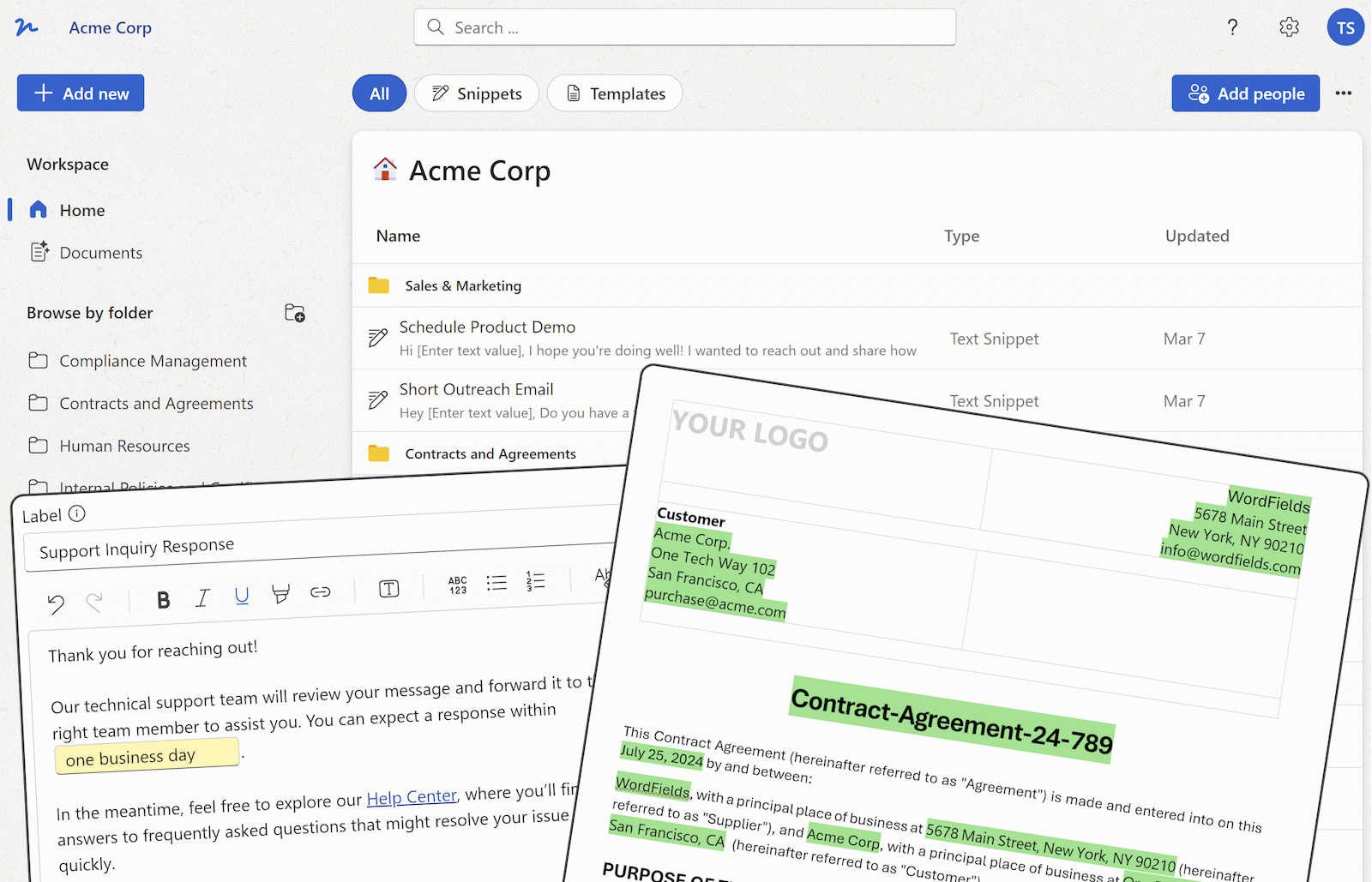
Use WordFields to fill in and generate a complete statement of work in under two minutes — scope, deliverables, milestones, and payment terms all update from the form. Share the template with your team so every SOW goes out on the same approved, consistently formatted document.
What's included
This template auto-populates the following fields when used in WordFields:
- SOW reference number and version
- Client company name, contact name, and email
- Sender name, job title, email, and company details (pulled from the logged-in user and workspace automatically)
- Project title, objectives, and background
- Scope of work — in scope, out of scope, and assumptions
- Deliverables table with acceptance criteria and deadlines
- Project timeline and milestones
- Roles and responsibilities for both parties
- Total fee, payment schedule, and payment terms
- Expense reimbursement terms
- Intellectual property option (ownership or licence)
- Start date, end date, and termination notice period
- Governing jurisdiction
When to use a statement of work
Send the SOW after the proposal has been accepted and before work begins. The proposal wins the engagement — the SOW governs it. A common mistake is treating the proposal as the governing document and skipping the SOW entirely. Proposals are persuasive documents, not operational contracts. They describe your approach at a level of detail sufficient to win agreement, not the precision required to manage delivery, handle disputes, or process a change request. Once a client says yes, the proposal has done its job. The SOW takes over.
The two most important sections to write with care are scope and deliverables. Vague scope is the primary cause of scope creep — the gradual expansion of work beyond what was originally agreed, usually without additional payment. Every item in the scope section should be specific enough that both parties would agree, without discussion, on whether it has been completed. The out-of-scope section is equally important. Stating explicitly what is not included removes the assumption that everything not mentioned is implicitly included.
The change request clause is not a defensive measure — it is a professional one. Clients who understand that changes go through a formal process are more likely to be deliberate about what they ask for and more respectful of the original scope. It also gives you a structured way to say yes to additional work without feeling like you are giving something away. If your team generates SOWs regularly, a shared template in WordFields means the change request language, payment terms, and IP clause are consistent across every engagement — not left to whoever wrote the last one.
Frequently asked questions
What should a statement of work include?
A statement of work should include a project overview and objectives, a detailed scope of work covering what is and is not included, a list of deliverables with acceptance criteria for each, a project timeline with milestones, roles and responsibilities for both parties, payment terms and schedule, a change request process, and a signature block. The scope section is typically the longest and most important — vague scope is the primary cause of disputes and scope creep in service engagements.
What is the difference between a statement of work and a scope of work?
A statement of work is a comprehensive, formal document that governs the entire engagement — it covers objectives, deliverables, timeline, payment, legal terms, and acceptance criteria. A scope of work is a focused section within the statement of work that details the specific tasks and activities to be performed. Think of the scope of work as the 'what and how' section inside the broader SOW. Both are sometimes abbreviated as SOW, which causes confusion, but they are not interchangeable documents.
What is the difference between a statement of work and a proposal?
A proposal is sent before the client has committed — it makes the case for why you are the right choice and outlines your proposed approach and pricing. A statement of work is created after the client has agreed to proceed — it formalises the specific terms of the engagement, defines deliverables precisely, and is typically signed by both parties before work begins. The proposal persuades; the SOW governs. In many sales processes, the SOW replaces or supplements a formal contract for service-based work.
Is a statement of work legally binding?
Yes, once signed by both parties a statement of work is generally a legally binding agreement. It can function as a standalone contract for service engagements, or it can operate as a project-specific addendum under a broader master service agreement. Because it is a legal document, you should have your legal team review the template before using it at scale, and ensure it reflects the laws of the jurisdiction in which you operate. This template provides a general starting point and is not a substitute for legal advice.
What is a change request clause in a statement of work?
A change request clause defines the process for handling work that falls outside the original scope. It specifies who can request a change, how it must be submitted, how it will be assessed and priced, and who needs to approve it before additional work proceeds. Including a change request clause protects both parties — it prevents the service provider from being expected to deliver extra work for free, and it gives the client a clear, formal path to request changes without disrupting the project.
Related sales templates
Explore more professional document and email templates you can copy, customize, and use immediately