Three professional job rejection email templates for recruiters and hiring managers — post-application, post-first interview, and post-final interview. Send with the right tone at every stage.
Dear [Candidate first name],
Thank you for taking the time to apply for the [Job title] role at [VALUE("Organization")]. We genuinely appreciate your interest in joining our team.
After reviewing your application, we have decided to move forward with other candidates whose experience more closely matches what we are looking for at this stage.
We will keep your details on file and encourage you to look out for future roles at [VALUE("Organization")] that may be a good fit.
We wish you the best in your job search.
Kind regards,
[VALUE("Author.FullName")]
[Sender job title]
[VALUE("Organization")]
Dear Candidate first name,
Thank you for taking the time to apply for the Job title role at =VALUE("Organization"). We genuinely appreciate your interest in joining our team.
After reviewing your application, we have decided to move forward with other candidates whose experience more closely matches what we are looking for at this stage.
We will keep your details on file and encourage you to look out for future roles at =VALUE("Organization") that may be a good fit.
We wish you the best in your job search.
Kind regards,
=VALUE("Author.FullName")
Sender job title
=VALUE("Organization")
Dear [Candidate first name],
Thank you for coming in to speak with us about the [Job title] role. It was a pleasure learning more about your background and experience, and we appreciate the time and preparation you put into the interview.
After careful consideration, we have decided to move forward with another candidate whose experience more closely aligns with our requirements for this particular role. This was not an easy decision — the standard of candidates we met was high.
We would encourage you to apply for future opportunities at [VALUE("Organization")] that match your skills, and we will certainly keep your application in mind. If you would like any feedback on your interview, please feel free to reply to this email and we will do our best to help.
We wish you every success in your search.
Kind regards,
[VALUE("Author.FullName")]
[Sender job title]
[VALUE("Organization")]
Dear Candidate first name,
Thank you for coming in to speak with us about the Job title role. It was a pleasure learning more about your background and experience, and we appreciate the time and preparation you put into the interview.
After careful consideration, we have decided to move forward with another candidate whose experience more closely aligns with our requirements for this particular role. This was not an easy decision — the standard of candidates we met was high.
We would encourage you to apply for future opportunities at =VALUE("Organization") that match your skills, and we will certainly keep your application in mind. If you would like any feedback on your interview, please feel free to reply to this email and we will do our best to help.
We wish you every success in your search.
Kind regards,
=VALUE("Author.FullName")
Sender job title
=VALUE("Organization")
Dear [Candidate first name],
Thank you for the time you invested throughout our interview process for the [Job title] role. We very much enjoyed our conversations with you and were genuinely impressed by [Specific positive quality — e.g. your depth of experience in X / the approach you outlined for Y].
After a great deal of consideration, we have made the difficult decision to offer the role to another candidate. The decision came down to [Brief honest reason — e.g. a closer match to the technical requirements of the role], and was in no way a reflection of the quality you demonstrated throughout the process.
We would very much like to stay in touch. If a role comes up that we think would be a strong fit for you, we will be in touch directly. In the meantime, please do not hesitate to connect with me on LinkedIn or reach out if there is anything I can do to support your search.
Thank you again — it was a genuine pleasure getting to know you.
Kind regards,
[VALUE("Author.FullName")]
[Sender job title]
[VALUE("Organization")]
[Sender LinkedIn URL — leave blank if not sharing]
Dear Candidate first name,
Thank you for the time you invested throughout our interview process for the Job title role. We very much enjoyed our conversations with you and were genuinely impressed by Specific positive quality — e.g. your depth of experience in X / the approach you outlined for Y.
After a great deal of consideration, we have made the difficult decision to offer the role to another candidate. The decision came down to Brief honest reason — e.g. a closer match to the technical requirements of the role, and was in no way a reflection of the quality you demonstrated throughout the process.
We would very much like to stay in touch. If a role comes up that we think would be a strong fit for you, we will be in touch directly. In the meantime, please do not hesitate to connect with me on LinkedIn or reach out if there is anything I can do to support your search.
Thank you again — it was a genuine pleasure getting to know you.
Kind regards,
=VALUE("Author.FullName")
Sender job title
=VALUE("Organization")
Sender LinkedIn URL — leave blank if not sharing
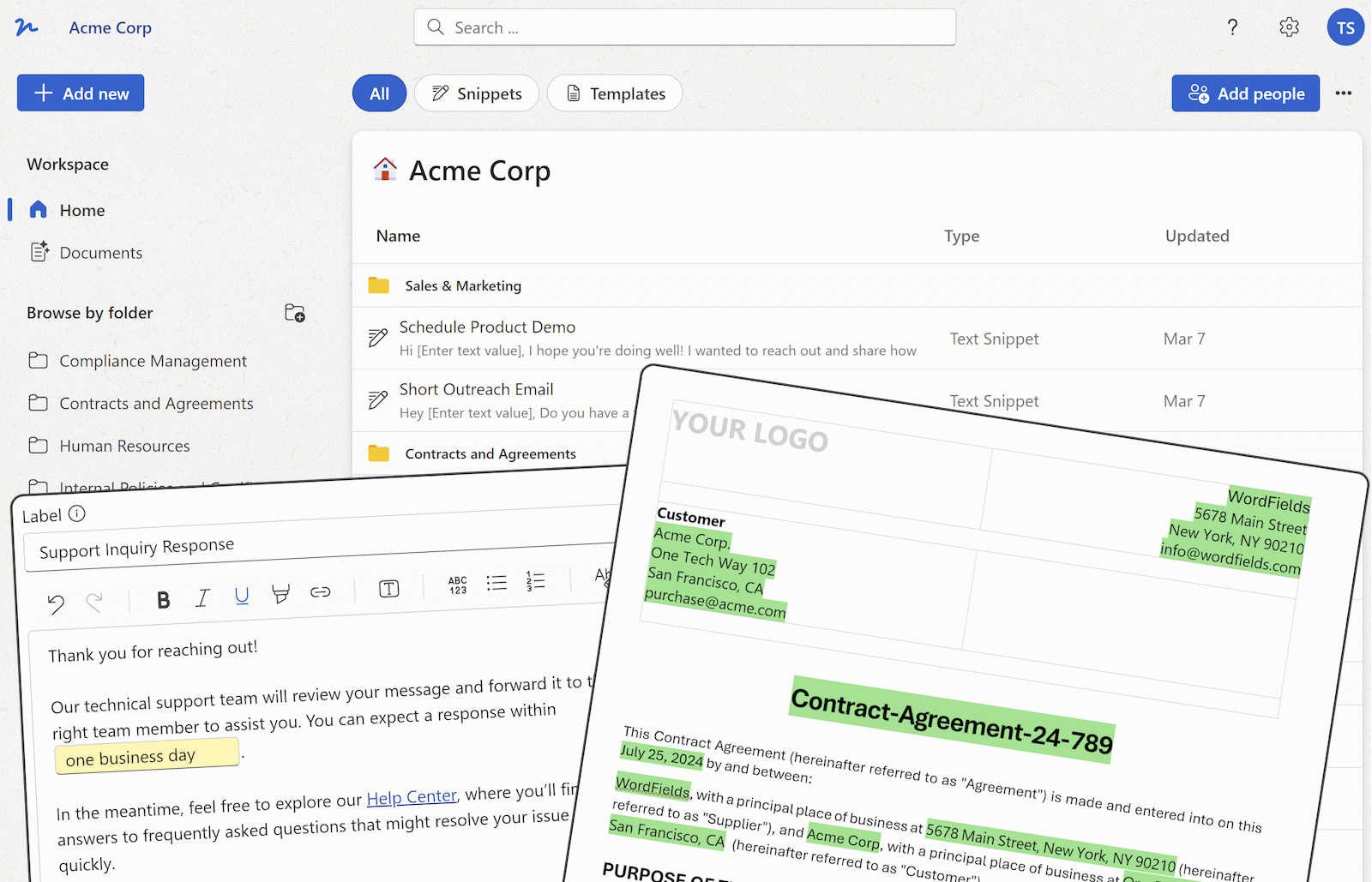
Save these snippets in WordFields so every recruiter and hiring manager on your team sends a consistent, correctly worded rejection at every stage — candidate name, job title, and sender details auto-populate from the form, so nothing gets left blank and no previous candidate's name gets accidentally left in.
What's included
Each snippet auto-populates the following fields when used in WordFields:
- Candidate first name
- Job title and company name (pulled from your workspace automatically)
- Sender full name and job title (pulled from the logged-in user automatically)
- Optional: specific positive quality and reason for rejection (post-final interview variant)
- Optional: sender LinkedIn URL (post-final interview variant)
How to use these templates
Match the variant to the stage. The post-application snippet is deliberately short — candidates rejected before interview have invested less time and a lengthy email can feel disproportionate. The post-first-interview snippet adds warmth and opens the door to feedback without making a commitment to provide a full debrief. The post-final-interview snippet is the most personal — it names something specific about the candidate, gives an honest reason for the decision, and ends the relationship on a genuinely warm note.
For final-stage rejections, consider calling the candidate before sending the email. A phone call gives them a moment to process the news and ask questions; the email then serves as written confirmation of what was discussed. If you call first, send the email the same day.
One field in the post-final-interview variant is intentionally left open: the specific positive quality and the reason for the decision. Do not leave these blank or fill them with generic text. Take sixty seconds to personalise them for each candidate — it is the single most important thing you can do to protect your employer brand at the final stage.
Frequently asked questions
What should a job rejection email include?
At minimum: the candidate's name, the role they applied for, a clear statement that they have not been selected, and a thank you for their time. For candidates who reached the interview stage, add a brief and honest reason for the decision and an invitation to apply for future roles if appropriate. Avoid vague phrases like 'we had many strong candidates' without any supporting context — candidates find them dismissive and they damage your employer brand.
When should you send a job rejection email?
As soon as the decision is made — do not wait until the successful candidate has accepted before notifying those who were unsuccessful. Candidates who have been through interviews are often holding off on other opportunities while they wait to hear, and leaving them in limbo is disrespectful of their time. For post-application rejections, aim to notify within two weeks of the application closing. For post-interview rejections, notify within 48 hours of the decision.
Should you give feedback in a rejection email?
For candidates who reached the interview stage, a brief reason for the decision is good practice and helps candidates understand where they stand. Keep it specific but concise — one or two sentences about the deciding factor is sufficient. Avoid excessive detail that could create legal risk, and never make the feedback personal. For post-application rejections where you may not have reviewed the application in depth, feedback is not expected and not necessary.
Is it better to call or email a candidate to reject them?
For candidates who have been through multiple interview rounds or a final-stage interview, a phone call before the email is considered best practice — it is more personal and gives the candidate a chance to ask questions. For candidates rejected after a first interview or at the application stage, email is standard and appropriate. If you do call first, always follow up with an email to confirm the decision in writing.
Can I use the same rejection email template for every candidate?
The structure stays the same, but the content should reflect how far the candidate progressed. A post-application rejection is shorter and less personal than a post-final-interview rejection. The three snippets on this page are calibrated to each stage — post-application is brief and respectful, post-first interview adds a light personal touch, and post-final interview is warmer and includes more context. In WordFields, the variable fields auto-populate so any recruiter on your team can send the right version in seconds.
Related human resources templates
Explore more professional document and email templates you can copy, customize, and use immediately