Three escalation email templates for operations and admin teams — escalating an unresolved issue to a manager, escalating a supplier performance failure, and escalating an internal blocker across departments. Factual, solution-focused, and professionally structured.
Hi [Manager name],
I'm escalating an issue that has not been resolved through normal channels and now requires your involvement.
Issue: [One clear sentence describing the problem].
Previous attempts to resolve:
- [Date and action taken — e.g. raised with IT helpdesk, ticket opened, no update received]
- [Date and action taken — e.g. followed up by email to [name], no response]
- [Date and action taken — add further attempts as needed]
Current impact: [One or two sentences describing current operational impact].
What I need from you: [Specific ask — e.g. confirm who owns this issue and set a resolution deadline / approve an interim workaround].
I would welcome a brief call if useful. Otherwise, please advise by [Response deadline].
[VALUE("Author.FullName")]
[VALUE("Author.EmailAddress")]
[VALUE("Organization")]
Hi Manager name,
I'm escalating an issue that has not been resolved through normal channels and now requires your involvement.
Issue: One clear sentence describing the problem.
Previous attempts to resolve:
- Date and action taken — e.g. raised with IT helpdesk, ticket opened, no update received
- Date and action taken — e.g. followed up by email to [name], no response
- Date and action taken — add further attempts as needed
Current impact: One or two sentences describing current operational impact.
What I need from you: Specific ask — e.g. confirm who owns this issue and set a resolution deadline / approve an interim workaround.
I would welcome a brief call if useful. Otherwise, please advise by Response deadline.
=VALUE("Author.FullName")
=VALUE("Author.EmailAddress")
=VALUE("Organization")
Hi [Senior supplier contact name],
I'm writing to formally escalate a performance issue that has not been resolved through communication with [Primary contact name at the supplier] at [Supplier company name].
Issue: [One sentence describing the issue — e.g. four consecutive late deliveries against the agreed lead time].
Timeline:
- [Incident 1 — date, order reference, what happened]
- [Incident 2 — date, order reference, what happened]
- [Incident 3 — date, order reference, what happened]
Previous communications: I raised this with [Primary contact name] on [First communication date] and again on [Follow-up communication date]. [Outcome — e.g. no response received / response on [date] did not result in any change to performance].
Contractual reference: Our agreement requires [Specific standard — e.g. on-time delivery of 98% / maximum lead time of [X] business days]. Current performance is not meeting this standard.
Operational impact: [One or two sentences — e.g. production stoppages, emergency stock costs].
I am requesting: [Specific ask — e.g. written root cause explanation within five business days / a meeting to agree a resolution].
[VALUE("Author.FullName")]
[VALUE("Author.EmailAddress")]
[VALUE("Organization")]
Hi Senior supplier contact name,
I'm writing to formally escalate a performance issue that has not been resolved through communication with Primary contact name at the supplier at Supplier company name.
Issue: One sentence describing the issue — e.g. four consecutive late deliveries against the agreed lead time.
Timeline:
- Incident 1 — date, order reference, what happened
- Incident 2 — date, order reference, what happened
- Incident 3 — date, order reference, what happened
Previous communications: I raised this with Primary contact name on First communication date and again on Follow-up communication date. Outcome — e.g. no response received / response on [date] did not result in any change to performance.
Contractual reference: Our agreement requires Specific standard — e.g. on-time delivery of 98% / maximum lead time of [X] business days. Current performance is not meeting this standard.
Operational impact: One or two sentences — e.g. production stoppages, emergency stock costs.
I am requesting: Specific ask — e.g. written root cause explanation within five business days / a meeting to agree a resolution.
=VALUE("Author.FullName")
=VALUE("Author.EmailAddress")
=VALUE("Organization")
Hi [Senior stakeholder name],
I'm flagging an unresolved dependency that is blocking progress on [Project or process name] and needs your visibility.
The blocker: [One sentence describing the blocker — e.g. legal sign-off requested on [date] and not yet received].
Impact on our work: [One or two sentences describing the operational impact of the delay].
What has been attempted:
- [Action 1 — e.g. request submitted to legal team via [channel]]
- [Action 2 — e.g. followed up with [name] by email]
- [Action 3 — e.g. raised in [meeting] — no update provided]
I am not looking to bypass the legal team's process — I recognise there may be constraints I'm not aware of. I am raising this so you can help identify whether there is a path to resolution within [Timeframe — e.g. this week / five business days] and, if not, what the appropriate next step is.
Please let me know how you would like to proceed.
[VALUE("Author.FullName")]
[VALUE("Author.EmailAddress")]
[VALUE("Organization")]
Hi Senior stakeholder name,
I'm flagging an unresolved dependency that is blocking progress on Project or process name and needs your visibility.
The blocker: One sentence describing the blocker — e.g. legal sign-off requested on [date] and not yet received.
Impact on our work: One or two sentences describing the operational impact of the delay.
What has been attempted:
- Action 1 — e.g. request submitted to legal team via [channel]
- Action 2 — e.g. followed up with [name] by email
- Action 3 — e.g. raised in [meeting] — no update provided
I am not looking to bypass the legal team's process — I recognise there may be constraints I'm not aware of. I am raising this so you can help identify whether there is a path to resolution within Timeframe — e.g. this week / five business days and, if not, what the appropriate next step is.
Please let me know how you would like to proceed.
=VALUE("Author.FullName")
=VALUE("Author.EmailAddress")
=VALUE("Organization")
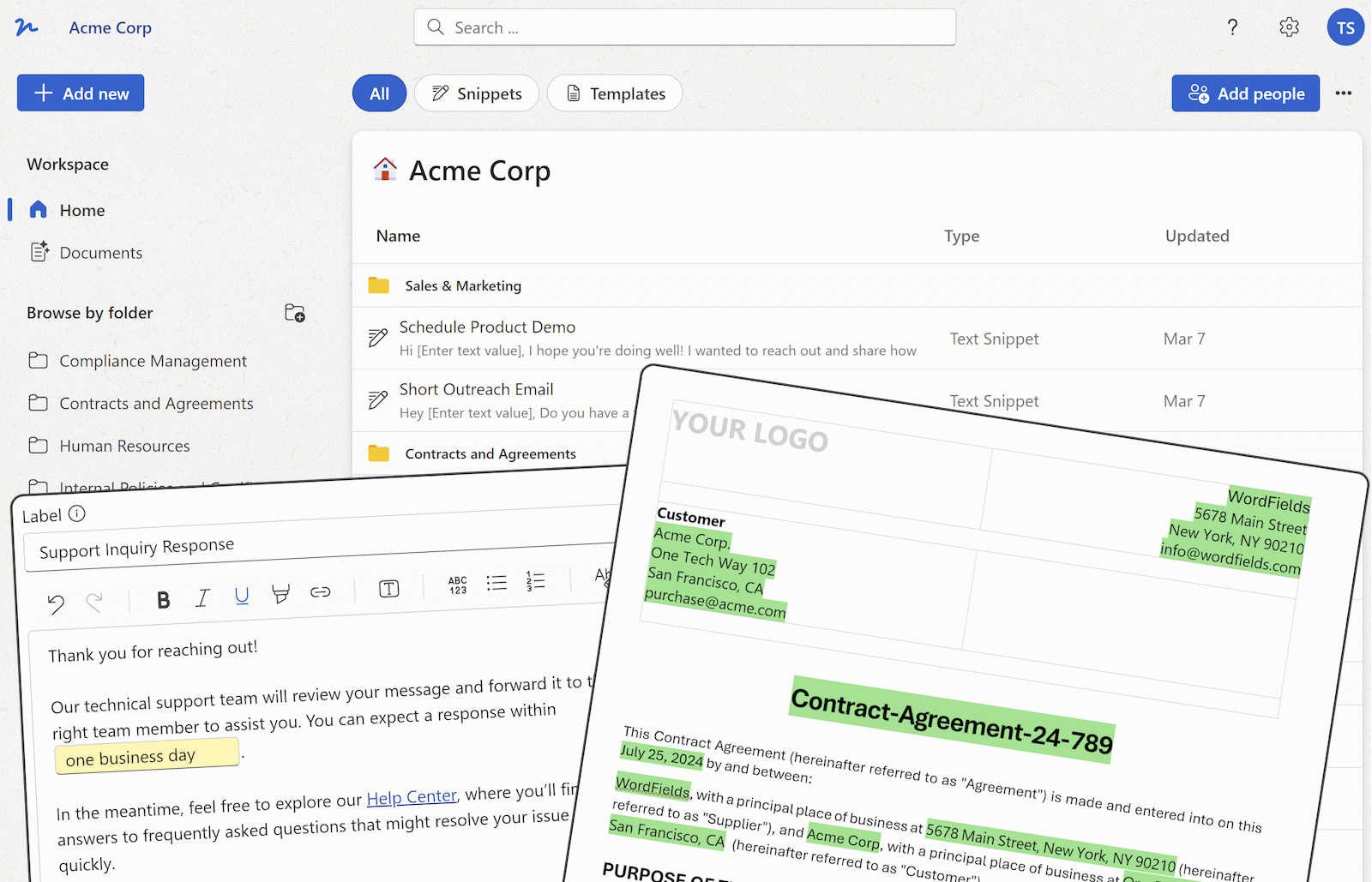
Your name, email address, and organisation name fill in automatically via WordFields merge tags — no manual edits before sending. Use the Chrome extension to insert directly into Gmail, Outlook, or any internal tool without switching tabs.
What's included
Each snippet auto-populates the following fields when used in WordFields:
- Issue summary and the date the problem started
- Chronological log of previous attempts with dates and outcomes
- Operational impact stated in concrete terms
- Contractual or agreed standard referenced by name or metric (supplier variant)
- Specific ask — decision, intervention, or action required — with a response deadline
- Sender name, email, and organisation name (pulled from the logged-in user and workspace automatically)
When to send an escalation email
Use the internal escalation to manager template when a problem has not been resolved through normal channels and the delay is creating operational impact. The three-item previous-attempts log is the most important structural element — it demonstrates that escalation is a last step, not a first response, and gives the manager the information they need to intervene without asking for a full briefing. Operations managers, procurement leads, and admin teams blocked on system access, approval delays, or unresponsive internal contacts will reach for this variant most frequently. The response deadline in the closing line is not optional — an escalation without a deadline is a status update. Including one signals that the issue is time-bound and requires a decision, not just awareness.
Use the supplier escalation template when a performance issue has been raised with a supplier's primary contact and has not produced a change in behaviour. The key distinction between this template and the supplier-feedback-email performance concern variant is the recipient: the feedback page targets the existing contact at the operational level, while this escalation goes above that contact to a senior person at the supplier organisation. The timeline section — incidents listed with dates and order references — is the core of this email. It removes any possibility of the supplier claiming they were unaware of the issue or that it was isolated, and it demonstrates that the escalation is grounded in documented fact rather than frustration. Procurement teams managing supplier relationships where informal feedback has not produced improvement will use this variant before moving to contract review.
Use the cross-department blocker escalation template when work is stalled because another internal team has not delivered a dependency — a legal sign-off, a finance approval, an IT configuration, a data request — despite repeated follow-up. The closing paragraph is deliberately collaborative in tone: "I am not looking to bypass the legal team's process." This framing is not diplomatic padding — it is the difference between an escalation that produces a senior-level conversation and one that puts a department head on the defensive. Operations teams exist at the intersection of multiple internal functions and frequently depend on decisions or outputs they cannot control directly. A well-framed cross-department escalation that acknowledges constraints while clearly stating impact and asking for a path to resolution is one of the most useful operational communication tools available.
Frequently asked questions
What is an escalation email?
An escalation email is a formal written communication sent to a higher authority — a manager, senior leader, or external counterpart — when an issue cannot be resolved at the current level. It is not a complaint. It is a request for visibility, decision-making authority, or intervention that the sender does not have access to on their own. A well-written escalation email describes the issue factually, documents what has already been tried, states the impact, and makes a specific ask — all without emotional language or blame.
When should you send an escalation email?
Escalate when a problem meets at least one of these conditions: a deadline has passed or is at risk and normal follow-up has not produced action; a decision is stalled and the delay is creating downstream impact; a risk is increasing that the current level cannot mitigate; or repeated attempts to resolve the issue through normal channels have been ignored or have failed. Do not escalate after a single unreturned email — allow a reasonable window for response first. Escalating too early signals impatience; escalating too late limits the options available to the person you are escalating to.
What should an escalation email include?
An escalation email should include a clear one-line statement of the issue in the subject line, a brief factual summary of what the problem is and when it started, a chronological record of previous attempts to resolve it with dates, a statement of the current impact on operations or the business, and a specific ask — whether that is a decision, an intervention, or a deadline for action. Keep the tone neutral and solution-focused. The reader should be able to understand the full situation and know exactly what is being requested without reading any prior emails.
How do you escalate an issue professionally without damaging relationships?
Frame the escalation as a request for help, not an accusation. Use factual language — dates, reference numbers, specific outcomes — rather than adjectives like 'unacceptable' or 'frustrating.' Acknowledge that the person or team being escalated over may have constraints you are not aware of. State the business impact rather than the personal inconvenience. And make the ask collaborative — 'I would welcome your guidance on how to resolve this' rather than 'I need you to fix this immediately.' Escalation done this way signals competence and professionalism rather than friction.
What is the difference between an escalation email and a complaint email?
A complaint email expresses dissatisfaction with a product, service, or behaviour. An escalation email requests intervention to unblock a specific issue that cannot be resolved at the current level. The key distinction is the ask: a complaint seeks acknowledgement or remedy; an escalation seeks authority, a decision, or action that only a higher level can provide. In practice, escalations are more structured, more factual, and more solution-focused than complaints. They are also more time-sensitive — an escalation is sent because something is actively blocking progress, not simply because something went wrong.
How do you escalate a supplier issue formally?
Document the specific performance failure with dates, order references, and metrics. Reference the contractual or agreed standard that was not met. State the operational impact in concrete terms — production delays, additional costs, customer complaints. Record the previous communications sent to the supplier's primary contact and the responses or lack of responses received. Then escalate directly to a senior contact at the supplier — account director, operations manager, or equivalent — with a specific request: a root cause explanation, a corrective action plan, or a meeting to resolve the issue within a defined timeframe.
How many times should you follow up before escalating?
For internal issues, two to three attempts through normal channels over a reasonable period — typically five to ten business days depending on urgency — is the standard threshold before escalation is appropriate. For external supplier issues with operational impact, one formal notice followed by one follow-up within 48 hours is often sufficient before escalating to a senior contact. The threshold should reflect the urgency and impact of the issue, not a fixed number of emails. If a deadline is imminent or the impact is already material, escalating after a single unanswered communication is entirely appropriate.
Related operations email templates
Explore more professional document and email templates you can copy, customize, and use immediately