Privacy policy update notice email templates for customer-facing and internal staff notifications. Fill in the key changes and effective date to send a compliant, transparent update every time.
Privacy policy update notice email templates for customer-facing and staff notifications — with fillable fields that generate a transparent, compliant update communication every time.
Dear [Recipient name, or "Valued Customer"],
We are writing to let you know that we have updated our Privacy Policy. The updated policy will take effect on [Effective date of the updated policy].
We are committed to being transparent about how we handle your personal data, and we want to make sure you have a clear picture of what has changed before the new policy applies.
What was changed
The key updates to our Privacy Policy are as follows:
[Change 1 — e.g. updated data sharing section, new third-party processor, new category of data collected]
[Change 2 — e.g. updated retention schedule, changed retention period for a data category]
[Change 3 — e.g. new section on automated decision-making, cookies, or data transfers]
Why we are making these changes
[Brief plain-language explanation — e.g. these changes reflect a new service we are introducing / updated legal requirements]
What you need to do
No action is required from you. By continuing to use [VALUE("Organization")]'s services after [TEXT([Effective Date], "d")], you are agreeing to the updated Privacy Policy.
Or, if action is required: Please review the updated Privacy Policy before [TEXT([Effective Date], "d")] and [Describe required action — e.g. confirm acceptance via the link below / update communication preferences].
You can read our full updated Privacy Policy here: [Privacy policy URL]
If you have any questions or would like to exercise your data protection rights, please contact our Data Protection team at [Data protection contact email]. You also have the right to lodge a complaint with the Information Commissioner's Office (ico.org.uk) or the relevant supervisory authority in your country of residence.
[VALUE("Author.FullName")]
[Sender title or job title]
[VALUE("Organization")]
[VALUE("Author.EmailAddress")]
Dear Recipient name, or "Valued Customer",
We are writing to let you know that we have updated our Privacy Policy. The updated policy will take effect on Effective date of the updated policy.
We are committed to being transparent about how we handle your personal data, and we want to make sure you have a clear picture of what has changed before the new policy applies.
What was changed
The key updates to our Privacy Policy are as follows:
Change 1 — e.g. updated data sharing section, new third-party processor, new category of data collected
Change 2 — e.g. updated retention schedule, changed retention period for a data category
Change 3 — e.g. new section on automated decision-making, cookies, or data transfers
Why we are making these changes
Brief plain-language explanation — e.g. these changes reflect a new service we are introducing / updated legal requirements
What you need to do
No action is required from you. By continuing to use =VALUE("Organization")'s services after =TEXT([Effective Date], "d"), you are agreeing to the updated Privacy Policy.
Or, if action is required: Please review the updated Privacy Policy before =TEXT([Effective Date], "d") and Describe required action — e.g. confirm acceptance via the link below / update communication preferences.
You can read our full updated Privacy Policy here: Privacy policy URL
If you have any questions or would like to exercise your data protection rights, please contact our Data Protection team at Data protection contact email. You also have the right to lodge a complaint with the Information Commissioner's Office (ico.org.uk) or the relevant supervisory authority in your country of residence.
=VALUE("Author.FullName")
Sender title or job title
=VALUE("Organization")
=VALUE("Author.EmailAddress")
Dear [Recipient name or Team],
We are writing to inform you of an update to [VALUE("Organization")]'s Employee Privacy Notice. The updated notice will take effect on [Effective date of the updated notice].
As your employer and data controller, we are required to keep you informed of how we collect, use, and retain your personal data, and to notify you of any material changes before they come into effect.
WHAT HAS CHANGED
The following changes have been made to the Employee Privacy Notice:
[Change 1 — e.g. new monitoring section, updated IT data processing description]
[Change 2 — e.g. updated third-party sharing section with new processor details]
[Change 3 — e.g. updated retention schedules for a category of HR records]
WHY WE ARE MAKING THESE CHANGES
[Brief explanation — e.g. introduction of new systems / updated legal requirements / change to third-party service providers]
WHAT YOU NEED TO DO
Please take a moment to review the updated Employee Privacy Notice, which is available at [Link or location — e.g. company intranet URL or attached to this email].
No action is required unless you have questions or wish to exercise your data subject rights. If you would like to do so, or if you have questions about how your personal data is handled, please contact [Data protection contact or HR team] at [Contact email].
You also have the right to raise a concern with the Information Commissioner's Office (ico.org.uk) or the relevant supervisory authority.
Thank you for your attention to this update.
[VALUE("Author.FullName")]
[Sender title or job title]
[VALUE("Organization")]
[VALUE("Author.EmailAddress")]
Dear Recipient name or Team,
We are writing to inform you of an update to =VALUE("Organization")'s Employee Privacy Notice. The updated notice will take effect on Effective date of the updated notice.
As your employer and data controller, we are required to keep you informed of how we collect, use, and retain your personal data, and to notify you of any material changes before they come into effect.
WHAT HAS CHANGED
The following changes have been made to the Employee Privacy Notice:
Change 1 — e.g. new monitoring section, updated IT data processing description
Change 2 — e.g. updated third-party sharing section with new processor details
Change 3 — e.g. updated retention schedules for a category of HR records
WHY WE ARE MAKING THESE CHANGES
Brief explanation — e.g. introduction of new systems / updated legal requirements / change to third-party service providers
WHAT YOU NEED TO DO
Please take a moment to review the updated Employee Privacy Notice, which is available at Link or location — e.g. company intranet URL or attached to this email.
No action is required unless you have questions or wish to exercise your data subject rights. If you would like to do so, or if you have questions about how your personal data is handled, please contact Data protection contact or HR team at Contact email.
You also have the right to raise a concern with the Information Commissioner's Office (ico.org.uk) or the relevant supervisory authority.
Thank you for your attention to this update.
=VALUE("Author.FullName")
Sender title or job title
=VALUE("Organization")
=VALUE("Author.EmailAddress")
These templates are a starting point. GDPR compliance requirements are complex and jurisdiction-specific — consult a qualified data protection professional before implementing these templates as part of your formal compliance process.
What's included
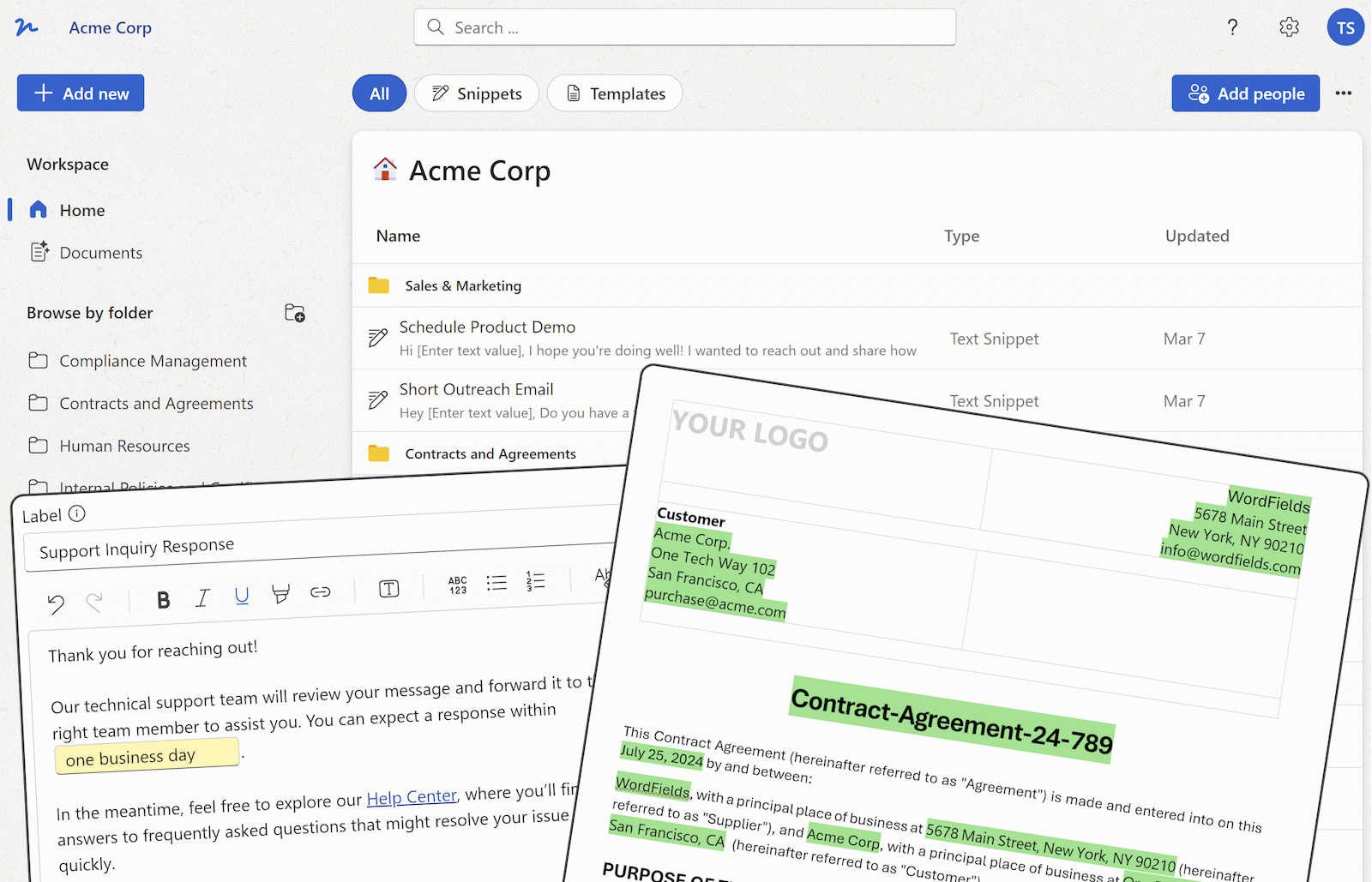
Each snippet auto-populates the following fields when used in WordFields:
- Recipient name or addressee
- Effective date of the updated policy
- Summary of key changes in plain language — each change listed separately
- Reason for the update
- Required action (or statement that no action is needed)
- Link to the full updated policy or its location
- Data protection contact email and supervisory authority reference
- Sender name, email, and organisation name (pulled from the logged-in user and workspace automatically)
When to use
Customer-Facing Privacy Policy Update: Use this snippet when your organisation is updating its customer-facing privacy policy or notice in a way that materially affects how customer data is collected, used, or shared — and you need to notify affected individuals before the change takes effect. Under the GDPR's transparency requirements, the notice should be sent sufficiently in advance of the effective date to allow recipients to review the changes and exercise their rights if they choose. The most common triggers are introducing a new third-party processor, changing the legal basis for an existing processing activity, adding new categories of data collection, or updating retention periods in response to regulatory or operational changes. Keep the summary of changes concise and in plain language — recipients are far more likely to read three bullet points than a dense paragraph of legal text. For organisations that also need to respond to individual rights requests following a policy update, the GDPR data subject request response is the companion template for that workflow.
Internal Staff Privacy Notice Update: Use this snippet when your organisation is updating its employee privacy notice — the document that tells staff how their personal data is handled in the employment context. This is a separate compliance obligation from customer-facing privacy notices and is frequently overlooked. Triggers include introducing new monitoring or tracking tools, changing payroll or HR system providers, adding occupational health or wellbeing data processing, or updating retention schedules for personnel records. The notice should be sent to all affected staff before the changes take effect, and a record should be kept confirming that the update was communicated. For organisations updating broader internal policies at the same time, the internal process update email in the Operations cluster handles the operational communication, while this snippet handles the compliance notification.
Frequently asked questions
When do you need to notify customers of a privacy policy update?
Under the GDPR's transparency obligations (Articles 13 and 14), you must inform individuals about material changes to how you process their personal data before those changes take effect. A privacy policy update notice should be sent in advance of the effective date — typically with at least 14 to 30 days' notice — so that individuals have an opportunity to review the changes and, where applicable, exercise their rights before the new policy applies.
What should a privacy policy update notice include?
A privacy policy update notice should clearly state what has changed and why, the effective date of the updated policy, a direct link to the full updated policy, any action the recipient needs to take (or a statement that no action is required if continued use implies acceptance), and contact details for questions. For material changes, the notice should summarise the specific changes in plain language rather than asking recipients to read and compare the full policy themselves.
Do you need consent to update your privacy policy?
Not necessarily. If your processing is based on legitimate interests or contractual necessity rather than consent, you do not need fresh consent to update your privacy policy — you need to provide notice. If the updated policy introduces processing activities that require consent as the legal basis (such as new marketing uses of personal data), you must obtain that consent separately before commencing that processing. The distinction between notifying and obtaining consent is legally significant.
What counts as a material change to a privacy policy?
A material change is any modification that meaningfully affects how individuals' personal data is collected, used, shared, or retained — or that changes their rights. Examples include introducing new categories of data collection, sharing data with new third parties, changing the legal basis for processing, updating retention periods, or significantly revising how data subjects can exercise their rights. Minor editorial or formatting changes do not require a formal update notice, though updating the revision date is good practice.
Can you use implied consent for a privacy policy update?
For certain types of processing, continued use of a service after a privacy policy update can constitute implied acceptance of the new terms — particularly for contractual processing. However, where the legal basis for processing is explicit consent (for example, for direct marketing), you cannot rely on continued use as a substitute for fresh consent if the processing activities are changing materially. The approach you take depends on the legal bases underpinning your existing processing activities.
Do employees need to be notified of privacy policy changes?
Yes. Organisations are required to maintain a staff privacy notice (sometimes called an employee privacy notice) under the GDPR, explaining how employee personal data is collected, used, and retained. When that notice changes materially — for example, if new monitoring systems are introduced, HR data is shared with new processors, or retention schedules change — employees must be informed before the changes take effect. This is a separate obligation from customer-facing privacy notices and should be treated as such.
How does WordFields help teams send privacy policy update notices consistently?
WordFields stores your privacy notice update snippets in a shared workspace so every team member sends from the same approved templates. Open the snippet, fill in the key changes, the effective date, and the link to the updated policy, and copy the completed notice to your clipboard or insert it directly into your email client via the Chrome extension. Consistent, compliant communications every time — without drafting from scratch when a policy update is due.
Related legal & compliance templates
Explore more professional document and email templates you can copy, customize, and use immediately