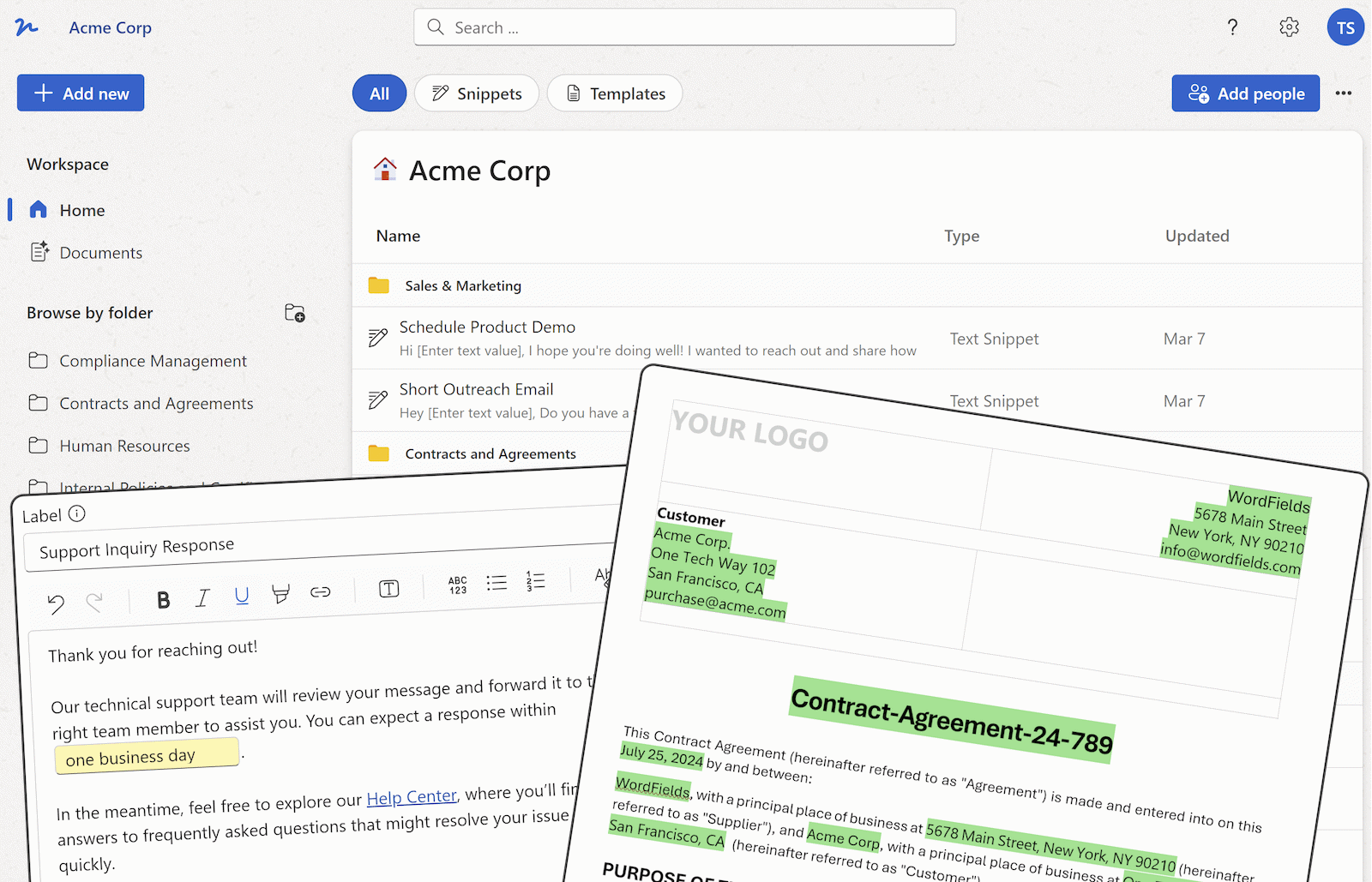
NDA templates for mutual and one-way confidentiality agreements. Add merge fields, generate a completed Word document in seconds, and keep every version in one shared workspace.
Non-Disclosure Agreement
This Non-Disclosure Agreement (the "Agreement") is entered into on [Effective date] (the "Effective Date") by and between [First party legal name], a [e.g. limited company] with its principal place of business at [First party address] ("Party A"), and [Second party legal name], a [e.g. limited company] with its principal place of business at [Second party address] ("Party B"). Party A and Party B are each a "Party" and together the "Parties".
Purpose
The Parties wish to explore [The business opportunity — e.g. a joint venture to distribute Party A's products in Germany] (the "Purpose") and, in connection with it, each Party may disclose confidential and proprietary information to the other. This Agreement governs how that information is treated. The Party disclosing information is the "Disclosing Party" and the Party receiving it the "Receiving Party".
Confidential Information
"Confidential Information" means any non-public information disclosed by one Party to the other, in writing, orally, electronically or in any other form, that is marked as confidential or that a reasonable person would understand to be confidential given its nature and the circumstances of disclosure. It includes, without limitation, business plans, financial data, customer lists, pricing, technical specifications, trade secrets, product plans and proprietary processes.
Exclusions
Confidential Information does not include information that:
- is or becomes publicly known through no breach of this Agreement by the Receiving Party;
- was lawfully in the Receiving Party's possession before disclosure by the Disclosing Party;
- is independently developed by the Receiving Party without use of or reference to the Disclosing Party's Confidential Information;
- is lawfully received from a third party without restriction on disclosure; or
- must be disclosed by law or court order, provided the Receiving Party gives the Disclosing Party prompt written notice and cooperates in seeking protection for the information.
Obligations
Each Party agrees, with respect to the other Party's Confidential Information, to:
- hold it in strict confidence;
- use it solely for the Purpose;
- not disclose it to any third party without the Disclosing Party's prior written consent;
- limit access to those of its employees, contractors and advisers who need it for the Purpose and are bound by confidentiality obligations no less protective than these; and
- notify the Disclosing Party promptly on becoming aware of any unauthorised use or disclosure.
Term
This Agreement runs from the Effective Date for [Term in years — e.g. 2] years, unless terminated earlier by either Party on [Notice in days — e.g. 30] days' written notice. The obligations in this Agreement survive its expiry or termination for [Years the obligations survive — e.g. 3] years, and for as long as any Confidential Information remains a trade secret.
Return or Destruction
On termination of this Agreement, or on the Disclosing Party's written request, the Receiving Party will promptly return or destroy all materials containing the Disclosing Party's Confidential Information and certify in writing that it has done so.
No Licence
Nothing in this Agreement grants either Party any right, title, interest or licence in the other Party's Confidential Information.
Governing Law
This Agreement is governed by the laws of [Jurisdiction — e.g. England and Wales], without regard to its conflict of law rules.
Entire Agreement
This Agreement is the entire agreement between the Parties on its subject matter and supersedes all prior discussions and agreements relating to it. Any amendment must be in writing and signed by both Parties.
| [[Party A Name]] | [[Party B Name]] |
| Signature: ___________________________ | Signature: ___________________________ |
| Name: [Signatory name] | Name: [Signatory name] |
| Title: [Signatory job title] | Title: [Signatory job title] |
| Date: ________________________________ | Date: ________________________________ |
This Non-Disclosure Agreement (the "Agreement") is entered into on Effective date (the "Effective Date") by and between First party legal name, a e.g. limited company with its principal place of business at First party address ("Party A"), and Second party legal name, a e.g. limited company with its principal place of business at Second party address ("Party B"). Party A and Party B are each a "Party" and together the "Parties".
The Parties wish to explore The business opportunity — e.g. a joint venture to distribute Party A's products in Germany (the "Purpose") and, in connection with it, each Party may disclose confidential and proprietary information to the other. This Agreement governs how that information is treated. The Party disclosing information is the "Disclosing Party" and the Party receiving it the "Receiving Party".
"Confidential Information" means any non-public information disclosed by one Party to the other, in writing, orally, electronically or in any other form, that is marked as confidential or that a reasonable person would understand to be confidential given its nature and the circumstances of disclosure. It includes, without limitation, business plans, financial data, customer lists, pricing, technical specifications, trade secrets, product plans and proprietary processes.
Confidential Information does not include information that:
- is or becomes publicly known through no breach of this Agreement by the Receiving Party;
- was lawfully in the Receiving Party's possession before disclosure by the Disclosing Party;
- is independently developed by the Receiving Party without use of or reference to the Disclosing Party's Confidential Information;
- is lawfully received from a third party without restriction on disclosure; or
- must be disclosed by law or court order, provided the Receiving Party gives the Disclosing Party prompt written notice and cooperates in seeking protection for the information.
Each Party agrees, with respect to the other Party's Confidential Information, to:
- hold it in strict confidence;
- use it solely for the Purpose;
- not disclose it to any third party without the Disclosing Party's prior written consent;
- limit access to those of its employees, contractors and advisers who need it for the Purpose and are bound by confidentiality obligations no less protective than these; and
- notify the Disclosing Party promptly on becoming aware of any unauthorised use or disclosure.
This Agreement runs from the Effective Date for Term in years — e.g. 2 years, unless terminated earlier by either Party on Notice in days — e.g. 30 days' written notice. The obligations in this Agreement survive its expiry or termination for Years the obligations survive — e.g. 3 years, and for as long as any Confidential Information remains a trade secret.
On termination of this Agreement, or on the Disclosing Party's written request, the Receiving Party will promptly return or destroy all materials containing the Disclosing Party's Confidential Information and certify in writing that it has done so.
Nothing in this Agreement grants either Party any right, title, interest or licence in the other Party's Confidential Information.
This Agreement is governed by the laws of Jurisdiction — e.g. England and Wales, without regard to its conflict of law rules.
This Agreement is the entire agreement between the Parties on its subject matter and supersedes all prior discussions and agreements relating to it. Any amendment must be in writing and signed by both Parties.
| =[Party A Name] | =[Party B Name] |
| Signature: ___________________________ | Signature: ___________________________ |
| Name: Signatory name | Name: Signatory name |
| Title: Signatory job title | Title: Signatory job title |
| Date: ________________________________ | Date: ________________________________ |
Non-Disclosure Agreement
This Non-Disclosure Agreement (the "Agreement") is entered into on [Effective date] (the "Effective Date") by and between [Disclosing party legal name], a [e.g. limited company] with its principal place of business at [Disclosing party address] (the "Disclosing Party"), and [Receiving party legal name, or the name of the individual], [e.g. a limited company / an individual] of [Receiving party address] (the "Receiving Party").
Purpose
The Disclosing Party intends to disclose confidential and proprietary information to the Receiving Party for the purpose of [e.g. evaluating a possible engagement as a consultant / performing services under the consultancy agreement dated 1 March 2026] (the "Purpose"). This Agreement governs how the Receiving Party treats that information.
Confidential Information
"Confidential Information" means any non-public information disclosed by the Disclosing Party to the Receiving Party, in writing, orally, electronically or in any other form, that is marked as confidential or that a reasonable person would understand to be confidential given its nature. It includes, without limitation, business plans, financial records, client and customer lists, product specifications, pricing, technical data, internal processes and trade secrets.
Exclusions
The Receiving Party's obligations do not apply to information that:
- is or becomes publicly known through no act or omission of the Receiving Party;
- was lawfully in the Receiving Party's possession before disclosure by the Disclosing Party;
- is independently developed by the Receiving Party without use of the Disclosing Party's Confidential Information;
- is lawfully received from a third party who owes no duty of confidence to the Disclosing Party; or
- must be disclosed by law or by a regulatory authority, provided the Receiving Party notifies the Disclosing Party promptly and assists in seeking protection for the information.
Obligations of the Receiving Party
The Receiving Party agrees to:
- hold the Confidential Information in strict confidence;
- use it solely for the Purpose;
- not disclose it to any third party without the Disclosing Party's prior written consent;
- limit access to those of its personnel who need it for the Purpose and are bound by equivalent confidentiality obligations; and
- notify the Disclosing Party promptly on becoming aware of any actual or suspected unauthorised disclosure.
Term
This Agreement runs from the Effective Date for [Term in years — e.g. 3] years. The Receiving Party's obligations survive the expiry or termination of this Agreement for as long as the information concerned remains confidential.
Return or Destruction
On the Disclosing Party's written request, or on termination of this Agreement, the Receiving Party will promptly return or permanently destroy all materials containing Confidential Information and, if asked, confirm in writing that it has done so.
No Licence
Nothing in this Agreement grants the Receiving Party any licence, right, title or interest in the Confidential Information or in any intellectual property of the Disclosing Party.
Governing Law
This Agreement is governed by the laws of [Jurisdiction — e.g. England and Wales].
Entire Agreement
This Agreement is the complete and exclusive statement of the agreement between the parties on its subject matter and supersedes all prior agreements, representations and understandings. Any amendment must be in writing and signed by both parties.
| [[Disclosing Party Name]] | [[Receiving Party Name]] |
| Signature: ___________________________ | Signature: ___________________________ |
| Name: [Signatory name] | Name: [Signatory name, if signing for a company] |
| Title: [Signatory job title] | Title: [Signatory job title, if signing for a company] |
| Date: ________________________________ | Date: ________________________________ |
This Non-Disclosure Agreement (the "Agreement") is entered into on Effective date (the "Effective Date") by and between Disclosing party legal name, a e.g. limited company with its principal place of business at Disclosing party address (the "Disclosing Party"), and Receiving party legal name, or the name of the individual, e.g. a limited company / an individual of Receiving party address (the "Receiving Party").
The Disclosing Party intends to disclose confidential and proprietary information to the Receiving Party for the purpose of e.g. evaluating a possible engagement as a consultant / performing services under the consultancy agreement dated 1 March 2026 (the "Purpose"). This Agreement governs how the Receiving Party treats that information.
"Confidential Information" means any non-public information disclosed by the Disclosing Party to the Receiving Party, in writing, orally, electronically or in any other form, that is marked as confidential or that a reasonable person would understand to be confidential given its nature. It includes, without limitation, business plans, financial records, client and customer lists, product specifications, pricing, technical data, internal processes and trade secrets.
The Receiving Party's obligations do not apply to information that:
- is or becomes publicly known through no act or omission of the Receiving Party;
- was lawfully in the Receiving Party's possession before disclosure by the Disclosing Party;
- is independently developed by the Receiving Party without use of the Disclosing Party's Confidential Information;
- is lawfully received from a third party who owes no duty of confidence to the Disclosing Party; or
- must be disclosed by law or by a regulatory authority, provided the Receiving Party notifies the Disclosing Party promptly and assists in seeking protection for the information.
The Receiving Party agrees to:
- hold the Confidential Information in strict confidence;
- use it solely for the Purpose;
- not disclose it to any third party without the Disclosing Party's prior written consent;
- limit access to those of its personnel who need it for the Purpose and are bound by equivalent confidentiality obligations; and
- notify the Disclosing Party promptly on becoming aware of any actual or suspected unauthorised disclosure.
This Agreement runs from the Effective Date for Term in years — e.g. 3 years. The Receiving Party's obligations survive the expiry or termination of this Agreement for as long as the information concerned remains confidential.
On the Disclosing Party's written request, or on termination of this Agreement, the Receiving Party will promptly return or permanently destroy all materials containing Confidential Information and, if asked, confirm in writing that it has done so.
Nothing in this Agreement grants the Receiving Party any licence, right, title or interest in the Confidential Information or in any intellectual property of the Disclosing Party.
This Agreement is governed by the laws of Jurisdiction — e.g. England and Wales.
This Agreement is the complete and exclusive statement of the agreement between the parties on its subject matter and supersedes all prior agreements, representations and understandings. Any amendment must be in writing and signed by both parties.
| =[Disclosing Party Name] | =[Receiving Party Name] |
| Signature: ___________________________ | Signature: ___________________________ |
| Name: Signatory name | Name: Signatory name, if signing for a company |
| Title: Signatory job title | Title: Signatory job title, if signing for a company |
| Date: ________________________________ | Date: ________________________________ |
These templates are a starting point. Have a legal professional review any agreement before signing.
What's included
Each template auto-populates the following fields when used in WordFields:
- Effective date of the agreement
- Party names, entity types, and addresses
- Purpose of the disclosure (e.g. partnership exploration, contractor engagement)
- Term in years, and for the mutual version the notice period and how long the obligations survive
- Governing law
- Signatory names and titles for each party
When to use
Mutual NDA: Use the mutual template when both organisations are going to exchange sensitive information as part of the same conversation — typically at the start of a partnership discussion, a joint venture, or a co-development arrangement. Because both parties are simultaneously disclosing and receiving, the obligations in this template run symmetrically: each side commits to the same standard of care for the other's information. Teams that regularly enter into new commercial relationships — partnerships, agency arrangements, supplier negotiations where proprietary processes are shared on both sides — will use this template most frequently. It sits naturally alongside a letter of intent or a service agreement as part of a pre-contract package.
One-Way NDA: Use the unilateral template when your organisation is the sole source of the sensitive information — sharing financial data with a potential investor, briefing a new contractor on internal processes, or providing a consultant with access to client data before a formal engagement is in place. In this structure, only the Receiving Party carries the confidentiality obligation, which keeps the agreement focused and reduces negotiation friction. This template is also the standard choice for pre-employment confidentiality, issued alongside an offer letter before a new hire's start date. For freelance or contractor engagements, it pairs cleanly with a freelance contract once the relationship progresses.
Frequently asked questions
What is the difference between a mutual and a one-way NDA?
A mutual (bilateral) NDA applies when both parties are sharing confidential information with each other — common in partnerships, joint ventures, or co-development projects. A one-way (unilateral) NDA applies when only one party discloses information to the other, such as when sharing proprietary details with a contractor, consultant, or prospective hire. The structure of the obligations differs: in a mutual NDA both parties are simultaneously the disclosing and receiving party.
What should be included in a non-disclosure agreement?
A standard NDA should identify the parties, define what constitutes confidential information, set out the receiving party's obligations, list any exclusions from confidentiality (such as publicly available information), specify the term of the agreement, and include governing law and signature blocks. The definition of confidential information is the most critical clause — vague language here weakens the agreement.
How long does an NDA last?
NDA duration varies by context and is specified in the agreement itself. Commercial NDAs commonly run between one and five years. Obligations relating to trade secrets may survive indefinitely even after the agreement's nominal term ends. The appropriate duration depends on the nature of the confidential information being protected.
Do I need a lawyer to create an NDA?
An NDA template gives you a professionally structured starting point, but for any agreement involving commercially sensitive information, proprietary technology, or complex business relationships, legal review before signing is strongly recommended. A qualified legal professional can confirm the agreement is enforceable in the relevant jurisdiction and covers your specific needs.
What information is typically excluded from an NDA?
Standard exclusions include information that is already publicly known at the time of disclosure, information the receiving party independently developed before receiving it, information learned from a third party not bound by confidentiality, and information the receiving party is legally compelled to disclose by court order or regulatory requirement.
Can the same NDA template be used for employees and external partners?
Not without adjustment. Employee NDAs are typically part of an employment agreement and operate within employment law constraints that vary by jurisdiction. External partner or vendor NDAs are stand-alone commercial agreements governed by contract law. The core clauses overlap, but the framing, term, and governing obligations differ. Using separate templates for each context reduces risk.
How does WordFields help teams manage NDA templates?
WordFields stores your NDA template in a shared workspace so the whole team works from one approved version. When someone needs to issue an NDA, they open the template, fill in the form — party names, effective date, governing law, term — and download a completed Word document with all formatting preserved. No editing the source file, no hunting for the latest version, no reformatting.
Related legal & compliance templates
Explore more professional document and email templates you can copy, customize, and use immediately