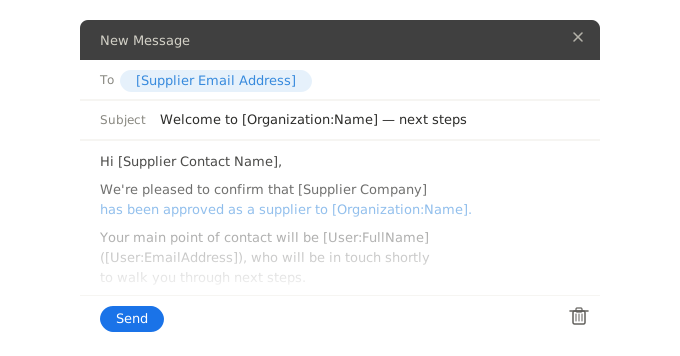
Two supplier feedback email templates for procurement and operations teams — recognising strong supplier performance and raising a performance concern professionally. Specific, constructive, and relationship-preserving.
Hi [Supplier contact name],
I wanted to take a moment to formally recognise [Supplier company name]'s performance over [Period — e.g. Q1 2026 / the past three months].
Specifically: [Two or three sentences describing what was done well — e.g. all deliveries on time, defect rate below threshold, response times within 24 hours].
This level of reliability has had a direct positive impact on [Your outcome — e.g. our production schedule / ability to fulfil customer orders on time], and it does not go unnoticed.
We have recorded this performance as part of our supplier review process. We look forward to continuing to work with you and hope to build on this going forward.
[VALUE("Author.FullName")]
[VALUE("Author.EmailAddress")]
[VALUE("Organization")]
Hi Supplier contact name,
I wanted to take a moment to formally recognise Supplier company name's performance over Period — e.g. Q1 2026 / the past three months.
Specifically: Two or three sentences describing what was done well — e.g. all deliveries on time, defect rate below threshold, response times within 24 hours.
This level of reliability has had a direct positive impact on Your outcome — e.g. our production schedule / ability to fulfil customer orders on time, and it does not go unnoticed.
We have recorded this performance as part of our supplier review process. We look forward to continuing to work with you and hope to build on this going forward.
=VALUE("Author.FullName")
=VALUE("Author.EmailAddress")
=VALUE("Organization")
Hi [Supplier contact name],
I'm writing to formally raise a performance concern regarding [Specific issue — e.g. late deliveries / quality failures / communication response times] over the period [Date range — e.g. January to March 2026].
What we have observed:
- [Supplier company name — also used in subject] — [Incident 1 — date, order reference, what happened]
- [Incident 2 — date, order reference, what happened]
- [Incident 3 or pattern summary if applicable]
Impact on our operations: [One or two sentences — e.g. production stoppages / emergency stock costs / customer complaints].
Under our agreement, [Reference the relevant standard — e.g. our agreed on-time delivery target is 98% / quality defects should not exceed X%]. Current performance is not meeting that standard.
We would like to resolve this together. Please respond by [Response deadline] with either a root cause explanation and corrective action plan, or a request to schedule a call to discuss. We are committed to working with you on a practical resolution.
[VALUE("Author.FullName")]
[VALUE("Author.EmailAddress")]
[VALUE("Organization")]
Hi Supplier contact name,
I'm writing to formally raise a performance concern regarding Specific issue — e.g. late deliveries / quality failures / communication response times over the period Date range — e.g. January to March 2026.
What we have observed:
- Supplier company name — also used in subject — Incident 1 — date, order reference, what happened
- Incident 2 — date, order reference, what happened
- Incident 3 or pattern summary if applicable
Impact on our operations: One or two sentences — e.g. production stoppages / emergency stock costs / customer complaints.
Under our agreement, Reference the relevant standard — e.g. our agreed on-time delivery target is 98% / quality defects should not exceed X%. Current performance is not meeting that standard.
We would like to resolve this together. Please respond by Response deadline with either a root cause explanation and corrective action plan, or a request to schedule a call to discuss. We are committed to working with you on a practical resolution.
=VALUE("Author.FullName")
=VALUE("Author.EmailAddress")
=VALUE("Organization")
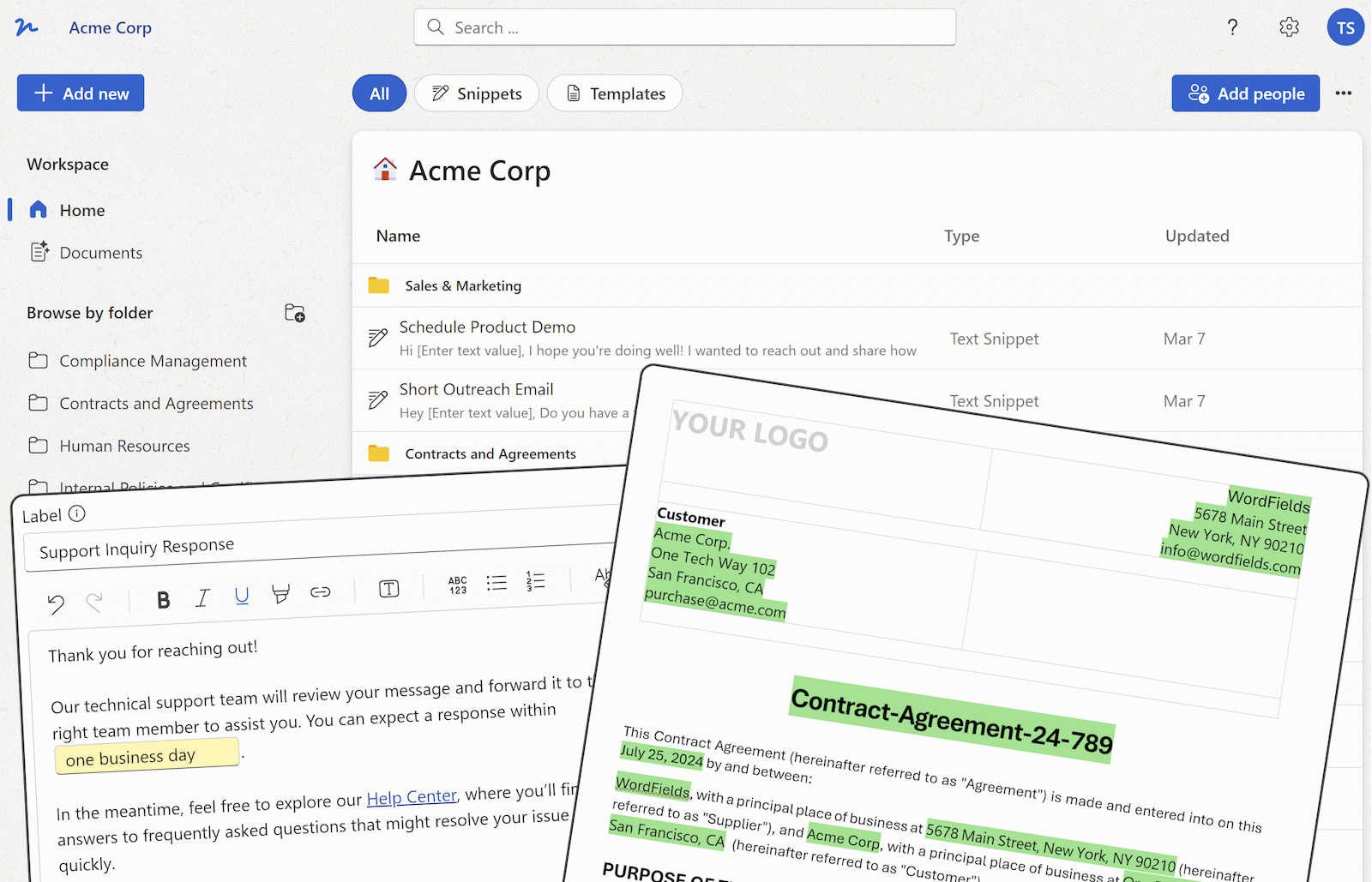
Your name, email address, and organisation name fill in automatically via WordFields merge tags — no manual edits before sending. Use the Chrome extension to insert directly into Gmail, Outlook, or your procurement system without switching tabs.
What's included
Each snippet auto-populates the following fields when used in WordFields:
- Supplier company name, contact name, and review period
- Specific performance observations referenced by date or order number
- Operational impact of the performance (positive or negative)
- Contractual or agreed standard referenced by name or metric (concern variant)
- Response deadline and requested next step (concern variant)
- Sender name, email, and organisation name (pulled from the logged-in user and workspace automatically)
When to send a supplier feedback email
Use the positive performance feedback email after a measurable performance period — a quarter, a project completion, or a significant delivery run — when a supplier has demonstrably met or exceeded your standards. Most procurement teams send performance concerns but rarely send formal recognition, which means suppliers receive structured communication only when something goes wrong. Sending positive feedback formally, with specific data, creates a documented performance history that is useful in both directions: it motivates the supplier to maintain standards, and it gives your organisation a reference point during contract renewals, supplier tiering reviews, and preferred vendor decisions. Operations managers and procurement leads conducting quarterly supplier reviews are the primary users of this variant.
Use the performance concern email as soon as a pattern of underperformance is identifiable — typically after two or three incidents of the same type within a short period, or after a single incident with material operational impact. The template's structure — specific incidents listed by date and order reference, operational impact stated plainly, the contractual standard referenced — is deliberate. Vague concerns like "we have been experiencing some delivery issues" give suppliers no actionable information and no clear expectation of what improvement looks like. Specific concerns with data behind them are harder to dispute, easier to act on, and create a formal record that matters if the relationship needs to escalate to contract review. The closing invitation for a corrective action plan or a call is equally important: it frames the email as a collaborative problem-solving step rather than a complaint, which is both professionally appropriate and practically more likely to produce a resolution. For teams managing multiple supplier relationships, storing a pre-configured version of this template per supplier in WordFields — with the contractual standard and relevant contact already filled in — means a concern email can be sent within minutes of identifying an issue, rather than hours.
Frequently asked questions
How do you give feedback to a supplier professionally?
Be specific rather than general. Reference actual performance data — delivery dates, defect rates, response times — rather than impressions. For positive feedback, name the specific outcome and why it mattered. For concerns, describe the issue factually, state its impact on your operations, and propose a concrete next step. Avoid vague language like 'we have had some issues' or 'things have been great.' Specific feedback is easier to act on and signals that your organisation takes supplier performance seriously.
What should a supplier performance concern email include?
A supplier performance concern email should state the specific issue with supporting data, describe the operational impact it has caused, reference the relevant contractual or agreed standard that was not met, propose a resolution or request a corrective action plan, and set a deadline for the supplier's response. The tone should be direct but collaborative — the goal is to resolve the issue and preserve the relationship, not to issue a complaint. Frame the email as a shared problem to solve, not a one-sided accusation.
When should you send a supplier performance concern email?
Send a formal performance concern email as soon as a pattern is identifiable — not after a single incident, but not after months of unaddressed issues either. A useful threshold is two or three incidents of the same type within a short period, or a single incident with material operational impact. Acting early preserves the relationship and gives the supplier the opportunity to correct the issue before it escalates to contract review or termination discussions. Waiting too long signals that your organisation does not monitor performance, which undermines the effect of the feedback when it eventually arrives.
How do you recognise good supplier performance without it seeming informal?
Reference the specific outcome that was achieved, the standard it was measured against, and the impact it had on your operations or your end customers. A positive feedback email that says 'delivery was on time and the order was complete' is a record of performance, not just a compliment. Recognising strong performance formally creates a documented history that is useful during contract renewals, supplier tiering decisions, and procurement reviews. It also motivates suppliers to maintain standards because they know performance is being tracked in both directions.
What is a supplier corrective action request?
A supplier corrective action request (SCAR) is a formal written request asking a supplier to investigate the root cause of a performance failure and submit a plan to prevent recurrence. It is typically used when a performance concern has not been resolved through informal communication, or when the issue has significant quality, compliance, or operational implications. A SCAR sets out the specific failure, the required investigation, and a deadline for the supplier's response. It creates a documented record that is essential if the relationship needs to be escalated or terminated.
Should supplier feedback emails be sent by email or handled in a meeting?
Both. Email creates a written record of the feedback, the date it was given, and the expected response — all of which matter for contract management and audit purposes. A meeting or call is better for collaborative problem-solving, particularly for performance concerns where you want to understand the supplier's perspective and agree on next steps together. The standard practice is to send a formal email first to document the concern, then follow up with a call or meeting to discuss resolution. Do not rely on meetings alone — without a written record, suppliers can claim they were not formally notified of a performance issue.
Can you use the same feedback email template for all suppliers?
A standard template is the right starting point, but the specific data, performance metrics, and contractual references must be tailored to each supplier relationship. The structure and tone can be consistent — and should be, so your communication is professional and predictable across your supplier base — but the content of the feedback must be specific to what that supplier actually did or failed to do. Generic feedback that could apply to any supplier signals that performance is not being tracked individually, which reduces its credibility and impact.
Related operations email templates
Explore more professional document and email templates you can copy, customize, and use immediately