How to build a consistent, document-driven employee onboarding process that reduces errors, saves HR time, and gives new hires a professional first experience, with templates for every stage from offer letter to first month.
A new hire's first impression is formed before they arrive. The offer letter, the welcome email, the first-day logistics — these signal whether they are joining a professional, organised team. Most HR teams know this, yet onboarding remains one of the most inconsistently executed processes in the business.
The cause is almost always the same: no standardised documents, no shared process, every manager handling it differently. The fix is a repeatable system with templates at every stage.
Note
This guide is written for HR managers and people operations leads responsible for designing and running the onboarding process.
The offer
Onboarding begins at the offer stage, not the start date.
A well-structured offer letter covers position, start date, compensation, benefits, contingencies, and the acceptance process — clearly and without ambiguity. Generate it from a template, not from scratch. Drafting from scratch introduces variation: different wording, different clauses, different formatting between hires.
Once the offer is accepted, send the new employee first-day checklist email 3-5 days before the start date. It tells the new hire where to go, who to ask for, and what to bring. Simple, but it eliminates a category of first-day confusion that damages first impressions.
Pre-arrival
The work done before a new hire arrives determines how their first day goes.
Use the HR onboarding checklist to manage pre-arrival tasks across three areas: documents and admin, IT and equipment, and communication.
Key tasks to assign to named owners in advance:
- Right-to-work documentation collected and verified
- Employee record created in HR system
- Payroll set up and email address created
- System access and building access arranged
- Team notified of the new hire's name, role, and start date
- Onboarding buddy assigned
Send the new employee welcome letter shortly after acceptance, a warmer document than the offer letter, setting out what to expect in the first week.
Warning
Do not leave IT setup to the first day. A new employee waiting for a laptop to be configured is time wasted and an impression that is difficult to recover from.
Day one
The goal of day one: make the new hire feel expected, informed, and comfortable.
Send the new employee welcome email on the morning of day one or the evening before, a personal message from HR or the hiring manager confirming the day's plan.
Day one activities to standardise across all hires:
- Personal welcome and office tour (or remote equivalent)
- Introduction to direct team and hiring manager
- System logins confirmed and working
- Employee handbook issued
- Key policies covered: absence, expenses, data security
- End-of-day check-in with hiring manager
The onboarding checklist covers day one, the first week, and the first month in a single document.
First week
The first week is when new hires form their opinion of the team and culture, and when most onboarding failures occur because nobody owns the process beyond day one.
Schedule mandatory compliance training in the first week, not left to the new hire to arrange. Arrange introductions to key stakeholders in advance, if not scheduled, they often don't happen until week three or four.
Run a brief end-of-week check-in. Most new hires won't raise issues unprompted; the check-in creates the space to do so.
First month
The first month ends with a 30-day check-in, not a performance review, but an expectations conversation. What has gone well, what has been confusing, what support is needed, and what the initial goals are for the next 60 days.
If the role has a probation period, confirm the terms have been communicated clearly. Probation clauses that are never discussed create HR and legal risk.
At the end of the month, verify that all admin is complete: payroll processing correctly, benefits enrolment finalised, compliance training done.
Summary: onboarding stages and templates
| Stage | What to do | Templates |
|---|---|---|
| The offer | Send structured offer letter and first-day logistics | Offer letter, First-day checklist email |
| Pre-arrival | Complete pre-arrival checklist, send welcome letter | Welcome letter, Onboarding checklist |
| Day one | Welcome, orient, confirm access, complete paperwork | Welcome email, Onboarding checklist |
| First week | Compliance training, stakeholder introductions, check-in | Onboarding checklist |
| First month | 30-day check-in, probation confirmation, admin verification | Performance review (next cycle) |
Standardising onboarding in WordFields
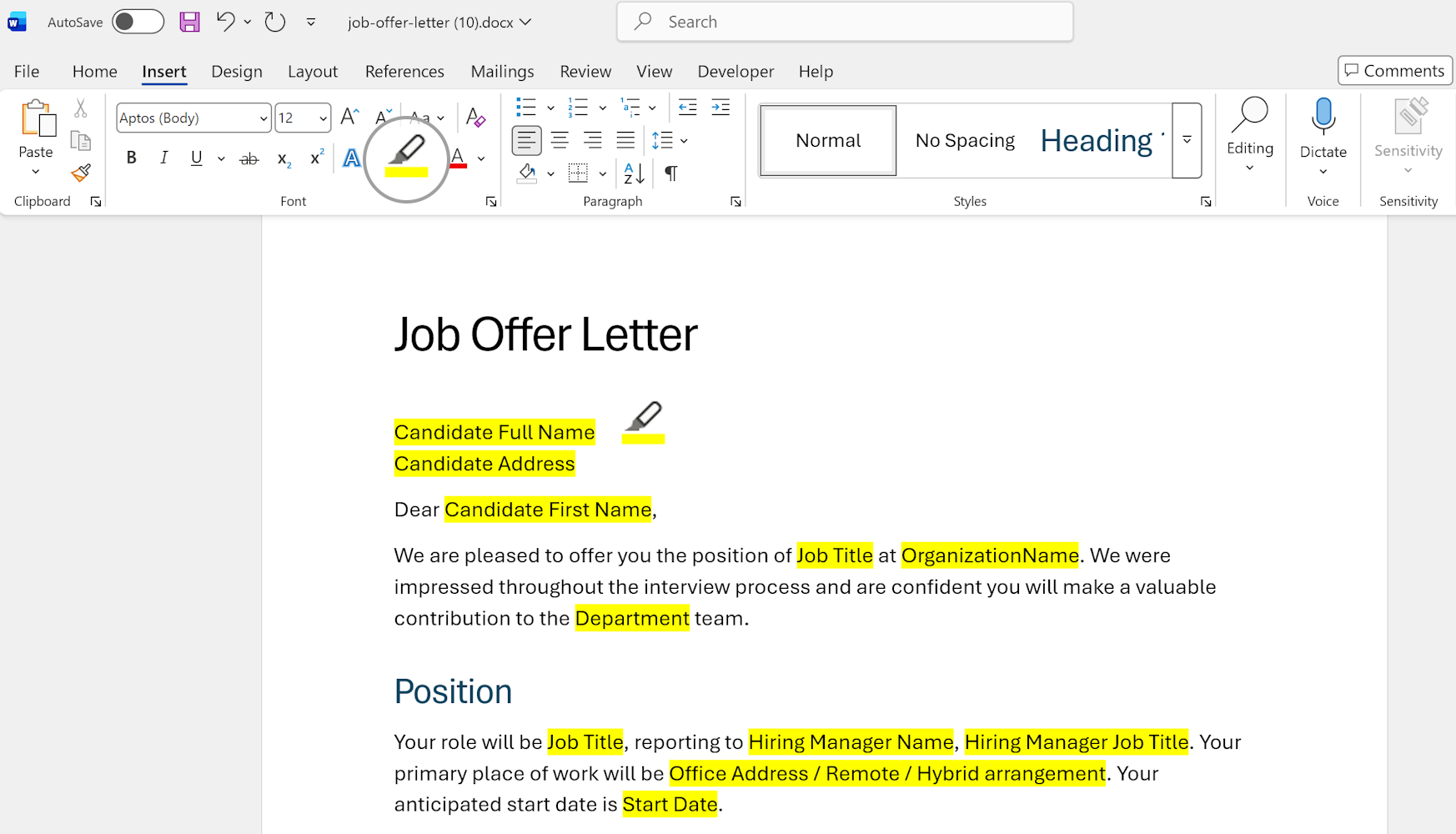
The onboarding documents that vary most from hire to hire, offer letters, welcome letters, welcome emails, first-day checklists — are exactly what WordFields is built for. Upload your existing Word documents as templates, add merge fields for the parts that change, and anyone on the HR team can generate a correctly formatted, personalised document in under a minute.
Tip
See WordFields for teams and businesses to learn how to set up a shared workspace for your HR documents and onboarding templates, or get started for free now.